
|
|
|
|
Financial Swaps A Swap is an agreement between two parties, called Counterparties, who exchange cash flows over a period of time in the future. When exchange rate and Interest rates fluctuate, risks of forward and money market positions are so great that the forward market & money market may not function properly. Currency futures and options are inflexible and available only for selected currencies. In such cases, MNC’s & governments may use swap arrangements to protect the value of export sales, import orders and outstanding loans dominated in foreign currencies. There are three basic motivations for swaps:
Financial swaps are now used by Multinational companies, commercial banks, world organizations and sovereign governments to minimize currency and interest-rate risks. Thus swaps have become another risk management tool along with currency forwards, futures and options. The origins of swap market can be traced back to 1970’s when traders developed currency swaps to evade British controls on movement of foreign currency. The market has grown rapidly ever since and in year 2002 about $44 trillion was traded via swaps Parallel Loans A Parallel Loan refers to a loan which involves an exchange of currencies between 4 parties, with a promise to re-exchange the currencies at a predetermined exchange rate on a specified future date. Typically, the parties consists of two pairs of affiliated companies. Parallel loans are commonly arranged by two multinational parent companies in two different countries. The structure of a typical parallel loan is illustrated in the following example. IBM in USA with a subsidiary in Italy wants to obtain a one year Lira loan for its subsidiary. Olivetti in Italy wishes to invest in US via a loan to its US subsidiary. With a Parallel loan, these loans can be arranged without currency crossing the national border. IBM lends $10M to Olivetti’s US subsidiary at US interest rates. Olivetti in return lends $10M in Lira to IBM’s Italian subsidiary.
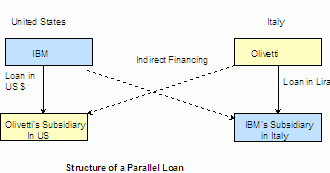
Back-to-Back Loans Bank to Back loan involves an exchange of currencies between two parties, with a promise to re-exchange the currencies at a specified rate on a specified future date. Back to back loans involve two companies domiciled in two different countries. For example, IBM borrows money in US dollars and lends the borrowed funds to Olivetti in Italy, which in return borrows funds in Italy and lends those funds to IBM in the United states. By this simple arrangement, each firm has access to capital markets in foreign country and make use of their comparative advantage of borrowing in different capital markets. Drawbacks of parallel and back to back loans
Swaps on the other hand overcome the above drawbacks by:
As a result, Swaps are very popular financial instruments. In 2000, the size of world swap market was greater than $25 billion Swap Banks Financial institutions which assist in the completion of a swap is called "Swap Bank". The swap bank makes profits from the bid-ask spread it imposes on the swap coupon. A Swap broker is a swap bank who acts strictly as an agent without taking any financial position in the swap transaction, i.e., mearly matches counterparties and does not assume any risk of a swap. A Swap Dealer is a swap bank who actually transacts for its own account to help complete the swap. In this capacity, the swap dealer assumes a position in the swap and thus assumes certain risks. Types of Swaps
Motivation for Swaps There are three basic motivations for swaps. First, companies use swaps to provide protection against future changes in exchange rates. Second, Companies use swaps to eliminate interest rate risks arising from normal commercial operations. Third, companies use swaps to reduce financing costs. Closing Thoughts Swap market has emerged largely because financial swaps escape many of the limitations inherent in currency futures and options markets. Swaps are custom tailored to the needs of two parties, swap agreements are more likely to meet the specific needs of the counterparties than currency futures and options. Swap market is done via financial institutions and offers privacy when compared to foreign exchange markets. Lastly swaps are not as highly regulated as options and futures markets.
|
