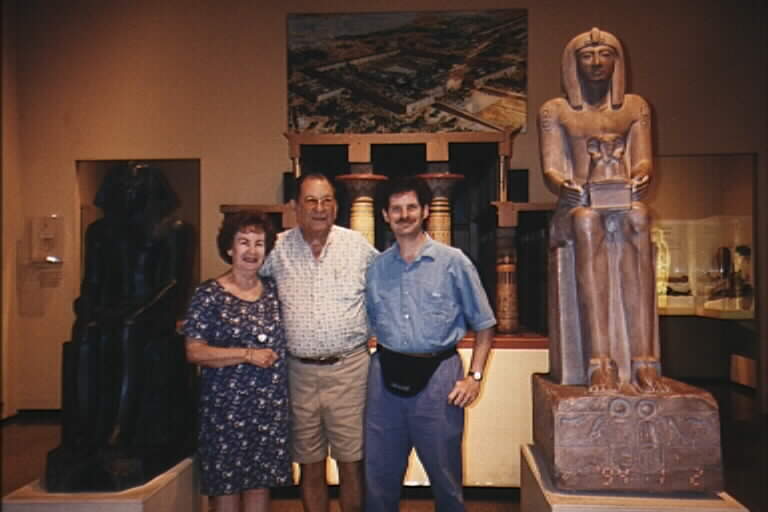

King Sety II (on right)
New Kingdom,
Dynasty XIX
Painted plaster cast
Original of siliceous sandstone
Mom, Dad, and "S"
in the middle
(photo originally taken
July 19th, 1998).
| Not a great deal is known about Sety II, who carries the name of his famous grandfather (?) Sety I. At 56, he apparently succeeded his cousin King Amunmesse and shared the throne with Queen Tewosret. Before he became pharoah, Sety had served as viceroy to Nubia and held titles "governor of the gold-country of Amun" and "chief steward of the king". The closing years of Dynasty XIX were governed by Queen Tewosret, who had probably assumed the title of pharaoh much like Hatshepsut of Dynasty XVIII had done, and by King Siptah, possibly a son of Sety II by a royal harem woman. | |
King Sety II (on right) |
Among the important monuments known from Sety II's short five year reign is his tomb and mortuary temple in western Thebes, a chapel with three chambers at Karnak, and a small temple of Amun with a hypostyle hall at Hermopolis.
The seated, serious and elegant looking king has very human proportions. As a pharaoh in less formal attire he wears a stylish wig with a uraeus posed above his forehead, a pleated shendyet, or short kilt, and thonged sandals.
Sety holds on his knees a shrine with a ram's head, the symbol of the god Khnum, one of the representations of the sun-god Amun-Re. The Egyptians believed Khnum ("the molder") shaped the great cosmic egg and Osiris and other beings of the world near Elephantine on his potter's wheel.
The original statue, discovered by Giovanni Belzoni among objects uncovered at the Temple of Mut at Karnak, arrived at the British Museum in London in 1816.
| McClung Lobby | Green-Audigier | Geology/Fossils | American Indian | Ancient Egypt | Vertiagen Gallery | Outdoors | TN WebPage | S&L Home Page |