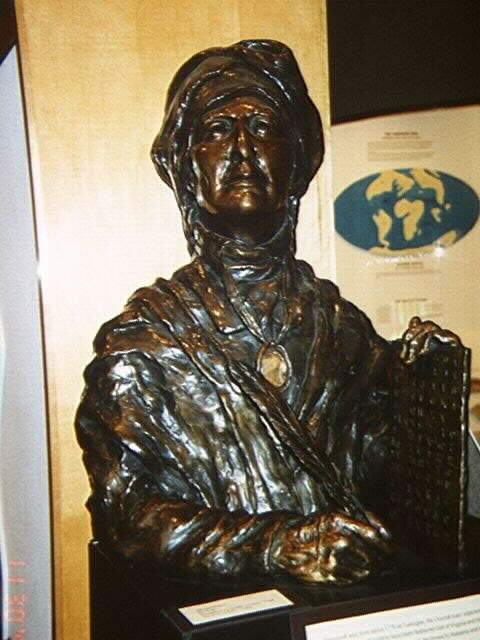
| SEQUOYAH (Photograph taken November
30th, 1997) Bronze Sculpted by Griffin Chiles, 1994 Gift of Dr. and Mrs. Chiles Sequoyah was born about 1776 at Tuskegee, the Overhill town adjacent to Fort Loudoun. His father is thought to have been Nathaniel Gist of Virginia and his mother was a full-blooded Cherokee. As a young man, he moved to Alabama and in 1817 to Arkansas. Realizing the advantages of a written language, Sequoyah worked for 12 years to perfect a system of writing the Cherokee language. Using letters from English and Greek, and some he invented, Sequoyah came up with 86 (later reduced to 85) symbols that stood for syllables in the Cherokee language. This syllabary was quickly adopted by the Cherokees and they became the first and only literate Indian tribe. While the Cherokee syllabary was his most important achievement, Sequoyah was active in the leadership of the Western Cherokee, especially in recounciling the Old Settlers (those who had moved west prior to the Removal) and those forced west in 1838. He died in 1843 in Mexico while seeking Cherokees who had moved there. |
|
| McClung Lobby | Green-Audigier | Geology/Fossils | American Indian | Ancient Egypt | Vertiagen Gallery | Outdoors | TN WebPage | S&L Home Page |