|
|

| Home | - | Info for Beginners | - | Performances | - | - | Social Events | - | Info & History | Music Suggestions | - |
|
|
By Barbara Bernstein I
was delighted when I checked my messages and heard my friend Stacy's
And
that is especially true when the dancing is a festive, "group-dance"
such as Casino Rueda. This dance originated in Cuba where it became
wildly popular in the middle of the twentieth century. It was later
exported to Miami via Cuban exiles where it became popular again. In
Miami, most of the salsa dancing that you see involves the unique style
and moves that are found in Casino Rueda. In casino rueda salsa, two
or more couples form a circle and do steps in synchrony that are called
by
one of the dancers. The steps have a particular look that I can best
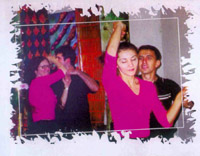
d She came one day to watch and remarked, "You and your partner look like you are tieing yourselves up in knots." Indeed, the advanced moves involve being quite intertwined and twisted up together. By contrast, ordinary salsa dancing has moves that are ballroom-ish in nature. Generally speaking, salsa dancing is like a flavorful, "street" version of mambo. Nonetheless, casino rueda salsa requires a great deal of discipline because every step and hand motion must be done synchronously by all the couples. Practicing the synchrony, which gives the dance its power, is sheer delight. And it is really the number of dancers interacting together that makes it such a thrill. This dance recently crept into the general public's consciousness with the release of the movie, "Dance With Me." The movie featured a segment of rueda dancing that was quite exciting to watch. And it is even more joyful to participate. Let me explain why this is so with an analogy. Imagine being in a movie theater with no one there but yourself. Sure, you won't catch a cold this time from anyone sneezing in the row behind you, but it is a flat experience. Now imagine that you can barely find two seats together in a movie for you and a friend because the place is packed. The latter experience is more lively. Other people's reactions---their gasps and laughs---make a difference in how you feel. I noticed the same principle applied recently when I took my son out trick-or-treating. He complained that it wasn't much fun on a street with no other kids and asked me to take him to a neighborhood with lots of other trick-or-treaters. So it is with dancing. Like watching a movie, dancing is a lot of fun. But if dancing with one partner is fun, dancing with many people at the same time is even more so. And group dancing tends to foster group friendships. Casino dancers need each other to dance, so they generally make phone or email contact with the group to arrange going out together. A gang of dance friends is a relatively stable social network which we all know is worth a great deal. The rueda group that I dance with is particularly fun because we play with the moves and alter the dance in creative ways. For example, we've altered the fundamental shape of the dance so that we are facing the audience for a more audience-friendly performance. We have designed some of our own steps and are working to see if we can mix two dances into one song smoothly. This playing with the movement always translates into a playful feeling at practice. Coming up with good ideas is difficult unless there is a pervasive spirit of fun, humor, and receptivity. During the brain-storming phase it is important that no one feels inhibited from throwing out an idea because it will not be well received. Even if an idea doesn't work well, it may stimulate someone else to think of something that does. And regardless, the creative effort keeps us laughing and our spirits high! |
 CASINO-STYLE
SALSA: THE PLAYFUL, PARTY DANCE
CASINO-STYLE
SALSA: THE PLAYFUL, PARTY DANCE 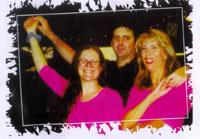 escribe
by quoting my neighbor.
escribe
by quoting my neighbor.