 |
BLOODROOT
Sanguinaria
canadensis
FPoison
- DO NOT INGEST
Common
Names: Indian Paint. Tetterwort. Red Puccoon. Red
Root. Pauson. Coon Root. Snakebite. Sweet Slumber.
|
| Range:
United States of America and Canada, found in rich open woods from
Canada, south to Florida and west to Arkansas and Nebraska. |
| Description:
A native perennial plant that is a member of the poppy family. The
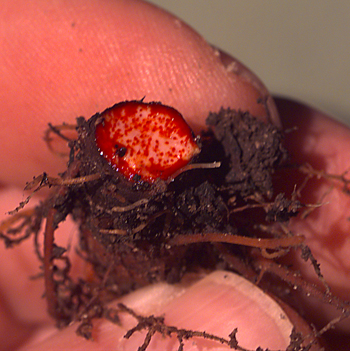
plant received its name because if
you break the root, a sap pours forth that looks like blood. The root has long been used by the American Indians as a dye for
the body and clothes. The red-orange juice from the
root was also applied to warts. |
 |
|
The red
juice from the root was a very popular remedy among Plains
Indians for sore throats, respiratory problems, and
growths on the skin. Bloodroot was found to be toxic,
however. It interferes with cell division when taken
internally. Externally, it has a unique ability to
dissolve abnormal growths without disturbing normal
tissue. So people continue to use it for moles, warts, and
some kinds of external cancers.
|
FFFFPoison:
Bloodroot paste is in a different league from other herbal
remedies since its actions are drastic. Inform yourself carefully
about its properties and risks and use it with great
caution. All parts of the plant are poisonous but the toxins
are most highly concentrated in the root after leaves are
completely open. The active alkaloid levels vary greatly between
regions as well as populations. The red-colored latex from
this plant contains several alkaloids similar to those found in
the Opium Poppy, and include sanguinarine, chelerythrine,
protopine, and homochelidonine, as well as resins.
Leaves:
Leaves palmate five to
nine lobed, 6 to 10 inches long. After flowering the leaves
increase in size, the underside paler showing prominent
veins.
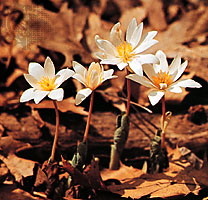
Flower:
One of the earliest
and most beautiful spring flowers. It
has a lovely white flower with golden stamens that produce only a
single leaf and a flowering scape about 6 inches high. When the
leaf first appears it is wrapped around the flower bud and is a
gray-green color covered with a downy bloom. The
seed is an oblong narrow pod about 1 inch long.
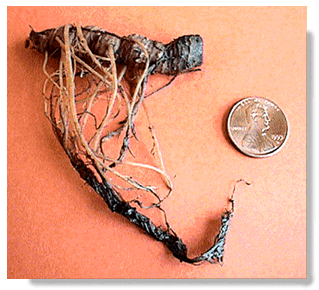
| Roots:
The roots are used
medicinally. The rootstock is thick, round and fleshy,
slightly curved at ends, and contains an orange-red juice, and is
about 1 to 4 inches long, with orange-red rootlets. When dried it
breaks with a short sharp fracture, little smell, taste bitter
acrid and persistent, powdered root causes sneezing and irritation
of the nose. |
 |
| The root
contains sanguinarine, which has
shown antiseptic, anesthetic and anticancer activity. American
Indians used the root for rheumatism, asthma, bronchitis, lung
ailments, laryngitis and fevers. |
Collection:
The root is collected in the autumn, after leaves die down; it
must be stored in a dry place or it quickly deteriorates.
Love
Charm: Males
of the Ponca tribe
used it by applying the
juice to their palms and then clasping the hand of the woman they
wanted to marry. Within 5 or 6 days,
it is said, she would be willing.
| HInteresting
Links |
|
Used externally, bloodroot has
a unique ability to dissolve abnormal growths without disturbing
normal tissue. You can get it from Alpha
Omega Labs in powdered form. Just add enough water to make a
paste and apply to the growth. You may want to cover it with a
Band-Aid. Before using bloodroot, please learn about its
properties and risks, then use it with great caution.
Bloodroot
Restaurant and Recipes
Bridgeport restaurant that was established under the philosophy of
political feminist vegetarianism. Read about their food, their
views and sample recipes.
|
|
|