


The discrete-time model of the digital communications systems considered
in this paper is depicted in figure 1. In this model
H0(z) is the channel transfer function and there are a total of
 interfering co-channels with transfer functions
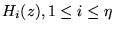 .
The linear dispersive channel and co-channels are modeled by
finite impulse response filters and, therefore, their transfer functions
are given by
.
The linear dispersive channel and co-channels are modeled by
finite impulse response filters and, therefore, their transfer functions
are given by
 |
(1) |
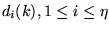 are assumed to be equiprobable and independent sequences. The data
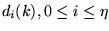 ,
would have zero mean, i.e.,
E[di(k)] = 0
and
,
would have zero mean, i.e.,
E[di(k)] = 0
and
![$E[d_i(k_1)d_j(k_2)]=\delta(i-j) \delta(k_1 - k_2)$](img9.gif) ,
where E[.]
denotes the expectation operator. The additive white Gaussian noise e(k)
has zero mean and variance
,
where E[.]
denotes the expectation operator. The additive white Gaussian noise e(k)
has zero mean and variance
 and is uncorrelated with the data
.
and is uncorrelated with the data
.
As defined in [2] the channel observation
y(k) = s(k) + u(k) +
e(k) contains three terms called the desired signal, the interfering
signal and the noise, respectively:
 and
and
 .
Let
.
Let
![$E[s^2(k)] = \sigma_s^2$](img13.gif) and
and
![$E[u^2(k)] = \sigma_u^2$](img14.gif) .
The signal to noise
ratio is then defined as
.
The signal to noise
ratio is then defined as
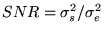 and the signal
to interference ratio is given by
and the signal
to interference ratio is given by
 and
finally the signal to interference and noise ratio is given by
and
finally the signal to interference and noise ratio is given by
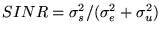 [3].
[3].
The task of the equalizer is to estimate the transmitted data d0(k) based on the channel observation y(k). There are variety of approaches proposed [10], basically dividing equalization into spread-spectrum (wideband) and nonspread spectrum (narrowband) techniques. The popular techniques with nonspread spectrum are the constant modulus algorithm (CMA), neural networks (NN) and higher order statistics (HOS) based algorithms. The NN techniques are sub-classified into those based on radial basis functions, backpropagation and polynomial perceptrons. The multilayer perceptrons however, has problems of slow convergence and unpredictable solutions during the training while the polynomial equalizer suffers from the drawback of having exponentially increasing filter dimensions. In this paper we are looking at the application of radial basis function (RBF) for the purpose of equalization.