|
Gilles SEBE, PhD - Wood and Wood Products Chemistry |
|
 �Education �Education
|
Contact
Laboratoire de Chimie des Substances V�g�tales, Institut du Pin - Universit� Bordeaux 1 - 351 Cours de la Lib�ration, 33405 Talence cedex, FRANCE
Tel: + 33 (0) 5 56 84 64 11
E-mail:[email protected] |
|
�Research
|
|
�Publications
|
|
�Communications
|

�
|
 �1996 �1996
|
Ph.D. degree in Wood Chemistry, Bordeaux 1 University (France) |
|
�1992
|
D.E.A (Dipl�me d�Etudes Approfondies) in Wood Science, Bordeaux 1 University (France) |
|
�1991
|
Master�s degree in Chemistry, Bordeaux 1 University (France) |
|
�1990
|
Bachelor�s degree in Chemistry, Bordeaux 1 University (France) |
Back to Summary
�
�
|
|
Development of novel plant fibre-reinforced matrix composites |
In the last few years, there has been growing interest in the development of industrial and consumer products that combine natural fibres and conventional polymeric matrices, such as thermosets or thermoplatics, to form composite products with unique properties and cost benefits. In particular, agricultural bast fibres like hemp, flax or jute have been quoted as being potentially suitable as replacements for synthetic fibres (e.g. glass, carbon or kevlar) in high-performance reinforced composites. The advantages of these fibres relate to their high specific strength and stiffness as well as abundance, renewability and biodegradability.
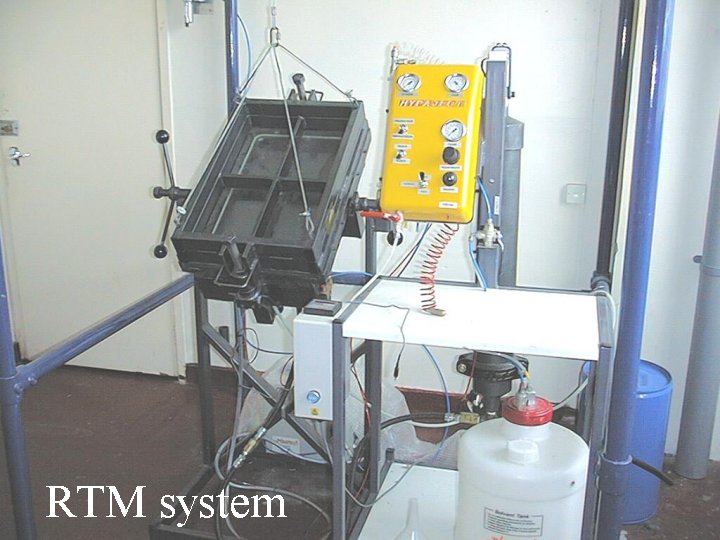
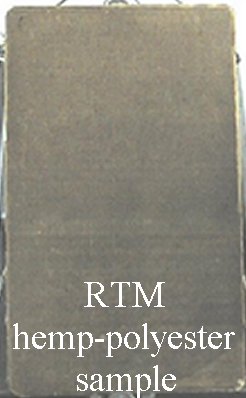
My research consist in developing novel plant fibre-reinforced matrix composites that could compete with synthetic fibre-based homologues in structural or semi-structural applications. It deals mainly with fibre/matrix interfacial adhesion issues, implying the development of novel compatibilisation systems and other chemical modification of the fibre surface. Thermoset-based composites prepared with a Resin Tranfer Moulding technique (RTM) were particularly investigated.
______________
|
|
Surface hydrophobisation of wood, paper and other natural products by chemical reaction with silicone polymers |
A significant number of wood properties, such as dimensional instability, biodegradability, weathering, poor wettability for some adhesives or coatings� are closely related to the hydrophilic character of its main constituents (e.g. cellulose, hemicellulose and lignin). It is reasoned that the chemical grafting of highly hydrophobic components to wood could drastically change its hygroscopicity and decrease many of its water-related drawbacks.
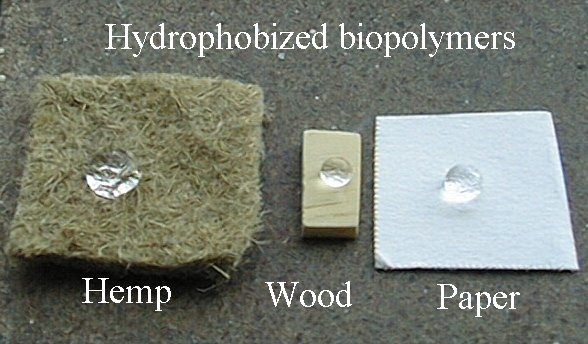
Therefore, wood, paper and other natural products were hydrophobized by chemical reaction with silicone, an extremely hydrophobic material. Distinct methods for the introduction of varied silicones at the surface of natural products are then developed.
______________
|
|
Dimensional stabilisation of wood by chemical reaction with organosilicon compounds |
Chemical modification is a very effective means of improving wood properties such as dimensional stability or biological resistance. The processes involved rely essentially upon forming covalent bonding between the hydroxyl groups of wood and some chemical reagent; leading to a modification of the basic chemistry of the cell walls. Many studies in this area have been focused on either etherification or esterification reactions, with a particular attention on acetylation with acetic anhydride.
With this work, the effect of grafted (hydrophobic) organosilicon groups on the dimensional stability of wood is specifically studied. For instance, Maritime pine sapwood (Pinus pinaster) was esterified using three synthesised organosilicon models bearing trimethylsilyl groups. The grafting was confirmed by infrared spectroscopy as well as 13C and 29Si NMR CP MAS analysis. The mechanism of dimensional stabilisation, whether it arose purely from a bulking effect or substrate hydrophobicity, was particularly discussed.
______________
|
|
Chemical modification of chemical pulp to improve the retention of paper additives |
The manufacture of paper requires the intermittent use of various additive formulations to improve or impart certain qualities to the paper product. Fillers such as titanium dioxide (TiO2) are used to provide brightness and opacity to paper and must be retained on the sheet to be effective. Titanium dioxide pigments are finely divided, chemically inert white powders that possess a high refractive index. They are commercially available in two distinct crystal forms, anatase and rutile.
The objective of this study is to chemically modify the pulp in order to improve the retention of TiO2 (rutile form) during sheet formation. This was achieved by an enzymatic treatment of the pulp, using 2-ethoxyethanol and b-glucosidase:

______________
|
|
Phosphorylation of cellulose to improve its biocompatibilty |
In the last few years, there has been growing interest in using cellulose and its derivatives in the biomedical field. The biocompatibility of cellulose is well documented and there have already been some successful attempts to use cellulosic materials as implants in cardiovascular and orthopaedic surgery.
In the present work, the phosphorylation of cellulose is envisaged with the view to stimulate bone induction. Once implanted, phosphorylated cellulose could promote the formation of calcium phosphates, having therefore closer resemblance to bone functionality. Satisfactory bonding at the interface between hard tissue and the biomaterial could also be expected.
For instance, the reactivity of cellulose with regard to phosphorylation was investigated, using the phosphorus oxychloride method (POCl3):
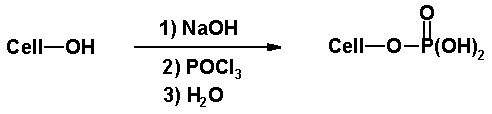
The degree of substitution of cellulose hydroxyl groups was evaluated by potentiometric titration.
Back to Summary
�
�
|
�
|
RTM Hemp Fibre-reinforced Polyester Composites; G. S�be, N. S. Cetin, C. A. S. Hill, M. Hughes; Applied Composite Materials 7: 341-349 (2000) |
Hemp fibre-reinforced polyester composites were prepared using a Resin Transfer Moulding (RTM) technique and the flexural and impact behaviour investigated. Flexural stress at break and flexural modulus showed an increasing trend with fibre content. Impact strength was found to decrease at low fibre content, then gradually increase with further addition of fibres
A strong interfacial adhesion between hemp and polyester was obtained using chemically modified hemp. This modification consisted in introducing reactive vinylic groups at the surface of the fibres, via esterification of hemp hydroxyl groups, using methacrylic anhydride. Increased bonding between fibres and matrix did not affect the flexural stress at break of the composite but was detrimental to toughness. This behaviour was ascribed to a change in the mode of failure, from fibre pull-out to fibre fracture, resulting in a marked reduction in the energy involved in the failure of the composite, leading to a more brittle material.
______________
|
�
|
An Investigation Into The Effects of Micro-Compressive Defects On Interphase Behaviour in Hemp-Epoxy Composites Using Half Fringe Photoelasticity; M. Hughes, G. S�be, J. Hague, C. A. S. Hill, M. Spear, L. Mott; Composite Interfaces 7(1): 13-29 (2000) |
Half fringe photoelasticity was used to evaluate the two dimensional state of stress in epoxy matrix micro-tensile specimens. The experimental technique is described in detail and demonstrated by the measurement of the stress distribution around a circular hole in a thin epoxy film subject to uniaxial tension. The results obtained using this photoelastic technique compare well with theoretical solutions. This system has enabled the mapping of stresses in the matrix of single (hemp) filament composites, strained parallel to the fiber axis, to be undertaken. Concentrations of stress were observed in the interphase region, adjacent to kink bands (micro-compressive defects) and stress concentration factors of ~ 1.4 were recorded. The role that these stress concentrations play in the failure of hemp fiber reinforced composites is discussed.
�______________
|
�
|
The Dimensional Stabilisation of Maritime Pine Sapwood (Pinus pinaster) by chemical Reaction With Organosilicon Compounds; G. S�be, B. De Jeso; Holzforschung 54(5): 474-480 (2000) |
The dimensional stabilisation imparted to Maritime pine sapwood by chemical modification with hydrophobic organosilicon compounds was investigated. The modification was performed via esterification, using different chemically synthesised models bearing trimethylsilyl groups: 3-trimethylsilylpropanoic anhydride (I), 2-trimethylsilylmethylglutaric anhydride (II) and trimethylsilylethenone (III). The grafting was confirmed by infrared spectroscopy as well as 13C and 29Si NMR CP MAS analysis and was located into the wood cell walls. The dimensional stabilisation induced by (I) and (II) appeared to be stable during the three oven-dry/water-soak cycles and, for a given number of hydroxyl blocked, to be much better than with acetic anhydride. On the other hand, the graft from (III) was found to hydrolyse progressively into an acetyl group via a metallotropic rearrangement. Further investigation on hygroscopicity and swelling behaviour of modified wood from (I) and (II) indicated that dimensional stabilisation was attributable to a bulking effect rather than a change in substrate hygrocopicity. The bulky grafts from (I) and (II) were, in particular, thought to over-swell locally the wood cell wall, revealing areas with new water-accessible hydroxyl groups.
�______________
|
�
|
Hydrophobization of Wood Surfaces: Covalent Grafting of Silicone Polymers; G. S�be, M. A. Brook; Wood Science and Technology 35(3): 269-282 (2001) |
The hydrophilicity of Maritime Pine wood surfaces was modified by silicone, an extremely hydrophobic material. A generic method for the introduction of varied silicones at the surface of pre-treated wood was developed. The initial treatment of wood with maleic anhydride and allyl glycidyl ether gave oligoesterified wood bearing terminal alkenes. The hydrosilylation of these groups, performed with hydride-terminated silicones, led to very hydrophobic surfaces, even after soxhlet extraction. The presence of silicon only at the surface of hydrosilylated wood was confirmed by ESCA. The silicones appear to be attached to the wood by covalent bonds.
�______________
|
|
Process to Hydrophobize Biopolymers including Starch, Wood, Cellulose, Proteins and other Polar Hydropolymers; G. S�be, M. A. Brook; patent in preparation |
A simple single-step method for the introduction of varied silicones at the surface of wood, paper and other hydropolymers has been developed and is currently being patented.
Back to Summary
�
�
|
�
|
RTM Hemp Fibre-Reinforced Polyester Composites; G. S�be, N. S. Cetin, C. A. S. Hill;
 �The 4th Pacific Rim Bio-Based Composites Symposium, Bogor (Indonesia), November 1998 (Chairman of the "Chemical modification of lignocellulosic materials" session) �The 4th Pacific Rim Bio-Based Composites Symposium, Bogor (Indonesia), November 1998 (Chairman of the "Chemical modification of lignocellulosic materials" session)
�5th International Conference on Woodfiber-Plastic Composites, Madison (USA), May 1999
�5th International Conference on Flow Processes in Composite Materials, Plymouth, July 1999
�
|
|
�
|
RTM Hemp Fibre-Reinforced Composite Automotive Components; G. S�be, N. S. Cetin, C. A. S. Hill;
�Automotive Composites Workshop, Brands Hatch (UK), December 1998
�
|
|
�
|
Hydrophobization of Pine Wood Surfaces by Grafting Polysiloxanes; G. S�be, M. A. Brook;
�4th International Conference on Woodfiber-Plastic Composites, Madison (USA), May 1997
�30th Organosilicon Symposium, University of Western Ontario (Canada), May 1997
�Invited Scientist at Michigan State University, Dept. of Forestry (USA), October 1997
�
|
|
�
|
Modifying Biopolymers with Silanes and Silicones; M. A. Brook, S. Balduzzi, V. Bartzoka, G. Hu, F. LaRonde, G. S�be, R. Stan;
�ACS Northeast Regional Meeting, Midland MI, May 1997
�
|
|
�
|
Approaches to the Dimensional Stabilization of Wood: Hydrophobization; M. A. Brook, D. A. Valentini, R. Stan, V. Bartzoka, G. S�be;
�Design Industriel, Architecture et Rh�ologie du Bois, Bordeaux, Mach 1997
�
|
|
�
|
Stabilisation Dimensionnelle du Bois de Pin Maritime (Pinus pinaster) par Greffage de Motifs Silici�s; G. S�be, D. Deffieux, B. De Jeso;
�4�me Colloque Sciences et Industries du Bois, Nancy, September 1996
|
�
Last update: December 21, 1999