Wood Turtle - Glyptemys insculpta
North American Wood Turtle
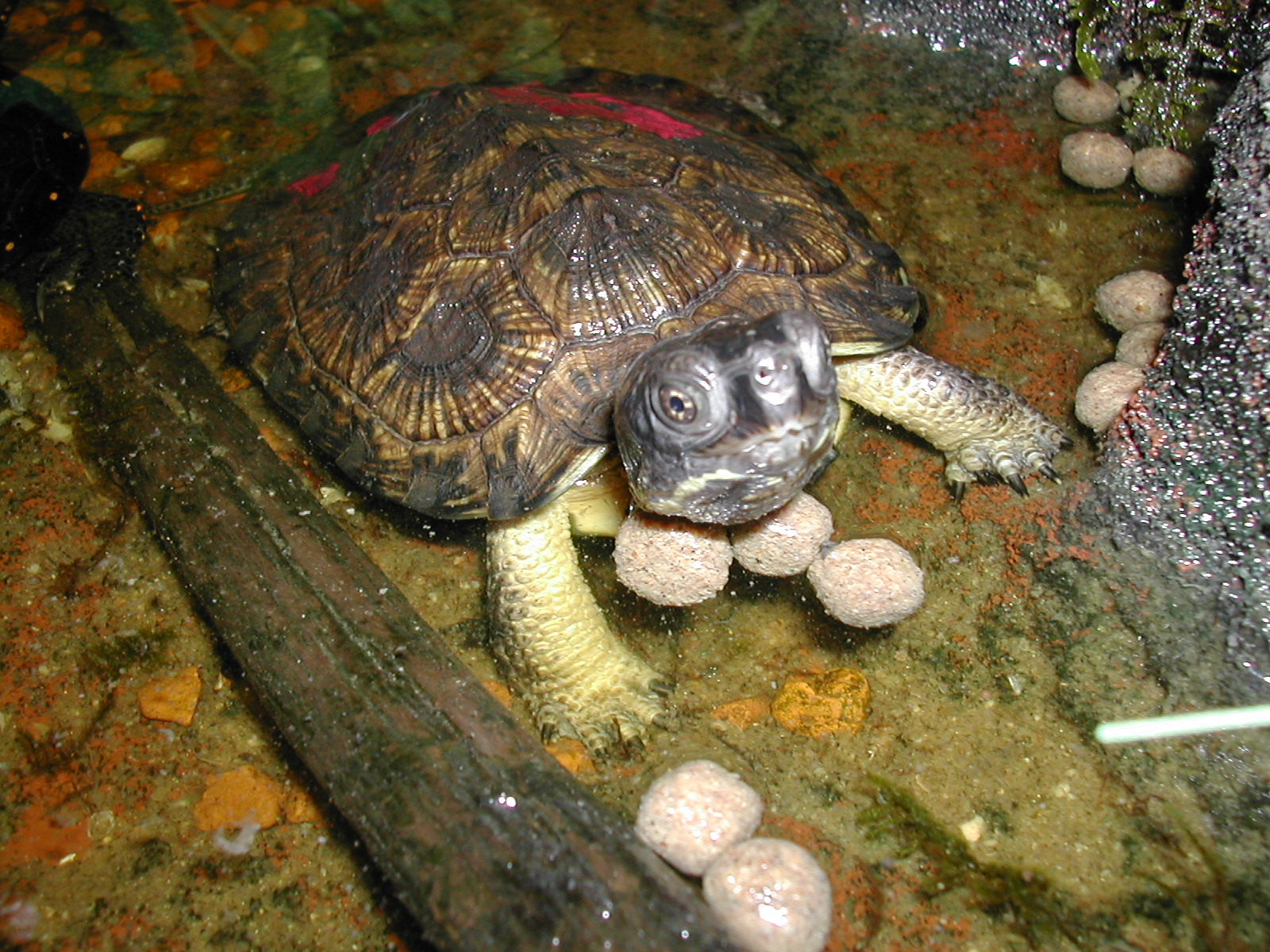
Glyptemys insculpta
The North American Wood Turtle is a moderately sized (6 to 9") semi-aquatic turtle found in cool, deciduous woodland stream, red maple swamp, marshy meadow, and farmland habitats of the northeastern United States. Its range extends from southern Nova Scotia south to northern Virginia and then northwest to southern Quebec and the Great Lakes region to eastern Minnesota and northeastern Iowa. The wood turtle is largely absent in areas surrounding the mid-atlantic bay regions.
The upper shell of the wood turtle is brown in color and keeled, giving it a rough, sculptured texture - hence its common name. The hingeless plastron is yellow in color, with short, thick, black bars present along the outer margins of the scutes. Referred to as "Old Redlegs" by local fishermen who encounter this species quite frequently at their favorite trout streams, the skin on the neck and legs of the wood turtle are often a reddish orange, with a more yellowish coloration being noted in specimens from western parts of its range. Males have a distinctly concave plastron and a thick, long tail.
I have been studying wood turtles for many years. They are my favorite of the North American, semi-aquatic turtle species. Wood turtles are still quite plentiful over certain areas of their range but with their growing popularity in the herpetological trade, will soon become scarce if immediate action is not taken to fully protect them. Even though they are protected to some degree in most of the states that they naturally occur in, adult wood turtles still turn up for sale on dealer lists who claim they originate either from long-term personal collections or from those states where protective legislation is minimal, if even existent. Although captive breeding may be the answer to satisfying the commercial demand for wood turtles, many hobbyists are scrambling to obtain adult specimens while they still can. Because wood turtles only reach sexual maturity after 6 to 10 years of life, the combination of poor hatchling survival rates (mainly due to predation) and disfunctional adult populations (due to habitat destruction and pillaging of adults for the herpetological trade), wild populations are certainly threatened with extinction.
Wood turtles are true "cold-weather" turtles, normally becoming active in early spring, even while ice and snow may still be present. Upon emerging from winter hibernation which often takes place at the bottom of moderately flowing streams (which never freeze over), wood turtles prioritize sun-bathing. They can often be found nestled among beds of tiger lilies (which normally grow in the moist soil along the edges of northeastern streams), with their shells fully exposed to the sun. This probably helps to normalize their metabolisms so that they may begin feeding and building up strength for upcoming courtship and eventual copulation.
Wood turtles are omnivores, meaning that they eat both plant and animal material. Earthworms and wild berries are favored food items, although they will eat just about anything found in the produce department of your local supermarket. They will also take other animal prey items such as fish, crustaceans, crickets, pinkie mice, and even small snakes (mine have wasted no time in devouring the occasional garter snake which haphazardly wandered into their pen). Wood turtles display an unusually intelligent and obviously inherited characteristic in which they lift their upper bodies high off the ground with their forelegs and then quickly drop down to create a "thumping" noise. The purpose of this is seemingly to entice earthworms out of the ground in anticipation of thunderstorm related rainfall. The worms think the thumping is thunder and as they rise up out of the ground, the diligent wood turtles eagerly consume them.
Courtship and copulation in wood turtles can be an agressive matter, although not necessarily always between males. Mature and immature males alike will actively pursue females both in and out of water. Male wood turtles will also often bite at the rear legs and tails of females and other males, sometimes replacing otherwise natural-looking tails with stumps. Copulation also occurs both in and out of water. Male wood turtles are very diligent in their efforts and if unsuccessful on land, frequently direct their potential mates into the water. Once in the water, males will often arduously submerge females in order to force copulation. When faced with the reality of either mating or drowning, most females ultimately allow the males to have their way. This rather dramatic mating ritual often keeps many hobbyists on edge with the threat of losing females. I personally have witnessed my male submerge females for up to 17 minutes at a time without consequence. I purposely keep the water level in their pond shallow so as to prevent any accidents.
Gravid females nest in early June through to late July, depending on climate. Anywhere from 3 to as many as 13 white, elliptical eggs are deposited in a 4 to 6-inch depression in the ground. Soil types depend on habitat and range from sandy loam 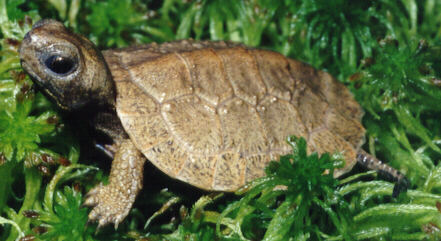 in open, lowland areas to sunny patches of forest floor debris in higher elevations. Incubation takes approximately 95 days, and the 1 1/4" hatchlings will often overwinter in their nests. It is essential to provide captive females with adequate nesting substrate, or eggs will often be layed at the surface and subsequently trampled upon if not found in time. Unfortunately, I speak from past experience. Digging a pit within their enclosure and filling it with sand has worked well for many hobbyists. Artificial incubation, if at all possible, will greatly increase successful hatching. Since scientific evidence suggests that sexual dimorphism in Glyptemys insculpta is genetically determined, exact incubation temperatures are irrelavent. Anywhere from 79 to 86 degrees farenheit with an overall relative humidity of above 75% will suffice.
Neonate Glyptemys insculpta have somewhat different care requirements than adults. Whereas adult wood turtles are primarily terrestrial and will periodically enter water, neonates are almost entirely aquatic and will literally spend the first few years of their lives hiding and feeding amidst aquatic vegetation. Diet is assumed to be entirely carnivorous (worms, insects (larvae), amphibians (larvae), fish, and crustaceans) at this stage of life, although I believe that a small amount of vegetation may also be consumed. Captive neonates can be kept in practically any size tank or tub. Just an inch or two of water will suffice - no deeper than the turtles are long. Provide adequate cover and a basking area. The shallow water will allow the young woodies to find their food easier. Neonates can easily be started on a diet of pre-fabricated turtle foods, my favorite of which include Reptomin and Turtle Brittle. Once established, neonates can be slowly switched over to various live foods and will usually begin accepting supplements of various fruits by about their 3rd or 4th year.
Once a wood turtle reaches its sixth year of life, it should be large enough (about the size of an adult Eastern painted turtle) to dramatically lessen the danger of predation by various mammals, birds, and other herps which would normally make haste in ending the lives of smaller neonates. The grim fact is that, on the grand scale, very few neonate wood turtles actually survive their first year of life, let alone actually have the opportunity to hatch. It is very easy to take the wood turtle for granted in areas where it is still locally common. Without proper conservation efforts, the future of Glyptemys insculpta is certainly on a downward trend.
Back to "TurtleGuy" |
Spotted Pond Turtle |
Bog Turtle |
Mediterranean Tortoises |
Links