(Thanks to the Computer
Chemistry Center at the University of Erlangen, where I found this
picture)
All about the world's most beautiful fair
|
|
||
|
| ||
|
|
||
| What are the highlights I must not miss? | ||
| What do other people say about the Bergkirchweih? |
What is the Bergkirchweih?
The Bergkirchweih is a popular local beer fest in Erlangen, Germany. "Berg" means hill or mountain and "Kirchweih" means parish fair, so "Bergkirchweih" might be translated as "Fair on the Hill". In the regional German idiom, Franconian, it is called Berchkärwa oder simply Berch (don't even try to pronounce that in English!).
Erlangen is a town of a about 100.000 inhabitants, approximately 20 km north of Nuremberg, Bavaria. But be careful: the northern part of Bavaria is called Franconia ("Franken"), and its inhabitants are quite proud of that! So you might not want to call anyone in Erlangen a Bavarian nor ask why no-one wears a "Lederhose" or a "Gamsbart" on his hat while dancing the "Schuhplattler". That's what Bavarians do (well, perhaps, some of them, while tourists are around)! Franconia, on the other hand, does have its own history and culture, being part of Bavaria for less than 200 years - which also explains, why the Bergkirchweih and the much more famous Munich "Oktoberfest" do have so little in common. Erlangen hosts a university and important parts of the Siemens company, and is known in Germany as "bicycle town", as it has constantly advanced the use of bikes instead of cars for more than 20 years now. It is a nice place to live in and also my home town.
The Bergkirchweih is the most important of the numerous Franconian fairs and beer fests, a (certainly not complete) list of which can be found here. Officially it is called "one of the most beautiful fairs of southern Germany", but once you've been there you will certainly agree that it is in fact one of the most beautiful in the world!
The special atmosphere of the Bergkirchweih comes from the fact that it takes place on top of the "Keller" (cellars) at the Burgberg, a steep hill just north of Erlangen. That, by the way, also explains the name "Bergkirchweih". The Keller are tunnels dug deep into the sandstone of the Burgberg. The numerous breweries of Erlangen used to store their beer there to keep it cool during the summer. Not only are temperatures constantly low down there, the beer was also chilled with ice cut from the lakes during the winter. Nowadays, of course, the Keller are only used as storage rooms during the Bergkirchweih.
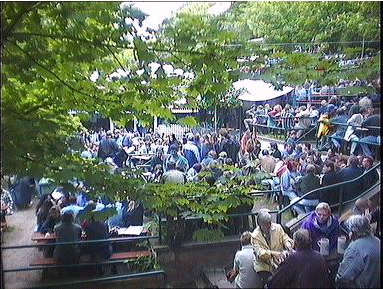
In 1755 a fair was held at the Burgberg for the first time. The beer stored inside the Keller was sold at the tunnel entrances that soon became decorated by building small houses around each of them. These "Kellerhäuschen" are still an important part of the beautiful scenery of the Bergkirchweih, each one being the center of a beer garden. In fact, nowadays Keller simply means beer garden. The tables and benches are standing beneath huge old trees on smaller and larger terraces that cover this part of the Burgberg, and can be reached by steep paths and stairs.
|
Typical scenery at the
Bergkirchweih
|
Most Keller are named after the brewery the beer of which is sold there: Erich, Henninger, Tucher ... Unfortunately, of the more than 50 breweries in Erlangen only Kitzmann and Steinbach could keep their independence when all others became parts of big brewing companies over the years. In fact, most of them still produce drinkable stuff, though. You can buy your beer directly at the Keller or from one of the waiters that constantly carry huge beer-mugs through the rows of benches. Huge mugs indeed, as they hold one "Mass" (one "measure"), i.e. one liter of beer. The beer is not really cheap - in 2003 you had to pay 6 Euro per liter - but the beer and the atmosphere together are certainly worth the price. You can find here a full list of all the Keller of the Bergkirchweih, with the possibility to book a table in advance.
Apart from the beer gardens there is a normal fair, too, with roundabouts and a giant's wheel. It takes place on a terrace of the Burgberg, east of the Keller, where room is rather limited. So, it is often overcrowded, but this does not disturb (indeed rather improve) the splendid mood.
When does the Bergkirchweih take place?
Every year around Pentacost. Traditionally, on Thursday before Pentacost the first barrel of beer is opened and distributed free of charge, an event known as "Bierprobe" (beer testing). The Bergkirchweih then lasts for 12 days until the weekend following Pentacost. The next Monday the last barrel of beer is buried in a solemn ceremony and the counting starts anew: 353 days till the Bergkirchweih, 352 days till the Bergkirchweih, 351 days ...
Each day the Bergkirchweih opens at 10 a.m. and closes at 11 p.m. (officially, at least). Afterwards most visitors continue their celebrations in one of the pubs and clubs of the town or at the "E-Werk", a common meeting point of the youth, that regularly becomes the "Berg-Werk" during the Bergkirchweih.
As mentioned above, Erlangen is situated about 20 km north of Nuremberg. The city of Erlangen provides comprehensive information for tourists on how to get there by plane, train, or car. Once you are in Erlangen, you will have no problem finding the Bergkirchweih. The Burgberg is located north of the town, so from the city center or from the main station just walk in that general direction and you won't miss it. An interactive city map of Erlangen may help you. Until 10 p.m. most of the people around you will have the same destination, anyway. Or you just follow the sound of music and the smell of "Bratwurst" (roasted sausage).
For several reasons (parking lots and alcohol among them) it is advisable to go to the Burgberg on foot, by bike or by bus. The local bus company has special offers during the Bergkirchweih.
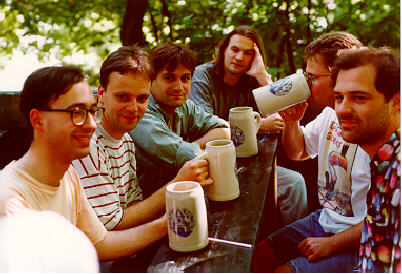 |
Drinking beer at the
Bergkirchweih
|
What are the highlights I must not miss? - A rather subjective list
Beer. Well, of course! I already mentioned you should try the beer of Kitzmann or Steinbach, the last independent breweries in Erlangen. Kitzmann beer is sold at the far western end of the Bergkirchweih area, at the so called "Entlas-Keller", Steinbach beer at the Steinbach-Keller near the main "entrance" of the Bergkirchweih.
"Fränkische Bratwurst" (Franconian roasted sausages). They are one of the main specialities of Franconian cuisine - you really have to try them. They are sold everywhere, two in a roll, with mustard.
The beef roaster. It is also found at the Entlas-Keller. Even if you don't like beef, it's rather impressive to see a whole ox being roasted every day. There is also a blackboard indicating the number of the ox during this year's Bergkirchweih (one per day is quite common)- and also his name ...
Whit
Sunday. If you don't know when exactly go to the
Bergkirchweih, choose Whit Sunday. That day traditionally the people of Erlangen
visit the Bergkirchweih with all their family. You really should be there
around 10 a.m. at least or you will have a difficult time looking for a free
bench (of course, the best benches are occupied much earlier). It is also
traditional to bring most of your food with you and to order beer only.
What do other people say about the Bergkirchweih?
They like
it, of course! There are the "official" Bergkirchweih web sites hosted by the City of Erlangen or by
Erlangen Online Stadtinfo. But you may also want to have a look at private sites such as Bergkirchweih.de (not much information, but a lot of pictures), the "Beer-Pages" by Manfred Wirth (even more pictures and links to other Franconian fairs) or simply Berch.de.
I must
also admit that there is another fair in Franconia that is almost as
beautiful as the Bergkirchweih: the Annafest
at Forchheim. Some Forchheimers really believe their fair is even better than the Bergkirchweih .... but let's not argue, and rather order another beer:
 . Get your own Free Home Page
