STRANDINGSTRANDING
Every year, thousands of whales, dolphins, and porpoises are found stranded, alive and dead, on beaches all over the world. They may be alone or in groups, and while some animals are old and unwell, many of them are young and perfectly healthy. This is a natural phenomenon, and has been happening since time immemorial, but it remains one of the great unsolved mysteries of the animal kingdom.
POSSIBLE CAUSES
Some stranding are easy to explain : the animals simply dieat sea and are washed ashore with tides and currents. But live strandings are more mysterious, and many theories have been put forward to explain their possible cause. One thory is that changes in the earth's magnetic field cause the animal to lose it's sense of direction. Alternatively, an earthquate or storm could cause it to panic; a brain infection could cause it to disoientation; its sonar system may fail; or it may simply get lost or feel unwell and need to rest. In mass strandings, the whole group may be in trouble in some way, or they may be following one individdual that is ill or disoriented.
MAGNETIC FIELDS
Cetaceans may have an extra sense called "biomagnetism", which enables them to detect variations in the earth's magnetic field. They use the magnetic field, like a map, to navigate. The field is always changing so, ocassionally, they could become confused and swim towards the shore.

A whale stranded on a beach in Santander (northern part of Spain). November 1997
FINDING A SSTRANDING CETACEAN
IN most cases, a straded cetacean will be unable to return to the sea without help. If you find a stranded animal, check whether it is a live or dead : listen for breathing (in some species there may be a gap of as much as 10 to 15 minutes between breaths) and see if the eyes move. If the animal is dead, inform the local police and do not touch the carcas. If it is alive, contact the police before trying to make the whale more comfortable. The guidelines oppoiste are very basic- it is always better to leave it to experts f possible.
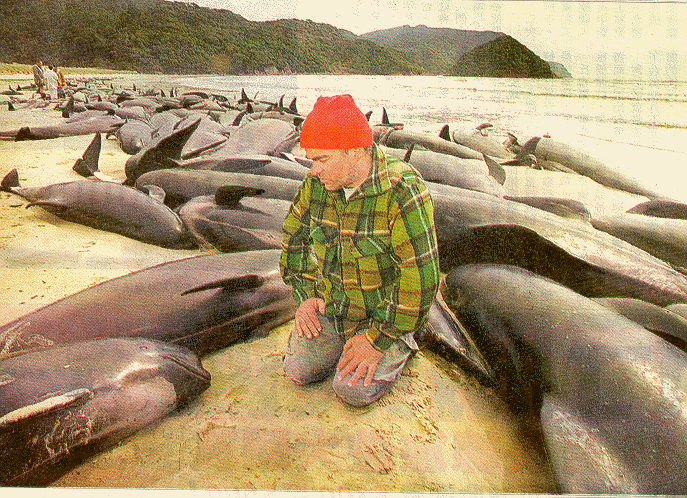
About 300 pilot whlaes stranded on a beach on Stewart Island, New zealand. October 1998
COMMON VCTIM
Some whale sare more susceptible to stranding than others. Pilot whales seem to strand more often than most: the social bonds between them are so strong that they are reluctant to desert one another; as a result, large numbers of them may strand together.
MASS STRANDING
A stranded animal is susceptible to sunburn and overheating, even in cold weather, so it should be kept moist and cool, with wet towels or water. It is vital to get expert help as quickly as possible. in some countries, it is illegal to give unauthorized first aid to a cetacean.
HOW TO DEAL WITH A STRANDED LIVE ANIMAL
WHAT TO DO
Get expert help as quickly as possible
Keep the animal's skin moist.
Erect a shelter to provide shade.
Keep the flippers and flukes cool.
Keep onlookers at a distance.
Make as little noise as possible.
Try to keep the animal upper side up.
DO NOT
Stand very close t othe tail or head.
Push or pull on the flippers, flukes, or head.
Cover the blowhole.
Let either water or sand enter the blowhole.
apply suntan lotion to the animal's skin.
Touch the animal more than necessary.
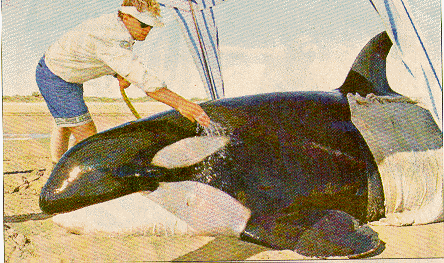
A killer whale mother and child stranded on a bay in Perth, Australia. The child had died and only the mother left alive. They had stranded with five other whales the day before. November, 1997
INFORMATION FROM STRANDING
For many years, the only information available on cetaceans was gleaned from animals killed by whalers and fishermen, or from strandings. Even now, despite increasing work being undertaken on healthy animals at sea, some species have never been seen alive, and many others are almost impossible to distinguish at sea. An examination of a dead specimen may be necessary for a positive identification; even badly decomposed animals can often be identified with certainty.