CONSERVATIONCONSERVATION
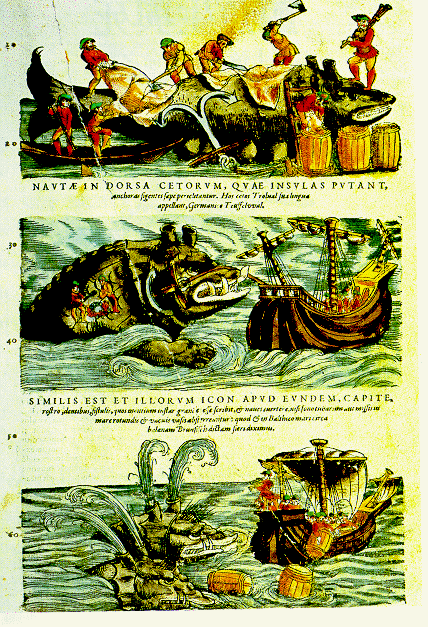
A few centuries ago, there were probably more cetaceans in the sea than there are today. Whaling and other forms of hunting, incidental cature in fishing nets, competition with fisheries for food, human disturbancce, habitat destruction, and marine pollution have all taken their toll. No cetacean has become extinct in modern times, but some species are now in serious trouble and others have all disa ppeared from many of their former haunts.The picture on the left hand side shows whaling in 16th century.
WHALING
Commercial whaling began hundreds of years ago, but two relatvely recent events precipitated an enormous increase in the killing worldwide. IN 1864 a new harpoon was developed, which could be fired from a cannon and would then explode inside the whale's body; and, in the early 1920s, floating factory ships were introduced to do all the processing at sea. One by one. large whales were hunted almost to the point of extinction. A worldwide ban was agreed in 1986, after tireless campaigning by conservation groups, but several haundred whales are still being killed every year. There is still some commercial whaling, in open defiance of the ban, but most of the killing occurs as a result of a serious loophole that allows any nation to issue its own permits to take whales for scientific research: the carcassws, however, are allowed to be processed for their meat and oil in the normal way.
Why do people in Taiwan today eat something their ancestors didn't think of as edible?Yang Hong-chia was the earliest in post-WWII Taiwan to study cetaceans. He speculates that perhaps the first immigrants to Taiwan brought the habit of eating dolphin with them when they crossed over from Fujian 400 years ago.
People living on the Jujian coast have always relied on the sea for their livelihoods. Perhaps they began eating the dolphin because in their local area meat was scarce, and the dolphin was rich in fat and oil. Eventually eating dolphin because customary,. When Yang did a survey in Yunlin in 1974, he found one fish market that specialized in selling dolphin meat.
But Yang emphasizes that "the area of dolphin consumption is very limited." In fact, it is mainly confined to Yunlin, and dolphins caught by fishermen from around Taiwan usually end up in thet county. It is widely believed that dolphin meat has great "supplementaruy value" (as Chinese dietary theory puts it). Women who are still weak just after giving birth, or old people with cold limbs from poor circulation, are said to bgenefit from dolphin meat cooked up with ginger or seasame oil. Also, back in the days when not everyone could afrord to eat pork, beef, or poultry, inexpensive dolphin meat was a source of protein for the poor.
However, after the promulgation of the Wildlife Cobservation Law in 1990, this "traditional"demand became a commercial opportunity. Chen Juei-yung notes that before the law, one catty (0.6kg) of dolphin meat fetched about NT$75). But now that the trade is illegal, the price has jumped nearly ten times over, to NT$400-500 per catty. You can't buy it in most ordinary markets, and only old familiar customers at seaffood rstaurants are "let in on the secret."
HUNTNG SMALLER SPECIES
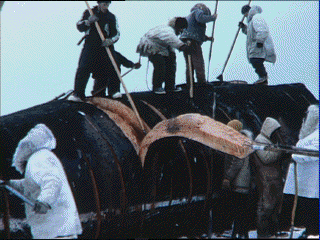
Smaller whale and dolphins are also being hunted, especially in Japan and South America, with nets, rifles, and hand-held harpoons. They provide meat for human consumption and bait for crab fisheries; in some areas, where fish stocks are severly depleted because of over-explitation, these cetaceans are blamed for the scarcity of fish and are "called" to "protect" the rest of the stock. Again, conservationists have been campaigning for many years to stop the hunting
FISHING
In many parts of the world, an increasing number of cetaceans become entangled and drown in fishing nets every year. The problem varies according to the type of fishing gear used, local customs the species, and the fishing season. IN some cases, a simple modification of either the nets or the management system can significantly reduce the incidental catch; in others, there may be no alternative but to ban the fishery. Most of the fisheries that kill dolphins do so accidentally, but tuna fishing is notable exception; many fishermen set their nets around dolphins intentionally, knowing that they tend to swim with the tuna, as it is the cheapest and quickest way to catch the most fish.
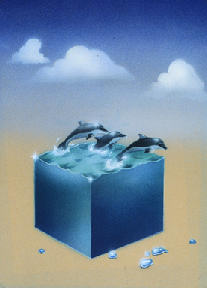
Pollution has badly affected the shores and inshore waters of closed-in seas. City sewage, cemical waste from factories, and fertilizers and pesticides from farms escape into rivers that flow into the sea. IN open waters, ships spill oil and drop garbage overhead. Marine life is under threat from all kinds of pollution and people's behavior. If we don't try to start saving our oceans, the living environment of the marine life will probably become the picture shown on the right hand side.
Save the ocean, save ourselves!