PHYSICAL
CHARACTERISTICSPHYSICAL
CHARACTERISTICS
PHYSICAL
CHARACTERISTICSPHYSICAL
CHARACTERISTICS
Cetacea are highly modified for life at sea. Hind limbs are absent, forelimbs are flippers, and the tail is flatened: most have a dorsal fins.
There are two main types of whale: toothed whales, which possess teeth, and baleen whales, which do not.The toothed whales include the Narwhal and Beluga, all the dolphins and porpoises, sperm whales and beaked whales; they feed mostly on fish, squid, and in a few cases, marine mammals, and normally capture one animal at a time. The baleen whales include most of the larger whales, such as the rorquals, right whales, and the Gray Whale, and have baleen plates instead of teeth; their vast jaws enable them to catch thousands of shrimp-like crustaceans or small fish at a time

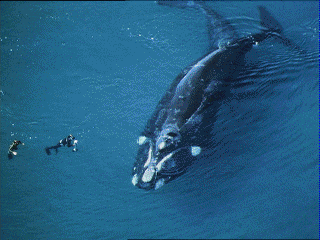
On Earth, no living thing matches the size of the blue whale. Bigger than anything that now lives, or ever has lived, this magnificent creature has been known to be as long as 33 m (108 ft.), and weigh up to 160 metric tons (176 tons). The right whale pictured here is not much smaller. It can weigh 100 metric tons (110 tons) and measure up to 15 m (49 ft.) long.Because of water's density, and the physical adaptations whales have made to their watery realm, large whales are just as efficient swimmers, for their size, as smaller ones. However, smaller whales, such as ~porpoises~ and dolphins, are more agile, and some of the maneuvers they make are different from those performed by larger whales.
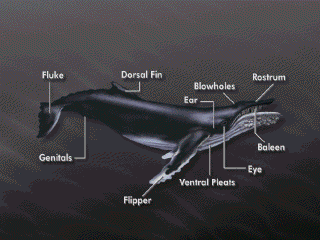
This diagram of a humpback whale shows all the essential features visible on the outside of its body. These body parts are the same for most whales, except that some ~species~ lack a ~dorsal~ fin and some have very small flippers.The humpback is a ~baleen~ whale, so its head, and especially its mouth, look different from those of toothed whales. Also, most baleen whale species have long ~pleats~, from chin to navel, on their undersides. These pleats allow the whale's body to expand as it takes in water mixed with seafood, in the baleen whale's unique way of eating. Toothed whales lack these pleats, and feed in an entirely different way.
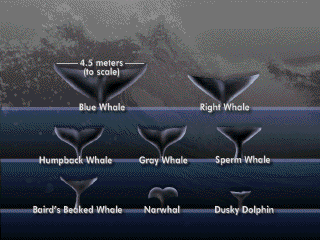
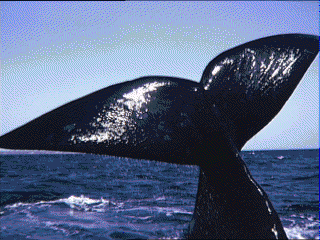
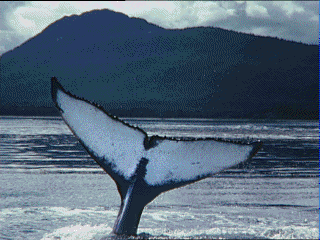
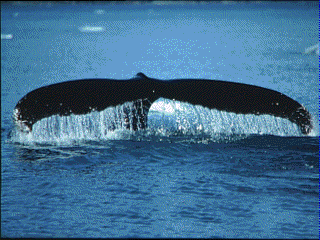
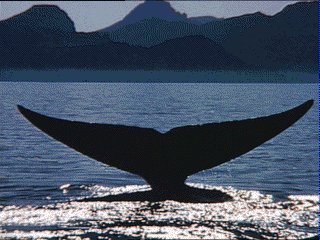
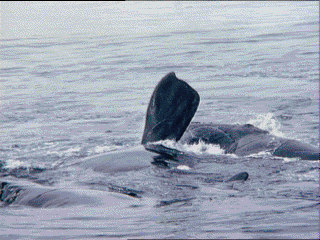
Whale tails are almost as varied as whale faces. Still, all whales have flukes--two fins located near the end of the tail. Each ~species~ has a particular kind of tail which can be used to distinguish one group of whales from another. Within a species, researchers have been able to identify and track the movements of individual whales by the patterns of color or scarring on the tail flukes. These distinguishing marks are especially useful in trailing humpbacks, which have distinctive patterns of white and black on the underside of their dark flukes. Flukes are only part of the tail. The tail itself may take up the final one-third of a whale's body, and is powered by strong muscles that attach to the vertebral column.
This picture shows how varied the size and shape of tail flukes can be. Many of the tails of the larger whales have distinct notches between the flukes. Not surprisingly, the tail of the blue whale is the biggest of all-- about 4.5 m (14.8 ft.) across. The only problem for tail watchers is that blues rarely raise their flukes before a dive.
Different whale flukes
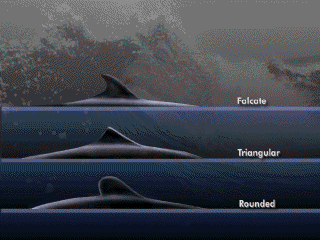
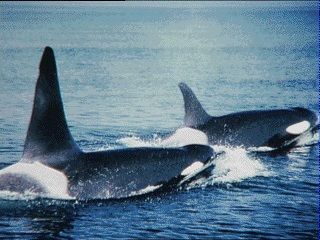
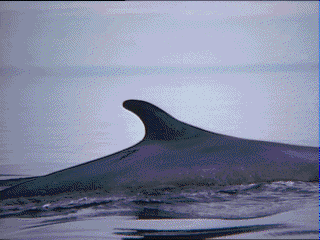
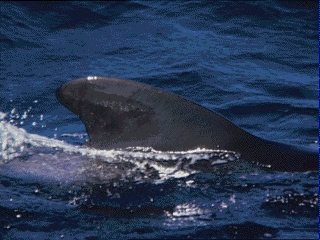
Not all ~dorsal~ fins--the ones attached to an animal's back--belong to sharks. Many whale ~species~ have them as well. Fins act like the keel of a boat, helping whales balance and steer their bodies while swimming. The shapes and sizes of fins vary among species. In general, there are three basic fin shapes: falcate (hooked), rounded and triangular. Fins sometimes differ in size and shape between males and females of the same species. The dorsal fin of a male killer whale, for example, is much larger and more pointed than that of the female.
Different whale dorsal fins
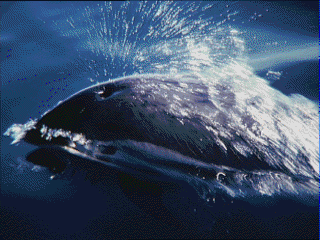
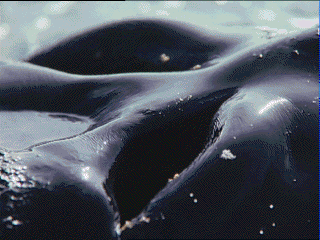
On the top of every whale's head is at least one hole, sometimes two. This is the nostril that, over millions of years of ~adaptation~, migrated from the front of the whale's ~snout~. The blowhole enables the whale to live successfully in the water by letting it breathe easily and efficiently at the surface. When a whale surfaces to breathe, it exchanges about 90 percent of the air in its lungs. A human, on the other hand, exchanges only 15 percent of the air with each breath. Because they utilize more of the oxygen they take in, whales are more efficient breathers than humans. When a whale dives, the strong muscles around the blowhole relax and close it off, so that water does not enter the lungs. Toothed whales, such as this Atlantic white-sided dolphin, have one blowhole.
The picture on the right hand side is a right whale, a ~baleen~ ~species~, has a double blowhole. Both types of whales have two holes in their skulls, but only baleen whales have two openings on the outside of their bodies.
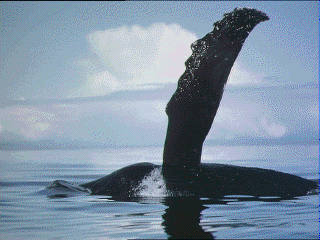
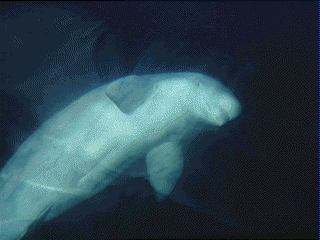
All whales have flippers, one on each side of the chest, that aid in steering the body. Flippers range in size from small ones on many dolphins to immense ones on the humpback whale. Humpback flippers may be as long as 5.5 m (18 ft.), a third the length of their entire bodies.Mother whales use their flippers to keep tabs on their young, constantly reaching out a flipper as they swim along to reassure themselves that the calf is nearby. Some researchers think that stroking with the flippers may be a form of affection among ~cetaceans~.
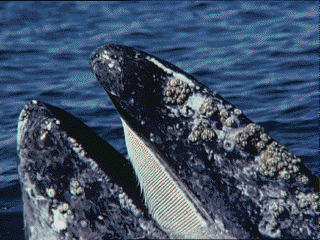
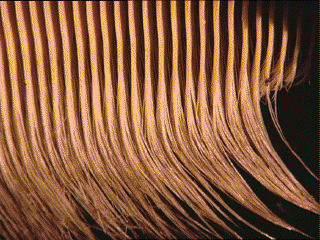
The gray whale in the picture is one of the 11 ~species~ of ~Mysticetes~, or ~baleen~ whales. Instead of teeth, Mysticetes have a "curtain" of baleen plates, or slats, hanging from their upper jaw.On the inside of the mouth the baleen is fringed, like \hich\af2\dbch\af16\loch\f16 a coarse beard, and serves as a sieve, to strain out of the water the tiny ~plankton~ that baleen whales eat.Baleen is made of the same kind of protein as your hair and fingernails, and hang in a slightly slanted, overlapping pattern like the teeth of a comb. There is a wide range of baleen plate sizes; in some species they are less than a meter long; in the huge mouth of a right whale they can be 2.8 m (9.2 ft.) long; in a bowhead more than 4 m (13 ft.) long.
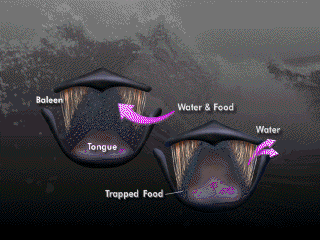
A ~baleen~ whale eats by opening its mouth and taking in a large amount of water mixed with tiny sea creatures called ~plankton~. Using its huge tongue, the whale forces the water out of its mouth. The food that is caught in the fringed filter of the baleen is then swallowed. The baleen gets a big workout every day. During the summer months, when most baleen whales are in cold polar waters, they take in up to four tons of food a day. That could put a real "strain" on any whale!
No one would ever confuse a flamingo with a ~baleen~ whale, but if you look closely, you'll find they have many things in common. Although they are not related, whale and flamingo mouths look remarkably alike. Moreover, whales and flamingoes have similar diets. Whales eat ~plankton~, including small ~crustaceans~ or shellfish, and flamingoes eat shellfish, too. Over millions of years, each has evolved the same kind of filter-like feeding mechanism. Scientists call this "convergent evolution." This means that unrelated animals adapted independently in similar ways to solve the same problems.