BEHAVIOR OF
CETACEABEHAVIOR OF
CETACEA
BEHAVIOR OF
CETACEABEHAVIOR OF
CETACEA
PREFACE
After years of studing dead animals washed ashore, or killed by whalers, we know a great deal about the anatomy and physiology of cetaceans, but surprisingly little about their behavior. It is extremely difficult to study animals that spend most of their lives underwater, often far from land, but with recent technological advances and in creased efforts to study cetaceans i nthe wild we are now beginning to discover some of their secrets.

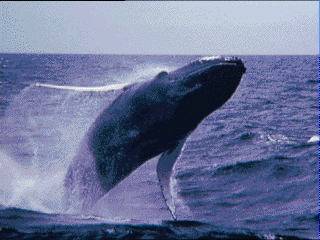
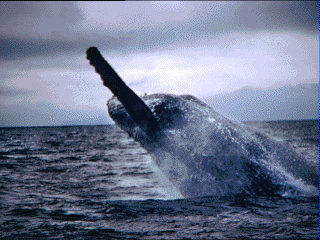
Whales, dolphins, and some porpoises aometimes launch themselves into the air head-first and fall back into the water with a splash. This is known as "breaching", and is undoubtedly the most spectacular surface activity. Often, it provides the only opportunity whales watchers have to see the entirely animal.
Most species have been observed breaching at one time or another. The smaller cetaceans can leap very high and often do complete somersaults, twists, and turns before re-enterning the water. Larger whales normally propel at least two-third of their bodies into the air and their breaches end in a belly flop, or they turn to one side or onto their backs.Some also perform "head-slaps", which resemble reaches, but involve lifting only the head and top part of the body out of the water before pounding them onto the surface. Many species breach several times in a row and, when one animal breaches, others may follow suit.
Humpback whales have been known to breach over 200 times in a single display, both at their feeding grounds and breeding grounds; this is a phemenal achievement, considering an average-sized Humpback weighs the equivalent of 400 people.
Breaching is still something of a mistery, although there are numerous possible explanations; it may be a courtship display, a form of signalling, a way o herd fish or dislodge parasites, a show of strength or a challenge, or it could be simply for fun.in fact, it probably has several of these functions.
Breaches range from a full leap clear of water to a more leisurely surge, in which only half the body emerges. It's not usual for a Bryde's Whale to breach, but Gray Whales, Humpback Whales, Sperm Whales, right whales, and many dolphins are better known or their breaching.
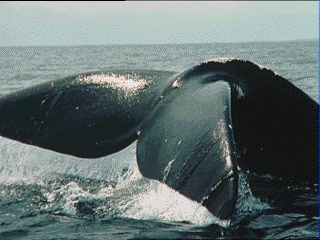
When whales and dolphins embark on a deep dive, or "sounding dive", they lift their tails into the air to help them thrust their bodies into a more steeply angled descent to deeper water. This is called "fluking". there are basically two kinds of fluking : a "fluke-up dive", when the flukes are brought high into the air, so that the undersides are visible, or a "fluke-down dive", when the flukes are brought clear of the water but remain turned down , hiding the undersides from view. When watching a whale, observe whether or not it raises its flukes into the air at the start of a deep dive and, if it does, note what the shape they are. Both are very helpful features for idintification.
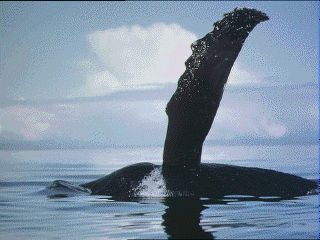
Whales and dolphins sometimes roll over at the surface to slap their flippers onto the water with a splash -sometimes several times in a row- as shown in this photograph of a Humpback Whale.this action is known as "flipper-slapping", "flipper-flopping", or "pectoral-slapping".Humpback Whales sometimes also lie on their backs, waving both flippers in the air, before slapping them onto the surface of the water simultaneously.
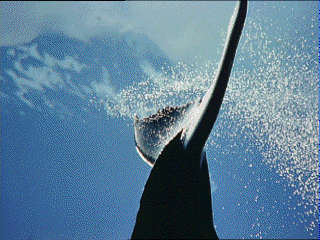
"Lobtailing" describes the forceful slapping of the flukes against the water, while most of the animal lies just under the surface; it also known as "tail-slapping". Lobtails may be repeated many times in a row. a superficially similar form of behavior is "peduncle-slapping", or "tail-breaching"; this involves throwing the rear portion of the body out of the body out of the water and slapping it sideways onto the surface, or on top of another whale.tail breaches are similar to normal breaches, but are tail-first instead of head-first; in some species, they are believed to be a form of aggression.
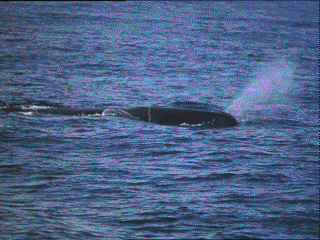
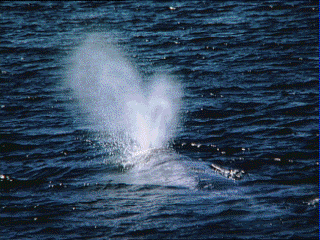
One of the best ways of locating large whales in a vast expanse of sea is by their breath. This is known as a "blow" or "spout". The term refers both to the act of breathing - an explosive exalation followed immediately by an inhalation - and to the cloud of water droplets produced above the animal's head when it breathes out.
The blow varies in height, shape, and visibility beween species and, especially on calm days, can be very distinctive; however, in wind and rain the water droplets disperse more rapidly and the shape of the blow is likely to change.
No-one really knows what makes a blow so visible. It probably includes water vapor that has condensed in the cold air, and a small amount of sea water that trapped in the blowhole, but it may also contain a fine spray of mucus from inside the whale's lungs. IN many smaller cetaceans, the blow is low and brief and, if it is visible at all, rarely has a distinctive shape.
Experienced whale watchers can tell one species of whale from aother, even from a considerable distance away, just by the character of the blow and with a breif glimpse of the animal's back.A right whale's blow consists of two separate columns of water vapour, e.g. while in Blue Whales and Fin Whales these merge to form a single spout. This low, bushy blow, which is leaning backwards slightly because of the wind, belongs to a Humpback Whale.
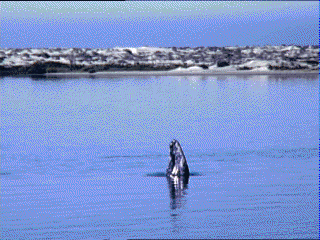
Many Cetaceans sporadically poke their heads above the surface of the water, perhaps to have a look around. Gray Whales, for exaple, slowly rise straight upwards, until their eyes are just visible, and then may turn in a small circle before slipping back below the surface.
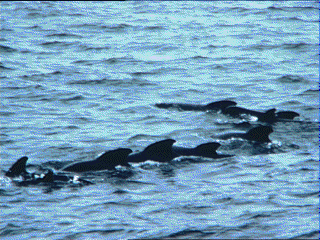
A group of Cetaceans like these Pilot Whales, may seen at the surface, floating motionless, and all facing in the same direction. This is known as "logging" and is a form of rest.