MATING
AND GIVING BIRTHMATING
AND GIVING BIRTH
MATING
AND GIVING BIRTHMATING
AND GIVING BIRTH
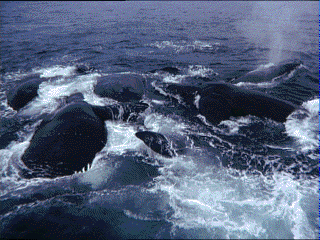
Only a few whale ~species~ have given up the secrets of their private lives when it comes to courtship and mating. Scientists have observed right whales, gray whales, killer whales and a few other species mating in the wild. Dolphins and killer whales in captivity have provided other opportunities to learn about this behavior.
Whale courtship usually begins with some kind of demonstration by males. At breeding time a number of males are ready to mate, and each one must try to convince the females that he is "Mr. Right." Males may slap at the water with flippers and flukes, ~breach~, roll in the water, and perform other attention-getting activities.
Some male behaviors also may be aimed at getting other whales to back off and give up. Males also fight among themselves, butting heads and whipping their competitors with flukes and flippers.
In some species--right whales, for instance--a number of whales may mate with one female. Mating is brief and occurs under water. The male who is last to mate will probably end up fathering the calf, since his sperm would likely force out the sperm of the previous mates. After the last mating, the female swims away. Among sperm whales, a single bull controls a number of females, and seems to have the exclusive right to mate with the members of this "harem."
The ~gestation~ period for whales differs among species. Toothed whale gestation lasts anywhere from 9-18 months, depending on the species. ~Baleen~ whales carry their calves between 10-14 months. Gray whales, for example, carry their calves almost 14 months, but may give birth only once every two years; fin whale mothers carry their young for 11-12 months, and may give birth every two to three years. The migrating species probably time their travels to arrive at the breeding grounds before the calves are born. Even if the mothers do give birth "on the road," they are not far from the breeding site.

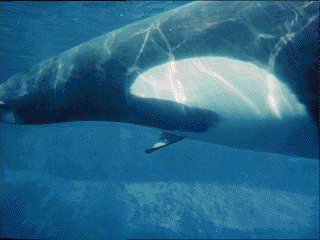
Whales usually give birth to a single calf after a ~gestation~ period ranging from 9-18 months, depending on the ~species~.
In this first picture, the mother is in labor--she is having the muscle contractions that are preparing her body to deliver the baby.This mother whale has been pregnant for 17 months, almost twice as long as a human mother.
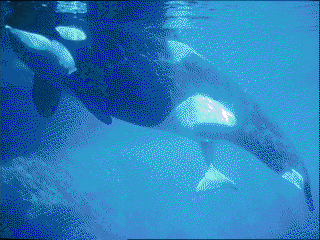
The baby killer whale, called a calf, is starting to be born. Its tail flukes appear first, sticking out from Bjossa's genital opening. Baby whales are usually born tail first,while humans and other ~mammals~ are usually born head first.
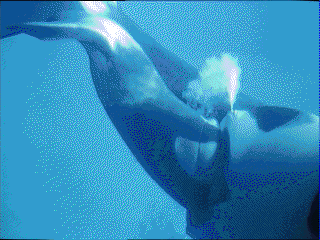
THe whale mother is pushing very hard to deliver the rest of her baby. She's pushing so hard, in fact, that milk squirts out from her mammary gland.

Congratulations. It's a girl! It's hard to tell from these murky pictures, but researchers at the aquarium soon found out that the baby was a 2-meter-long (6.6 ft.), 135 kg (298 lbs.) female. They gave her the name K'yosha.
Baby whales need to breathe immediately after birth, so the mother will help the calf reach the surface to get some air. Imagine the shock of leaving the warmth of the mother's body for the cold water of the tank.