 THE CHINESE
WHITE DOLPHINTHE CHINESE
WHITE DOLPHIN
THE CHINESE
WHITE DOLPHINTHE CHINESE
WHITE DOLPHIN
OUR LIMITED KNOWLEDGE AND THE NEED FOR INFORMATION

| SCIENTIFIC NAME | SOUSA CHINENSIS |
| LENGTH | 70 CM AT BIRTH, TO 3.0 M MAXIMUM |
| WEIGHT | MAXIMUM 285KG |
| PREFERED HABITAT | SHALLOW, SHELTERED WATER OFTEN NEAR ROCKY SHORES |
| PREFERED FOOD | SMALL FISH, SQUID, SHRIMP |
| FAMILY | 1 CALF EEVERY 3 YEARS, CHILDREN SEEM TO STAY WITH THEIR MOTHER UNTIL THEY ARE QUITE OLD. sOME OF THE OLDER OFFSPRING STAY AND HELP WITH THEIR YOUNGER BROTHER AND SISTER. |
| FEATURES | SHY AND GENERALLY UNDERMONSTRATIVE, POSITIVELY PINK IN ADULTHOOD, LONG NOSE AND WELL-DEFINED HEAD, BLACK EYE, SMALL DORSAL FIN. |
| TEETH | 116-152 TOTAL, SMALL AND SHARP, A LITTLE LIKE DOG'S TEETH BUT BIGGER! |
The first recording of the Chinese White Dolphin or Indo-pacific Hump-backed Dolphin, Sousa chinensis, appeared in a 17th Century publication, The Travel of Peter Mundy 1608-1667 who described 'porpoises' in the Pearl River estuary as being, "white as Milke, some of them Ruddy withal". No further literature appeared until Per Osbeck described them in 1751 in his Voyage to China as, "Snow white dolphin.....tumbled about the ship.....". A century later, Robert Swinehoe captured the first museum specimens in the Fuzhou River and 1,200km (750 miles) up the Yangtze at Hankou. Very little is known about this species and there continues to be debate regarding its taxonomic status, for example, whether it is the same species that occurs in the lower reaches of rivers along the east coast of Africa, the Indian sub-continent, Indonesia and Australia.
OUR LIMITED KNOWLEDGE AND THE NEED FOR INFORMATION
Information on abundance, population identity, range, biology and behaviour is urgently required for all these dolphins in order to assess the status and initiate conservation and management programs. Currently a study, initiated by WWF HK and the HK Marine Conservation Society, is being undertaken by two research students at The University of Hong Kong's Institute of Marine Science with funding from Hong Kong Government.The colour is variable and may be pink, white, grey or spotted with a light pink belly. The pectoral fins are small and rounded and the flukes are rounded and triangular. Animals from the Indian Ocean have a hump on the back below the triangular dorsal fin but those from the Pacific have\ an indistinct or absent hump. The beak is slender, long and low. Size ranges from 70cm at birth to 3m at maturity and calves are born throughout the year with a peak in the summer months.There were few records of these animals until WWF HK started to collate observations in 1990, when the location of Hong Kong's new airport at Chek Lap Kok was announced. Over this relatively short period, the vulnerability of these marine mammals has become apparent. One example of the effects of the development can be found in a particular group of 8 - 12 dolphins which were sighted on a regular basis to south of the Brothers Islands both during the day and night. Certain individuals could be recognized and identified as belonging to this same pod. Since the dredging and construction works began along the north Lantau coast and the leveling of the Brothers Islands is underway, this pod has disappeared.
The construction of Hong Kong's new airport at Chek Lap Kok and the additional Port Development, could cause a serious, if not total decline, in the population as a whole.
BLASTING- The site formation for the airport project involves blasting to a scale that could cause fatal damage to any dolphins in the immediate vicinity of the work. Damage to the lungs and subsequent internal bleeding resulting from transmitted shock waves, could be enough to kill outright. The sound of the blast itself may be enough to deafen a dolphin or interfere which its sonar capabilities, both of which would result in death.
SEWAGE POLLUTION- Another area of concern is the proposed sewage outfall for the airport and the new town of Tung Chung which will also receive sewage from Discovery Bay and the proposed container terminal port. Initially, sewage treatment will only be preliminary with grit removal only. No study has been undertaken to assess the effect of the chemical disinfectant, Racasan, which is used in aircraft toilets and will be dispersed directly into the marine environment. The risk of disease from swimming and feeding in such areas would presumably be similar to that of any other mammals including human.
LOSS OF HABITAT- Chinese White Dolphins typically feed in shallow coastal areas up to a depth rarely exceeding 10m. Extensive reclamation for the airport platform and North Lantau Expressway is physically removing these important areas forcing the dolphins to move further away, possibly towards new habitats unable to support them. Crustaceans, for example, are known to form part of the diet of these animals and an increase in sediment will threaten the food chain and in turn lower the amount of food available for the dolphins.
TOXIC AND DUMPING- Dredging in the area of West Kowloon reclamation has resulted in millions of tonnes of toxic mud needing a disposal site. Once again an important area for dolphins has been chosen to dump the waste. Huge pits have been formed and the toxic mud allowed to drop into them. Each remains open, and available to marine animals, until it is full when it is finally capped. More are scheduled to open to cope with increasing loads of contaminated mud. Animals feeding on the seabed form the base of a food chain and may eventually be consumed by dolphins along with the heavy metals and other pollutants accumulating in their bodies.Increased Shipping- Another possible complication is the increase in the number of vessels in the area off North Lantau once the PADS project has been completed, since dolphins rely on sonar for communication and spatial awareness, increased noise levels may cause confusion and much additional stress.
OVER-FISHING- A problem which is affecting fish stocks throughout the world but in Hong Kong there are no laws to limit the size of catches, nor restrictions on species captured. Fewer fish are being caught for human consumption which also means less are available for the dolphins. Reports from fishermen in the area are of dolphins feeding further out into Chinese waters and rarely visiting their previous grounds. One even broke a fishing net in March 1993, disregarding its fear of the fishermen in an attempt to satisfy its hunger.
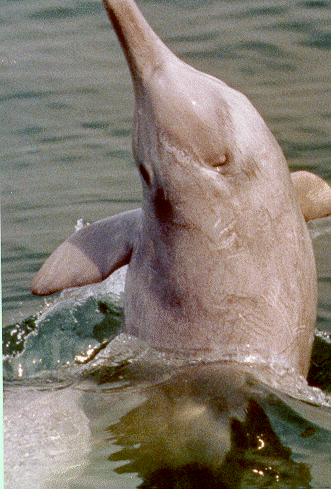
It's name is Moonshadow which i have adopted since June 1996 ( it was borned in 1994, the first year of SWIMS dolphin study in Hong Kong. )
WANT TO ADOPT CHINESE WHITE DOLPHINS YOURSELF?
CLICK THE BUTTON BELOW TO CHECK OUT THE INFORMATION IN WORLD WIDE FUND HONG KONG :




 BACK TO THE TOP