EVOLUTIONEVOLUTION

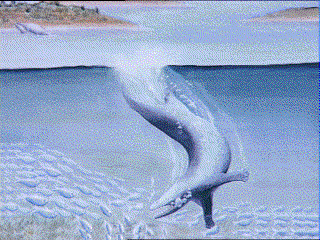
This is an artist's idea of what Pakicetus, the earliest whale known, might have looked like. Pakicetus means "Pakistan whale"; the creature was named after the country in which its bones were found.
Pakicetus lived some 50 million years ago, but it is similar in some ways to modern whales. Notice that it has a ~streamlined~ body and appears hairless. Its nostris sit not at the front of the ~snout~, but on top of the head. It doesn't have arms and legs, only paddle-like limbs, and many sharp teeth like the toothed whales of our time.
What is the story of this strange creature? Look at the picture closely. You'll see a Pakicetus mother and baby on land, headed into the water. These archaeocetes ("ancient whales") still lived part of the time on land, where they were born, but headed to the water to eat. They had very little competition for food in the shallow sea s of 50 million years ago.
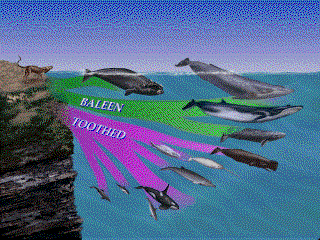
You are looking at a diagram of the family tree of modern whales. At the far left is a furred animal that looks something like a wolf. How did that creature get there? Where is Pakicetus?
The furry creature at left is included because most experts agree that it is a good representation of the ancestor of both Pakicetus AND modern whales. Whale ancestors started out as furry land ~mammals~, known by the group name to which such animals belong--mesonychid.
Though it probably looked similar to a wolf and had the sharp teeth of a meat eater, the mesonychid had hoof-like feet, not furry paws. Feet are a very important distinguishing feature in the world of animal classification. The mesonychid's "hooves" put it clearly in the same group as pigs, cows, sheep, deer and other hoofed mammals. The whales' land-based ancestor, amazingly, is also Bambi's distant cousin!
Mesonychids lived along the seashores during the Paleocene era, some 60 million years ago, shortly after the dinosaurs mysteriously disappeared. Some scientists think that mesonychids took advantage both of the abundant food in the shallow seas during the Paleocene era, and of the lack of competition. By then, the ichthyosaur, or fish dinosaur, had disappeared, so mesonychids started hunting in the shallow seas. Gradually, over millions of years, mesonychids adapted to a lifestyle that was at least partly spent in water. That's where Pakicetus comes in.
If mesonychids and archaeocetes were long gone before the appearance of modern mammals--including modern whales and humans--how do we know all these things?
Actually, all we have are ~fossil~ bones discovered in places that were once under water. The entire painting of Pakicetus, the first picture in this section (you may want to turn a few sections back to "How whales evolved"), is based on incomplete, broken bones of the skull, including a few teeth. Everything besides the skull is an artist's recreation, based on the best suggestions of scientists.
That's the way things go in paleontology--the study of ancient life through the fossil record. Only rarely do ~paleontologists~ find an entire specimen of something. Usually they just have to make do with a few bones, pieced together with lots of educated guesswork.
Evolution doesn't happen overnight. It took millions of years for land ~mammals~ to develop all the adaptations that led to full-fledged whales. Air and water are such different environments that to be fully adapted to one makes it difficult, if not impossible, to survive in the other. While whales are mammals, they exhibit many common ~mammal~ traits in a unique way. They also have develop other characteristics that are unique to whales.
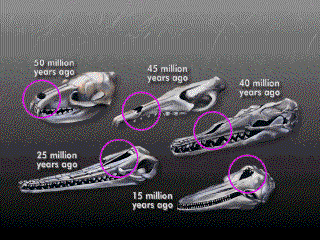
Of all the kinds of bones that survive as ~fossils~ over millions of years, skulls and skull parts are among the most numerous. They can also tell us a lot about the animal of which they were a part. These five whale skulls tell a fairly complete story about the lives of ancient whales. Let's look for the clues.
First check out the teeth. Those belonging to the first skull, that of a mesonychid, are not much different than those of a modern meat-eating animal. There are sharp ~incisors~ for biting and ripping meat, and blunter teeth in the back for chewing. As you look at the next four skulls, notice how the teeth change. Over millions of years they become uniform in shape and size, and more numerous. This suggests that the diet has changed to one of fish and squid, which are caught with the teeth, given a quick chomp or two, and then swallowed.
Next, look at the shape of the jaw, which changes with the shape of the teeth, becoming more narrow and beaklike. This also was probably a response to a change in diet.
Finally, notice that over millions of years the whale's nostril, or blowhole, travels from the front of the ~snout~ to the top of the head. By the time the blowhole reaches the position it's in today, we can guess that the animal is probably spending most, if not all, of its time in the water.
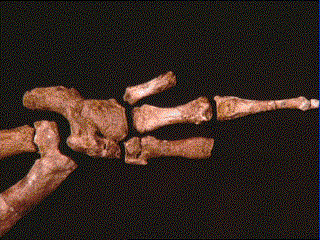
Though they may look like the bones of your hand, these are the "finger" bones of an ancient whale, the Basilosaurus.
Anyone familiar with dinosaurs will probably notice that this ancient whale has a dinosaur name, meaning "king lizard." The name was given more than one hundred years ago when the first Basilosaurus bones found were mistaken for those of a reptile.
Yet the Basilosaurus, which lived some 40 million years ago, was a descendent of Pakicetus. Scientists found that the Basilosaurus not only had fingers, but toes--and a foot and leg to go with them! This discovery changed a lot of experts' minds about the earlier Pakicetus. Now scientists think that the Pakicetus also had legs--short ones that probably weren't any use on land.
Today's whales still have hand-like bones inside their flippers. Some also have the tiniest remains of the hind legs, though these don't show on the outside of the body.
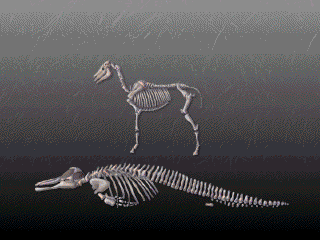
Evolution doesn't happen overnight. It took millions of years for land ~mammals~ to develop all the adaptations that led to full-fledged whales. Air and water are such different environments that to be fully adapted to one makes it difficult, if not imposible, to survive in the other. While whales are mammals, they exhibit many common ~mammal~ traits in a unique way. They also have developed other characteristics that are unique to whales.
There's no doubt about it, whales and horses do look different. Hardly anyone would confuse the two, although they're distant cousins. But horses are adapted to life on land. Their long, strong legs support a heavy body during running and walking. On the other hand, whales don't have a leg to stand on. Anything that would dangle from the body would be a hindrance to swimming, the whale's primary way of getting around. Supported by water, whales can grow to immense size, a feat that land-bound walkers can't match. Over time, whales have kept all their basic mammalian features, but all of these have been modified in ways that adapt to life in the water.
Like other ~mammals~, whales breathe air. Most modern whales don't come onto land, except in the most unusual circumstances, but they continue to breathe air. Therefore, they must come to the surface of the water periodically to renew their suppl y of oxygen. Whales breathe through a blowhole on the top of the head. When they exhale, a ~spout~ of water vapor emerges from the blowhole. When whales dive back into the sea, the strong muscles around the blowhole relax and close it off, so that water cannot enter the lungs.
Like other mammals, whales have hair. Few adult whales have hair on their bodies; those that do, have only a few bristles around the mouth or elsewhere on the head. Yet most whales have hair at some time during fetal development, losing most of it before birth.
Like other mammals, whales bear live young and nurse their offspring. Baby whales are born alive directly from their mothers' bodies, usually tail first. Their first task is to get to the surface to take a breath, then they nurse.
Whales nurse their calves from the mammary slits on their bellies; each slit protects a nipple. Lacking real lips, the calf does not suck; instead, the mother squirts milk into its mouth.