WHAT IS CETACEA?WHAT IS CETACEA?
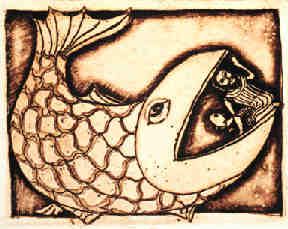
The picture above shows the earliest document about cetacean. The big fish commanded by God to swallow Jonah in must be a whale. ( Old Testament, Book Jonah).
In the West, dolphins are seen as friendly and intelligent animals. There are many tales of dolphins rescuing drowning people or helping fishermen. The hunter Orion made his way into the heavens riding a dolphin. In ancient Greece, killing a dolphin was held to be as serious as offense as killing a man. And in the French royal court, the heir to the throne was honored with the name "Dauphin"(dolphin).
Im the Orioent, in ancient records,the early Chinese personified the dolphin, depicting it as a lively creature. Moreover, thse records clearly state thatdolphin meat is not suitable for eating. In a Chinese tale, a man named Bo Ya is playing the zither, hoping in vain for an appreciative audience, unntil a dolphin comes along who hears and understands his music. Also, dolphins were said to appear to warn people of impending disaster.
According to another legend, reported in the Shu Yi Ji (Records of the Strange),the dolphin is the transformation of a woman, surnamed Yang, who was drowned by her mother-in-law. Thus it a also carries the name "lazy daughter-in-law fish ." Pirhaps the dolphin's large amount of body fat is reminiscent of a daughter-in-law who is not hard-working enough! Because Chinese found dolphin fat "repellent," they sid that only "barbarians" would eat dolphin. Chinese only used the kolphen to get oil for lamps or for mixing with lime to repair boats.

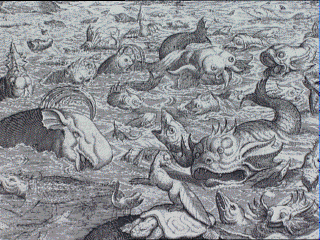
People who lived two hundred, or one hundred, or even 50 years ago, would not have had such an easy job of painting a whale. Although they might have found some information about whales, it might not have been accurate. Back then, people just didn't know as much about whales as we do now. In fact, not too long ago many people had some very strange ideas about whales. Sailors, even early whalers, had many misconceptions--wrong ideas--about whales. People viewed the great whales, with their tremendous strength and power, as sea monsters that could swallow up whole b oats, together with their crews. Artists who heard these tales created drawings and paintings like the one shown in the second image. You can't really blame these people for their ideas. They didn't have cameras to take pictures of what they saw, or modern boats with special instruments for studying the sea. Often, they had only brief, unclear, glimpses of creatures they never saw before, fuzzy memories--and very active imaginations.
IN every ocean of the world, and in a few rivers , are found whales, dolphins and porpoises --- the cetaceans, from the Latin 'cetus' (a large sea animal) and the Greek 'ketos' (sea monster).
Cetacea is an order that comprises the one extint (Archaeoceti) and two extant (Odontoceti and Mysticeti) suborders of whales. There are about 85 living species of whale in the seas of the world. some of them areso rare that no living examples have ever been seen. Most whales are Odontocetes.
Odontoceti, toothed whales is a suborder of marine mammals that comprises ancestral forms, known from the Upper Ecocene, and the four super-families : Squalodontoidea (extinct forms), Platanistodea (river dolphins), Physeteroidea (large whales), and Delphinoidea (smaller whales, dolphins and porpoises).
Mystceti, baleen whale is a suborder of marine mammals that comprises three families : Eschrichtiidae, Balaenidae, and Balaenopteridae of baleen whales.
Cetacea are mammals, and this means that unlike fish they breathe air, and their young are born alive and fully formed, and are suckled on their mother's milk. Whales come in a wide variety. They may be as small as a dolphin or as huge as the blue whale, the largest animal that ever lived on Earth. Most live in oceans and feed in the polar seas, while others have adapted to the warm, fresh waters of forest rivers.
The earliest whales (Archaeoceti) are known from Eocene rocks, especially in Africa.Of the two existing groups of whales, the Odontoceti (toothed whales) can be traced back to ancestral forms in the Upper Eocene, while first Mysticeti (baleen whales) occur in Oligocene strata.