| Home Cages |
Care, when dealing with the housing of your budgie, needs to be taken as good housing can provide mental as well as physical stimulation. The minimum cage size for a single bird should be 31 cm long by 31 cm high by 36 cm wide. Budgies fly back and forth not up and down, so cylindrical cages are not the best, nor are bamboo, for all that they look good, budgies love to chew and they would chew through the bamboo. The minimum cage size for a breeding pair should be 46 cm long by 31 cm high by 36 cm wide. The perches should be positioned such that the tail of the budgie sitting at the top perch does not touch the perch below it. Perches should also be covered with a perch cover (sand paper). These aid in keeping the toenails short and also gives the budgie something to chew on every now and then. Baths (especially ones with mirrors in the base) in the bottom of the cage can be lots of fun in summer (or lacking that a plant sprayer, that has never held chemicals, can be used to spray water on them during the height of the heat). Bathing encourages preening. Mirrors are almost a must for budgies, especially ones that are on their own. When you're out it gives them something to talk to. Bells can also be great fun and budgies can learn to ring their bells when they want something (but make sure that the clapper of the bell is securely fastened or the budgie will chew it off and try to eat it).
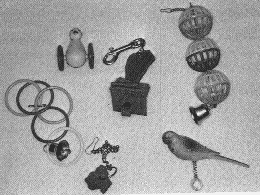
In the picture you can see some of the many toys available for budgies, you do, however, need to take care that you don't overcrowd the cage with toys. The paper on the bottom of the cage should be removed at least once a week, if not more often. The cage and all parts should be washed once a month to ensure that there is no illness developing. The parts should be allowed to dry well before returning the birds to the cage. If necessary have a second cage into which you place the birds while washing their cage, or release them into the room for a bit of exercise. Also, during this monthly clean, when you reassemble the cage, rearrange the placing of perches and/or toys, this also provide stimulation for your budgie. The size of an aviary depends on the number of birds you intend to keep. There should be approximately 1.5 ft3 per bird (45cm3 per bird). There should be an indoors and an outdoors section to the aviary (if it is outside). There should be enough perches (inside and outside) to allow all the birds to perch and flap their wings. This will reduce fighting over perching space. The best kind of door to an aviary is what is known as a safety door. This is in fact two doors with some space in between. It allows you to open the outside door, enter the space and then close the door before opening the door into the aviary. This prevents birds from escaping. The aviary should be checked regularly for holes where the budgies can escape. The netting used should be strong enough to hold the weight of the birds and the gaps between the strands of wire should be small enough so that budgies can't get their heads stuck between them. There should not be any grass growing in the bottom of the aviary, because this will become soiled by the birds and then eaten. Nor should there be a tree in the aviary. The best way to make it easy to clean the aviary is to have a concrete bottom, which is then covered with washed sand. The sand enhances the appearance and makes cleaning easier. The floor of the aviary should be cleaned weekly. Never use a disinfectant that can be harmful to the birds. Careful thought needs to go into deciding where to place your birds. When introducing a new member into the household, there will be a lot of curiosity, mainly from young children, dogs and cats. Children can shake the base of a stand and cats can get onto just about anything (even though they can be taught not to go after the bird, that will take time and you do have to catch them in the act of eyeing the budgie) so the best place to put your budgie is to hang it from the ceiling. If the ceiling too high to be able to see the budgie from the ground, then a piece of colourful rope can be attractive and serve to lower the budgie. The budgie will also need stimulation so the best place to put it would be in a room where you are often for instance the TV room or kitchen etc. When deciding where to put an aviary, you need to take into consideration night fright. Night fright is a condition that can strike the aviary at anytime. As the name suggests it happens at night once the birds have settled down for the night. Something will spark it, a dog barking, lights from a car, and the entire aviary will go into panic. This can be dangerous and in some cases deadly. You need to consider what surrounds your house. If your neighbour has a dog, then placing the aviary near that neighbour would not be advisable, because the dog would frighten the birds etc. They also need to be somewhere where you can see them easily. |