
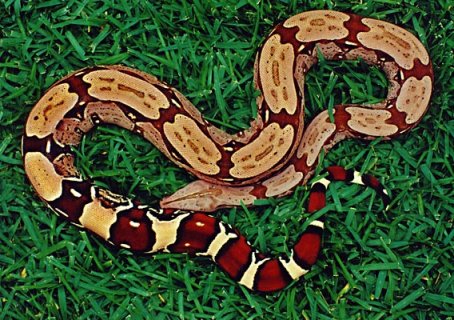
While some of the Boas sold today are true red-tailed Boas, Boa c. constrictor, most are actually a subspecies of Boa constrictor, Boa c. imperator, from Columbia, Mexico, and countries throughout Central America.
Boas have a lifespan average of 20-30 years, with the record being over 40 years old. They have the ability, if properly cared for, to be a wonderful pet for a good part of your life.
MOST seem to enjoy being handled and will rarely bite. I would recommend getting a captive bred specimen as opposed to one caught in the wild. Among other things, captive bred snakes are less likely to bite as they are more used to being handled
In the wild, boas range from areas in Mexico and Central America, all the way down to areas in South America such as Columbia and Brazil, living anywhere from the high cloud forests to the dry low lands. Boas are mainly crepuscular, (active at dawn and dusk), but some boas tend to be nocturnal, (active at night).
One thing that should be included in your snake's enclosure is a hide box. For this, you can use anything from a half log, which you can buy at any pet store, to a cardboard box with a hole cut in it. Without somewhere to hide, your boa can become stressed. Another must is a water dish. The dish should be big enough and deep enough for your snake to fit it's entire body in. Boas often defecate in thier water dish so it is important to check it daily and change it as needed as they need to drink from this same water.
For substrate, you can use anything from carpeting to old newspapers.
I used to use a product called "BONE AID Calci-Sand", made by a company called "T-REX". It is a fine granular sand made from calcium carbonate. It is designed to be digestable if your snake should swallow it. It conducts heat well and does not harbor mites nor the growth of molds and fungus. It is available in a variety of colors and makes spot cleaning very easy as it clumps readily to wet waste material, making it easy to remove. I have now switched to astroturf...Not as pretty, but it is cheaper than replacing the sand as it gets soiled.
I would definately stay away from cedar chips...as they can be deadly to your snake if swallowed. I would also steer clear of substrate made from recycled paper as it can may contain ink or chemical contaminants.
As far as temperature control goes, during the day, the temperature should range from 85-90 degrees F. This varies according to who you talk to, (my boa seems comfortable at around 82-85 degrees F), but most will agree that at night, the temperature should drop to around 75-80 degrees F. The temperature should not be allowed to stay below 70 degrees F for any length of time. Snakes are cold blooded, meaning they use the outside temperature to regulate thier body temperature. A warm climate is essential for good digestion of food, and if it is too cold, your snake might not want to feed
Boas also need to be maitained at a fairly high humidity. Somewhere around 60% humidity should be sufficient. If the humidity is too low it can dry out your snake, causing among other things, very bad sheds.
Another point to go along with feeding that I have found to be useful is this. Try to feed your snakes somewhere other than in their enclosure. There are two reasons for this...1)If you feed the snake in his enclosure, it will asscociate the opening of the cage, with feeding time. This can be a bad thing when you just want to reach in and pick the snake up. It may mistake your hand for food and strike. 2)Feeding your snake inside it's enclosure can also cause it to inadvertantly swallow some of it's substrate while it feeds, which is not good for it and can cause many problems...from mouth rot, to impaction, even death. For these reasons, I feed my snakes in a big cardboard box lined with newspaper.
If you have gotten to the point that you are satisfied that the snake will eat...The next step is to closely inspect the snake...BEFORE YOU PURCHASE IT!!! (There is nothing worse than getting an animal home and finding out the hard way that there was something wrong with it.) Ask to hold the snake. A healthy snake will have clear firm skin and clear eyes (no wrinkles or dry skin over the eyes.) The snake should be fairly active. It should be alert to it's surroundings and should actively flick it's tongue every few seconds. It should also grip you firmly, but gently as it moves around. You also do not want to purchase a snake that is overly aggressive.(This could be a sign of a wild caught snake.) A snake that repeatedly tries to strike when you get near it is not an ideal pet. Although, if you have the patience and nerve to keep handling an aggressive snake, it eventually will learn to trust you and stop striking...It is not something I would recomend...especially to a beginner. It is better to steer away from snakes that are too shy or too aggressive.
Closely inspect the snake for any visible sores or infections. The snakes mouth should be clean and have a pinkish (Not Red) color and should be free of any mucus. Stay away from any snake that has sores in it's mouth. Check the anal scale (vent), ensure there is no crusty material or smears of diarrhea as this can be a sign of an unhealthy snake. You will also want to closely inspect the snake for ticks and mites. Mites are tiny little bugs that feast on your snakes blood. They can be hard to see sometimes so look closely. Most adult mites are no bigger than the period at the end of this sentance. Mites usually gather around a snake's eyes and mouth.
If your snake passes all of these inspections, you have probably chosen a healthy snake...But do not be happy with just that...It is a good idea to take any and every recently purchased animal to a vet as soon as possible. An experienced vet may be able to find things that might have been overlooked, and will be able to test for internal parasites, which wont know about until the snake does get sick.
If you are smart when selecting your snake and give it proper care and love, you will no doubt enjoy many years of company with your new Boa, and your snake will thank you for it.

This page hosted by
 �
Get your own Free Home Page
�
Get your own Free Home Page