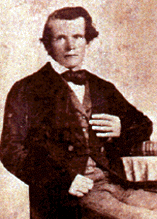
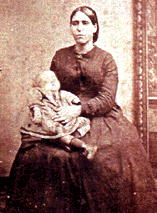
Looking back at the men who fought in the War
Between the States, and their women who kept the homefires
burning, from our present day perspective often causes us to
overlook certain things. Things that we take for granted,
but which in 1862-1865, were very extraordinary.
For example, world travel.
This is the story of one of those Confederate soldiers.
He was not born here, and he got here by going "the long
'way around", via England and Australia. The story of his
arrival and subsequent participation in the war, and the
picture that develops of his character, is a fascinating
one!
John Fearn was born in England about 1826 or 1827. The
Fearn family was well-known and well-respected, having made
a name for themselves in the cutlery industry.
England in the early 19th Century was crowded, and people
often lived in squalor. Every opportunity was taken to
lessen the population by removing as many as possible.
Records exist that show that in 1841, a John Fearn was tried
and convicted. The charge: Receiving stolen goods and not
knowing; Sentence: 15 years in Van Diemen's Land (now
Tasmania), Australia.
The first inkling of John's character appears here. When
he arrived in Australia, he went by the name of John
Francis, so as not to bring disgrace upon the family back in
England. Most of the convicts who were transported to
Australia gave no thought to what effect their actions may
have had on other family members. It mattered to John.
The records from that time period indicate that John
worked on Rocky Creek Convict Station, in northern Van
Diemen's Land, a base for convicts sent to clear land for
the Van Diemens Land Company. After seven years service, he
was given a conditional pardon for good behavior. In July,
1852, John married Ellen Malley, a native of Tasmania, at
St. James Old Cathedral in Melbourne, Victoria, Australia.
Some time was spent on the goldfields in Victoria, which
were then very reminiscent of the California gold rush of
1849. While in the goldfields, he met some American
prospectors whose advice to him was to go to Louisiana and
grow cotton or sugar.
The exact date of John & Ellen's arrival in America
is unknown, but some clues exist. John Francis purchased two
acres of land in Mansfield, Louisiana, on 21 September 1857.
The property was located on Crosby Street, just off the
Mansfield-Natchitoches Road. The 1860 Census of DeSoto
Parish shows they had 4-yr-old Eliza and 1-yr-old Mary, both
born in Louisiana. We can safely assume they were here by
1856.
When the call went out for men to volunteer for military
service, John was one of the first. He enlisted as a private
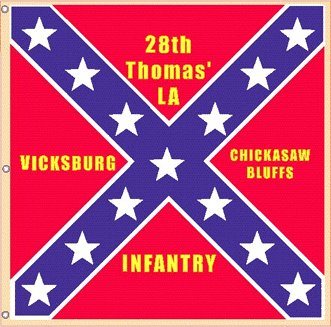
on 29 March 1862, in New Orleans, a member of the 28th
(Thomas') Louisiana Infantry Regiment, Company B. John &
Ellen's third child, William, was born shortly after John
enlisted. Muster roll records reveal John was a nurse on
daily duty in the camp hospital.
At one time during September and October of 1863, he was
shown as "Absent with leave. Sent home for clothing for
company." Probably part of a detail sent for the
uniforms/clothing. More facets of his character emerge; he
was honest, he could be trusted, he was reliable. His
superiors would not have allowed any man to go home, for any
reason, if they did not think he would return. And they knew
he could be counted on to procure the clothing they needed.
The history of this unit has been so very ably documented
elsewhere on this web site. The main participation of this
company was the Battle of Chickasaw Bluffs/Bayou, and the
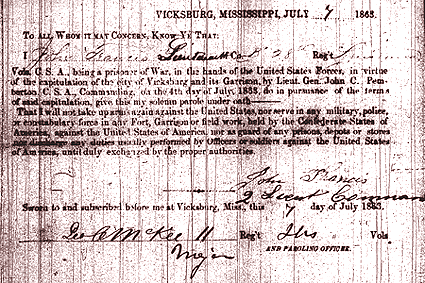
Siege of Vicksburg. A copy of John Francis' parole document
shows him to be a 2nd Lieutenant.
When the spring of 1864 arrived, John was at home in
Mansfield. The approach of the Union Army from the south,
the infamous Red River Campaign, brought out every
able-bodied man in the town. The Battle of Mansfield
occurred on the Moss Plantation, which was three miles from
John's property on Crosby Street. It is very likely that any
experienced soldier, especially one who had withstood the
Siege of Vicksburg, would not have hesitated to defend his
home and family from the enemy at his very door.
We know John's prior military service was as a nurse in
the camp hospital. It would have been very unlike him not to
have done the same here. We may never know whether John
Francis died carrying a weapon in the battle, or if he was
killed tending the wounded. Our research is still ongoing.
When we discover the facts surrounding John Fearn Francis'
death, we will post them here.
No records are found for John Francis after the Battle of
Mansfield, 8 April 1864. It is assumed from other details
that he was killed at that battle. The numerous unmarked
graves of Confederate soldiers attest to the magnitude of
that fight. To our knowledge, John was not an "official"
member of any unit at that time. Was he considered a
civilian, not a soldier? Ellen may have known where he was
buried. She may even have found him after the battle, and
made the arrangements herself. The knowledge of his burial
place may have gone with her.(1)
After the surrender, the new government required that
tutors (guardians) be appointed for children of deceased
soldiers. Ellen Francis and W.S. Donaldson were appointed
tutors for John's three children - Anola Mary, William, and
John. (John Thomas was born 10 January 1865. His father
never knew about him.) Somewhere between 1860 and 1865, the
oldest child shown for them on the 1860 census had died.
Ellen Francis sold the property on Crosby Street in
November 1865. She and the children are found on the Ship's
Passenger List for the Great Britain, which departed from
Liverpool, England, in February, 1866, and arrived in
Melbourne, Victoria, Australia, in March, 1866.
And their last name is given as Fearn. Evidently she had
gone from Louisiana to England where John's family lived. We
can only speculate as to what transpired then. Did she go
just to tell them of John's last days, and to let them see
his children before she returned to her homeland?
Or did she hope to be able to stay there so the children
would grow up in their father's home, only to be rejected by
his family? We may never know.
Can you imagine what it must have been like to have to
cope with three young children, one of them only an infant,
on an ocean voyage of over four weeks duration, and to have
to do it alone? We take world travel today with so little
thought, and accomplish it in a fraction of the time. And
she did it twice -- from Louisiana to England, then from
England to Australia.
After returning to Australia, Ellen met and married
Alexander Wannan. John's three children took on the name
Fearn-Wannan, which their descendants bear to this day.
This family came to Louisiana, left their mark on our
history, and then left our shores. They were here 10 years
at the most, and half of that was the most terrible we've
ever known. It would be so easy for their story to be lost,
as there is no one here to keep their memory alive.
But we must not let their story go untold, or countless
others like them. John Fearn Francis died for the heritage
that is ours. His family had to go on without him. And we,
the descendants of the men with whom he fought, are richer
for the price he paid.
I have had the good fortune to become acquainted with Mr.
William Fearn-Wannan, now in his 85th year, a resident of
Victoria, Australia. He is the grandson, and namesake, of
John & Ellen's son, William (the baby in the photo with
Ellen above). My life has been greatly blessed by knowing
him.
(1) Special notation
regarding the practice of burial site locations...The
federal troops were invading many parts of Louisiana...and
even though the forces of General Taylor had pushed the
forces of General Banks back downriver on his failed Red
River Campaign, it was still a time of terror for the
civilians and men left to protect the families, farms,
towns, etc. It was a common practice to bury your dead
soldier without ANY grave marker. The reason being, often --
when federal soldiers came upon burial sites of MARKED
Confederate dead, usually the desecration of the grave was
done as an additional insult to the family of the soldier.
It was also a fairly common practice to place the name
and unit of a FEDERAL soldier on the marker of a fallen
Confederate soldier, in order to prevent this. The truth was
known usually only to the family (if the family buried the
soldier) or would have been passed on to the family by the
people handling the burial details. This practice was
documented by the folks in southwest Louisiana, for this
desecration was done as a common practice. Also burial sites
of the Confederate dead was usually carried out by the
family at a desolate spot, so invading federal soldiers
could not find the site. So it would stand to reason, that
this was not uncommon among the folks of that time." --
J. Richard, 28th Thomas' Regiment Louisiana Infantry.
The John Fearn Francis biography was written by a dear
and spiritually close family friend of the Great grandson of
the late John Fearn Francis---Mr. William Fearn-Wannan.
Without this kind lady's tireless dedication and
perservance, this new page dedicated to the Veterans of the
28th Thomas' Regiment Louisiana Infantry (Volunteers) could
not have been written. We, at the 28th Thomas' Regiment web
site owe a debt of gratitude to a very gracious lady---
Full credit for the above biography of
John Fearn Francis is graciously extended to:
Alice Y. Holtin, great-great-granddaughter of
Eli Arnold, 4th Alabama Cavalry, Co. M., C.S.A.

[email protected]
The above biography of John Fearn Francis relies
extensively on materials contained within the "Fearn Family
History -- A Snyopsis" compiled by Alan Daley & Howard
Fearn-Wannan, November 1995 and exerpts used in the John
Fearn Francis biography are used with the kind permission of
the Fearn-Wannan family.



 Get Your Own Free Home Page