
FLAG HISTORY
Under a government contract our country's first flag was made by Mary Pickersgill a professional flagmaker.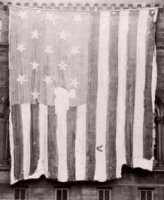 She was assisted by her daughter, two nieces, and her mother who was also a flagmaker. The 30 x 42 foot flag was laid out and assembled on the floor of a neighboring brewery. English woolen bunting was used for the stripes and the union and cotton for the stars. Each star was about two feet across. It was a garrison flag that was flown over Fort McHenry in Baltimore MD.
After the British attack on Fort McHenry in 1814, it became a valued keepsake, and remained in the family of the fort's commander Maj. George Armistead, for 90 years. Francis Scott Key's song was known by most Americans by the end of the Civil War, but the flag that inspired it remained unknown outside of the city of Baltimore until the 1870s. The increasing popularity of Key's anthem and American's developing sense of national heritage transformed the flag from a family keepsake into a national treasure. During the years that the flag remained in the Armistead family it was occasionally flown at patriotic gatherings in Baltimore. In 1880 Eben Appleton (George's Grandson) permitted the flag to go to Baltimore for their sesquicentennial (150th) celebration. After that his concern for the flag's deteriorating condition led him to keep it in a safe deposit vault. In 1907 he lent the flag to the Smithsonian Institution, and in 1912 he converted the loan to a gift. When the flag arrived at the Smithsonian it was hung on the exterior wall of the Smithsonian Institution Building. Newspaper men wanted a photograph of it to publish in the various local papers. Its presence in the Museum caused a huge wave of patriotism. Since coming to the Smithsonian the flag has been a reminder of the ideals represented by the American flag and the need to preserve these ideals. One of the mysteries facing historians about the flag is why it was altered. In researching correspondence from the Armistead family it is found that certain people were granted the privilege of cutting fragments from the fly edge of the flag as souvenirs. The missing star was cut out by Louisa Armistead (George's Wife), and was present to an official person. And the red chevron on the white stripe is an A for Armistead. During the restoration to the flag in 1914 Georgiana Armistead Appleton's (George"s Daughter) signature dated June 24, 1876 was found on one of the fifteen stars. Part of the inscription above her signature is cut away. It is believed that she planned to donate the flag to a museum but later changed her mind. In 1994 Museum officials realized that the flag had weakened and needed more restoration and preservation to remain on display. The flag was removed from Flag Hall in December 1998, and in June 1999 a three year restoration project began on the flag. She was assisted by her daughter, two nieces, and her mother who was also a flagmaker. The 30 x 42 foot flag was laid out and assembled on the floor of a neighboring brewery. English woolen bunting was used for the stripes and the union and cotton for the stars. Each star was about two feet across. It was a garrison flag that was flown over Fort McHenry in Baltimore MD.
After the British attack on Fort McHenry in 1814, it became a valued keepsake, and remained in the family of the fort's commander Maj. George Armistead, for 90 years. Francis Scott Key's song was known by most Americans by the end of the Civil War, but the flag that inspired it remained unknown outside of the city of Baltimore until the 1870s. The increasing popularity of Key's anthem and American's developing sense of national heritage transformed the flag from a family keepsake into a national treasure. During the years that the flag remained in the Armistead family it was occasionally flown at patriotic gatherings in Baltimore. In 1880 Eben Appleton (George's Grandson) permitted the flag to go to Baltimore for their sesquicentennial (150th) celebration. After that his concern for the flag's deteriorating condition led him to keep it in a safe deposit vault. In 1907 he lent the flag to the Smithsonian Institution, and in 1912 he converted the loan to a gift. When the flag arrived at the Smithsonian it was hung on the exterior wall of the Smithsonian Institution Building. Newspaper men wanted a photograph of it to publish in the various local papers. Its presence in the Museum caused a huge wave of patriotism. Since coming to the Smithsonian the flag has been a reminder of the ideals represented by the American flag and the need to preserve these ideals. One of the mysteries facing historians about the flag is why it was altered. In researching correspondence from the Armistead family it is found that certain people were granted the privilege of cutting fragments from the fly edge of the flag as souvenirs. The missing star was cut out by Louisa Armistead (George's Wife), and was present to an official person. And the red chevron on the white stripe is an A for Armistead. During the restoration to the flag in 1914 Georgiana Armistead Appleton's (George"s Daughter) signature dated June 24, 1876 was found on one of the fifteen stars. Part of the inscription above her signature is cut away. It is believed that she planned to donate the flag to a museum but later changed her mind. In 1994 Museum officials realized that the flag had weakened and needed more restoration and preservation to remain on display. The flag was removed from Flag Hall in December 1998, and in June 1999 a three year restoration project began on the flag. |