
Northrop F-5
The Early days
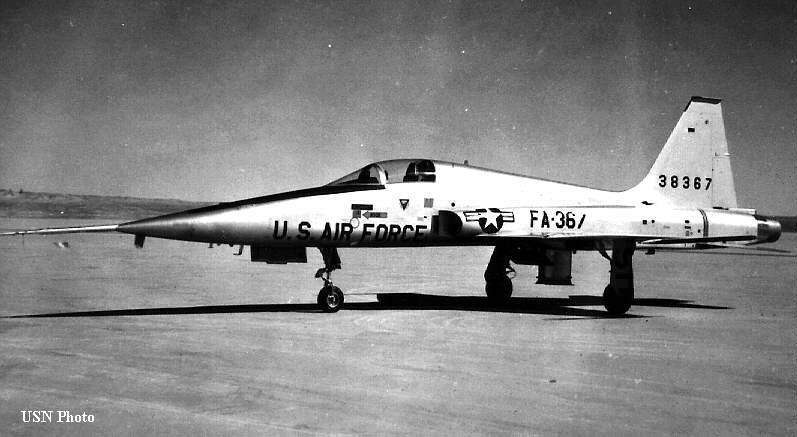
YF5 – Early Prototype
Northrop F-5 is a supersonic fighter, equipped with two jet turbines whose development dates back to the middle of the 1950 decade. At that time, US Air Force pilots, based on combat experiences against Soviet MiG-15s in the Korea War, wanted lighter airplanes, better maneuvered and with better fire capacity. For instance, the six machine guns of 12,7mm that equipped North American F-86 Sabre were not enough to kill MiG-15, which had, for the time, a cannon of 37mm or two of 23mm!
In 1955, a team of Northrop engineers led by Welko Gesich projected a light fighter jet, under the designation N-156 , known as " Tally-Ho ". Seven different versions were proposed, including one to operate in aircraft carrier. N-156 was one of the first airplanes to use the concept of area rule, in order to allow a better supersonic behavior; this led to smaller fuselage width at the insert of the wings, which were also quite thin, thus reducing the effects of drag.
The first variant acquired by USAF was the training version, N-156T, which was chosen to substitute Lockheed T-33 Thunderbird then in service. Upon receiving the designation T-38 Talon, it became the USAF standard supersonic trainer, being still in service today.
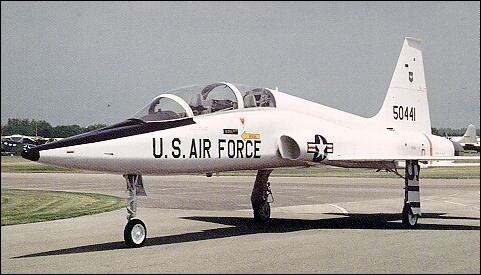
T-38 Talon – a training variant from the F5
The F-5 is also used by NASA, as a trainer and chase plane during the flights of experimental aircrafts, such as the Space Shuttle .
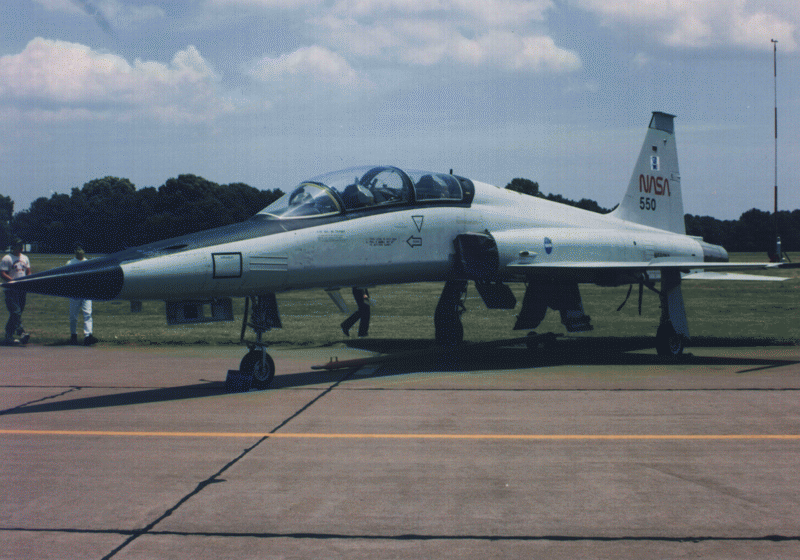
F5F on NASA duty