
Northrop F-5
The A/B versions
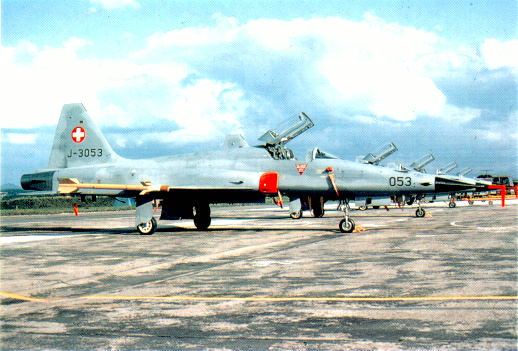
Swiss air force
The fighter version, N-156F, didn't attract the interest of USAF, but was selected by the U.S. Department of Defense to become the standard fighter airplane of the program of military assistance to friendly nations (" Military Assistance Program "). The first flight of N-156F was accomplished in July 30, 1959 and the first series copy, denominated F-5 Freedom Fighter, rose to the air in October of 1963.
Two basic versions were built: a monoplace fighter , F-5A, equipped with two Pontiac M-39A2 20mm cannons in the nose and two heat guided missiles AIM-9 Sidewinder installed at the tips of the wings; and a training one, F-5B, a biplace without armament and usually equipped with two tanks of fuel – which looked like bombshells at the tips of the wings. Another version was a reconaissance, RF-5A, without cannons, with a group of oblique and vertical cameras installed in the nose.
Northrop built 815 F-5As, 290 F-5Bs and 106 RF-5As. Besides those, Canadair produced 115 CF-5A/Bs for use by the Canadian armed forces and another 102 in association with the Dutch Fokker, designated NF-5A/B which equipped the air forces of Holland and Norway. The Spanish CASA also produced 70 SF-5A/Bs for the air force of Spain.
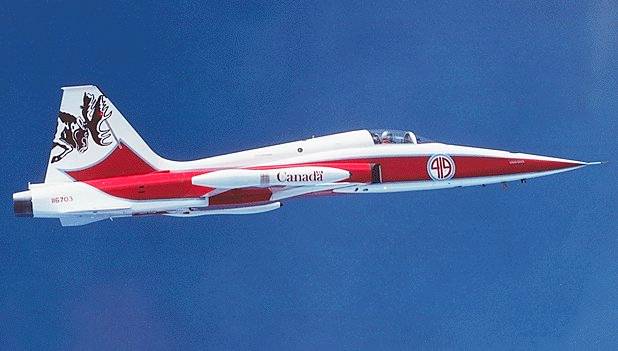
Canadair CF-5A
By 1965, twelve F-5As (followed by four more later) were appraised in combat by USAF in South Vietnam , in a program called " Skoshi Tiger ". The results demonstrated the limited tactical capacity of the aircraft - short range and small capacity of bomb load - as well as being economical in operation and pleasing to the pilots. When the program was ended, after twenty-one months of activities, the remaining units were transferred to the South Vietnam air force.
In 1968, the U.S. government invited eight companies to introduce their proposal for a fighter to be sold to the friendly nations (" Improved International Fighter Aircraft "). After presenting the project F-5-21, Northrop was chosen, in November 1970. The new fighter was denominated F-5E Tiger II and accomplished its first flight on August 11, 1972.
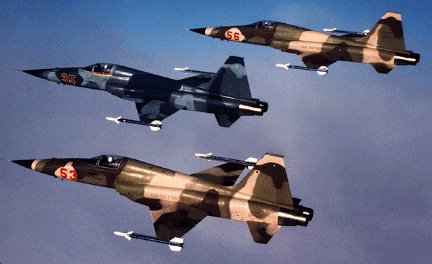
Trio of USAF F5Es
In comparison to the F-5A, it presented several modifications, including the use of more powerful engines; it supported operations in short tracks, with take-off capacity aided by rockets (JATO, " Jet Assisted Take-Off "), expandable wingtip to increase the angle of attack and landing hook; larger capacity in the internal tanks of fuel; redesigned extended fuselage, incorporating new electric air outlet; wings equipped with prolongations of the root of the attack board (LERX ", " Leading-Edge Root eXtension ") and multimode maneuver flaps operated electrically (these last ones, already present in NF-5A); radar operating in the band X; and larger payload capacity under the wings (result of the evaluation in Vietnam).
The training biplace version, F-5F, presented a fuselage extended in 1,06m in comparison to the that of the F-5E, which allowed the installation of a 20mm cannon, giving an operational capacity to the fighter. The reconaissance version, RF-5E Tigereye, was equipped with a modified nose, carrying oblique and vertical cameras.
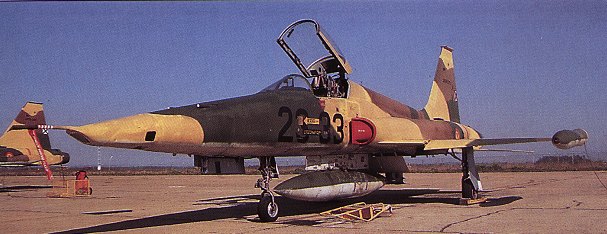
CASA’s SF5 – Spanish air force reconaissance version
