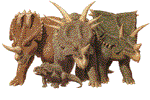
The Ceratopsian's are divided into to two main groups that are the short frilled (Centrosaurines) and the long frilled (Chasmosaurines). The behaviors of both are the same. It is believed that they moved in herds, the way modern living animals do today. The protected they're young by circling around them when a predator was present. The horns are for protection. The frills are still uncertain. They may have been for protection from predators or they may have been used for identifying each other, for mating purposes. By showing off the frills. In a way like birds do with their tailfeathers.
CENTROSAURINES
Short Frilled
Achelousaurus horneri 'mythological lizard'
Late Cretaceous 83 -76 MYA. Plant eater. 20-25 feet long. Has no nose horn. Solid mass of bone. Thick bone over eyesockets.
Avaceratops lammersi 'Ava(Cole) horned face'
Late Cretaceous 77-73 MYA. 7 feet long. Plant eater. Solid neck frill. It maybe a juvenile ceratopsian. Small ceratopsian may represent small adult with fused braincase. But others believe it may represent a juvenile ceratopsian.
Brachyceratops montanensis'short horned face'
Late Cretaceous 80-70 MYA. 6 feet long. A small horned ceratopsian. Slightly curved brow horn. Five small dinosaurs found by large adult. Is at Smithsonian Institute. It is a very distant relation to Centrosaurus, Styracosaurs and Triceratops. Found in 1913 by Charles Whitney Gilmore. It is probably non & dubian sub-adult. (Questionable)
Ceratops montanus'horned face'
Late Cretaceous 80-73 MYA. 25 feet long. Known from horn cores and knob-likes bone that attached to its first neck vertebra. Found in 1888. It is questionable as a valid name.
Claorynchus trihedrus 'broken beak"
Late Cretaceous 83- 73 MYA. Plant eater. Based on front portion of jawbone. It is questionable as being a valid name.
Dysganus encaustus 'bad brightness'
Late Cretaceous 83-73 MYA. Plant eater. Known from teeth. It is questionable as being a valid name.
Einiosaurus procurviconis 'buffalo lizard'
Late Cretacous 83- 76 MYA. Plant eater. 20-25 feet long. Its nose horn curves forward in a hook shape and has to long spikes on frill.
Centrosaurus apertus'sharp point reptile'
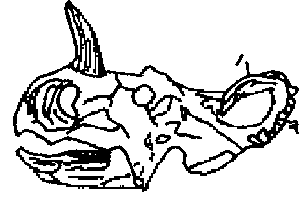 Late Cretaceous 76-72 MYA. Plant eater. 20 feet long. Related to Styracosaurus. This is one of the oddest frills among the ceratopians. It has a tongue shaped pieces of bone that point downward into the window like openings of the frill. Centrosaurus has a very large nasal horn. There are also small round lumps of bone going around the edge of the frill called epoccipital bones. There is a secondary skull roof.
1. Points to the tongue shaped bone that is found on its frill.2. Points to one of the eppoccipital bones around the frill.
Late Cretaceous 76-72 MYA. Plant eater. 20 feet long. Related to Styracosaurus. This is one of the oddest frills among the ceratopians. It has a tongue shaped pieces of bone that point downward into the window like openings of the frill. Centrosaurus has a very large nasal horn. There are also small round lumps of bone going around the edge of the frill called epoccipital bones. There is a secondary skull roof.
1. Points to the tongue shaped bone that is found on its frill.2. Points to one of the eppoccipital bones around the frill.
Monoclonius crassus 'single twig (horn)'
Late Cretaceous 76-73 MYA. Plant eater. 17 feet long.
Small brow horns and a large nosehorn. Edward Cope named this from a broken pieces of crest and some pieces of skeleton that were found in Montana.
Stryacosaurus albertensis'spiked reptile'
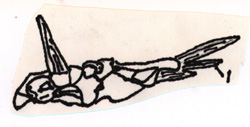 Late Cretaceous 77-73 MYA. 18 feet long. Plant eater. Its closest relative is Centrosaurus. Like Centrosaurus it has a very large nasal horn. It has six long epoccital bones that stick out from the top of its frill, which I think, is unusual. Below those bones are the smaller epocciptital bones that are a bit larger then those of Centrosaurus.
1. Points to one of the eppoccipital bones coming off of its frill.
Late Cretaceous 77-73 MYA. 18 feet long. Plant eater. Its closest relative is Centrosaurus. Like Centrosaurus it has a very large nasal horn. It has six long epoccital bones that stick out from the top of its frill, which I think, is unusual. Below those bones are the smaller epocciptital bones that are a bit larger then those of Centrosaurus.
1. Points to one of the eppoccipital bones coming off of its frill.
CHASMOSAURINES
Long Frilled
Chasmosaurus belli 'opening reptile'
Late Cretaceous. 76-70 MYA. Plant eater. 17 feet long, 2-3 tons. The skull is 5 feet long; most of it is frill. Neck frill was thin. Body is slender in build. Big nosehorn short brow horns.
Triceratops horridus'three horned face'
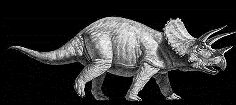 Late Cretacous. 30 feet long. Herbivore. 5-6 tons. Related to Centrosaurus and Styracosaurus but not closely. The largest ceratopian to date.
There are currently 10 species of Triceratops that are recognized.(I have found that a student recently working on their Masters studied all the available skulls and found only were only two different skulls.) That could mean that there maybe only one species... male and female? (I do not know what the student's conclusion was though.) Unlike the other ceratopians there is no window like opening in Triceratops frill, it is short and solid. It has two very large brow horns and a smaller nasal horn. It also has small epoccital bones around the frill. The mouth is also longer than any of its relatives too.
Late Cretacous. 30 feet long. Herbivore. 5-6 tons. Related to Centrosaurus and Styracosaurus but not closely. The largest ceratopian to date.
There are currently 10 species of Triceratops that are recognized.(I have found that a student recently working on their Masters studied all the available skulls and found only were only two different skulls.) That could mean that there maybe only one species... male and female? (I do not know what the student's conclusion was though.) Unlike the other ceratopians there is no window like opening in Triceratops frill, it is short and solid. It has two very large brow horns and a smaller nasal horn. It also has small epoccital bones around the frill. The mouth is also longer than any of its relatives too.
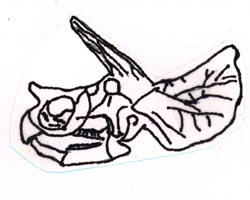
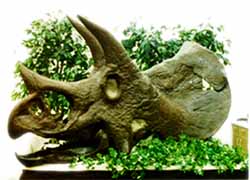 The Triceratops skull on the right is from the Dakota Dinosaur Museum.
Torosaurus latus'protuberance reptile'
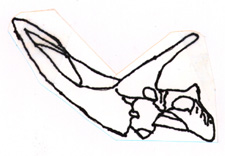 Late Cretaceous 70-65 MYA. Plant eater. Related to all the long frilled ceratops but most closely related to Arrhinoceratops. Torosaurus has an 8.5 foot long frill the largest of any long frilled ceratop. Unfortunately this is the only part of the dinosaur that has been found. But the estimates for the length of this dinosaur are at about 25 feet long. It is the largest of the frilled ceratopians. It doesn't have any epoccipital bones around the frill. Two species, Torosaursus gladius and Torosaurus latus represent it. (Maybe one species...male and female?)
 Go toPachycephalosaurs or back to...Dino Menu