

WILLIE NELSON


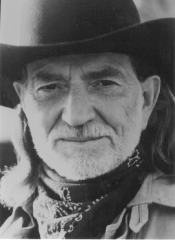 Willie Nelson remains as much an outlaw in the 90's
as he was 20 years ago because he makes Nashville
bend for him rather than forcing his distinctive
style into a traditional country sound. Nelson's
deeply interpretive singing style gives him his
flexibility. Whith a voice as smooth as scotch and
the savvy to consiently surround himsellf with
musicians who carry the bite of a jagged ice cube.
Nelson has enjoyed a long musical career.
Willie Nelson remains as much an outlaw in the 90's
as he was 20 years ago because he makes Nashville
bend for him rather than forcing his distinctive
style into a traditional country sound. Nelson's
deeply interpretive singing style gives him his
flexibility. Whith a voice as smooth as scotch and
the savvy to consiently surround himsellf with
musicians who carry the bite of a jagged ice cube.
Nelson has enjoyed a long musical career.
Born on April 30 1933 in Abbott, Texas, Nelson was very young when his parents divorced. He and his older sister, Bobbie, were raised by their grandparents.
As a youth, Nelson's ears were tuned into all kinds of music. He heard late-night jazz from a New Orleans radio station and piano boogie woogie from Freddie Slack. One of Nelson's earliest and most lasting influences was Frank Sinatra.
In 1943 Nelson landed his first professional job as an acoustic guitarist with the Bohemian Polka Band in nearby Fort Worth. By the ttime he reached high school Nelson had joined the Texans, a loose country aggregation frounted by his brother in law.
After graduating from high school in 1951 Nelson enlisted in the Air Force. A chronic back injury resulted in a medical discharge in less than a year. He rejoined the Texans and in 1952 married Martha Mathews, a 16 year old Cherokee indian.
Nelson had thought of becoming a preacher in the early 1950's, he was a Sunday school teacher at a baptist church in nearby Fort Worth. But, in pursuit of a career in agriculture he moved to Waco Texas and enrolled in Baylor University. to pay for his college education he toiled at several odd jobs, including selling vacumm cleaners and Bibles door to door.
After two yeares Nelson dropped out of college and became a disc jockey in San Antonio. This job led to other radio gigs in California, Texas and Vancouver British Columbia. In the fall of 1956 while working at KVAN in Vancouver Nelson decided to cut a record of his own. It was an original composition called "Np Place For Me" with a Leon Payne tune, "Lumberjack" on the flip side. He had 500 copies of the single pressed and sold them over the radio at a dollar apiece. Today "No Place For Me" is regarded as Nelson's rarest recording.
Nelson returned to Texas in 1957 and settled in Pasadena, where he continued pursue songwriting while working as a disc jockey. During this time he penned "Family Bible" and one of country music's biggest hits "Night Life." Nelson however felt he was going nowhere fast in Texas and in 1960 he took off for Nashville in a beat up 1946 Buick.
Nelson had planned to be a songwriter but after hanging around Tootsie's Orchid Lounge in downtown Nashville, he was hired in 1961 as a bass gutiarist in Ray Price's band the Cherokee Cowboys. Offstage, Nelson's songwriting career began to blossom. In 1961 he wrote "Crazy" for Patsy Cline, "Funny How Time Slips Away" for Billy Walker," and "Hello Walls" for Faron Young. Liberty Records signed him too the lable in 1962.
By 1964 Nelson had become a regular at the Grand Ole Opry. Despite becoming increasingly disenchanted with the lush strings and emotive backing choirs that defined the Nashville Sound. Nelson achieved moderate succses as a preformer during the 1960's. After a December 1970 fire gutted his home in Ridgetop Tennessee, Nelson returned to Texas, settling in Austin.
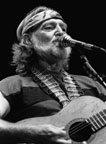 Nelson's commercial breakthrough came in 1972, when
he signed whth Alantic Records. In Febuary 1973,
Nelson holed up for five days in a New York City
studio and recorded a mass of material. From these
sesions the album Shotgun Willie was born. A seninal
work in Nelson's career, the album was the frist to
showcase his unique vocal interpertations. His band
included his sister Bobbie as pianist, Doug Sahm of
the Sir Douglas Quintet, Larry Gatlin and western
swing fiddle player J.R Chatwell. The soulful Memphis
Horns, best known for their work with Stax Records,
appeared on a couple of cuts. Nelson has often stared
that the Atlantic period was the turning point in his
career.
Nelson's commercial breakthrough came in 1972, when
he signed whth Alantic Records. In Febuary 1973,
Nelson holed up for five days in a New York City
studio and recorded a mass of material. From these
sesions the album Shotgun Willie was born. A seninal
work in Nelson's career, the album was the frist to
showcase his unique vocal interpertations. His band
included his sister Bobbie as pianist, Doug Sahm of
the Sir Douglas Quintet, Larry Gatlin and western
swing fiddle player J.R Chatwell. The soulful Memphis
Horns, best known for their work with Stax Records,
appeared on a couple of cuts. Nelson has often stared
that the Atlantic period was the turning point in his
career.
When Atlantic dissolved it's country division in 1974 Nelson moved to Columbia, where he had complete control. His debut album at Columbia, 1975's Red Headed Stranger, was a smash. The album spawned Nelson's first pop hit. "Blue Eyes Cryin In The Rain."

Nelson followed up the success of Red Headeed Stranger with 1976's Wanted; the Outlaws, on which he collaborated whth Waylon Jennings, Jessi Colter and Tompall Glaser. The album featured reissued material from Nelson's earlier years, but the instrumentation when against the commercial Nashville Sound. Wanted hit number one on the country charts, crossed over into the top ten on the pop charts, and was the first country album ever to go platimum. The Country Music Association voted it Album of the Year and "Good Hearted Woman" a Jennings-Nelson duo from the album was named Vocal Duo of the Year and Single of the Year. The albums massive popularity set the conservative Nashville establishment on its ears, and Nelson's "outlaw" image was forever embedded in country music culture.
But Nelson truned an about face on the red-ban-danna outlaw image in 1978 releasing the resplendent Stardust, a collection of pop standards that has sold four million copies. the financial and popular success of Stardust led him to record a second collection of pop standards in 1981, Somewhere Over The Rainbow.
With his long hair, rugged physical appearance, and outlaw persona, Nelson seemed a natural for the movies. Hollywood came calling in the late 1970's and Nelson costarred with Robert Redford in the 1979 film The Electric Horseman. In 1980 he graduated to staring roles when he appeared opposite Dyan Cannon in Honeysuckle Rose, a film about a country singer's lifestyle on the road. Musical outlaw Willie got to play a real outlaw in the western Barbarosa, about a freespirited gunslinger on the lam. Nelson's flirtation with Holywood was brief but exposed him to even larger audiences.
To show his gratitude and support for the people of Austin, his adopted home town, Nelson started his famous annual Fourth of July celebrations featuring country musicians outside the Nashville mainstream. In the 1980's he devoted much of his free time to heading the Farm Aid movement, which raises money for the American Farmers.
Nelson has frequently recorded with other artist. He and Waylon Jennings reunited in 1978 to record Waylon & Willie, another platinum album and a major hit on both the pop and country charts. Nelson, Jennings, Johnny Cash and Kris Kristofferson got together in 1986 to record Highwayman.
In late 1990 the Internal Revenue Service seized Nelson's property to ensure payment of $16.4 million in back taxes. Two of Nelson's ranch homes and many of his personal items were auctioned off to raise money. He recorded a mail-order album, Who'll Buy My Memories, to pay off the debt. It contained demos of 25 songs whos rights had been seized by the IRS. But in 1993 after an investigation the IRS reduced his debt to $5.4 million.
"There's nothing precious in life except loved ones." Nelson who has been married four times and fathered several children, once stated "All of these things I've lost are just things" Nelson's comment became an eerie propheey: On Christmass Day 1991 his son, Billy, commited suicide at the age of 33. But Nelson's storied life has been about bending, never breaking. Despite adversity he continued to write songs and make music. His recent albums still showcase his eccentric vocal style whether he is reworking familliar tunes in new arrangements or introducing new songs.
In 1991 he released the eclectic album Across The Borderline, which included vocal contributions by Bonnie Raitt, Bob Dylan and Sinead O'Connor. Nelson hearkened back to Stardust and Somewhere Over The Rainbow in 1994, when he put together Moonlight Becomes You another album of pop and country standards. In 1996 Nelson signed with Island Records and released the stripped down album Spirit.
Nelson's long career has left him at the pinnacle of success. As an innovator in country music. Willie Nelson helped push country away from the lush choruses and orchestrated arrangements that dominated Nashville in the mid-1970s. His Austin-inspired honky-tonk style and spare, minimalist instrumentations represented an alternative to the Nashville Sound. Despite his respect for pop singers and his owm experimentations with pop music, he personifies progressive country music. Not the least of his contributions has been introducing the new listeners attracted by his crossover hits, to country music.

