


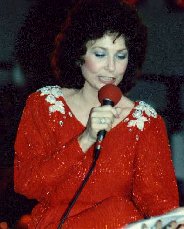
 Loretta Lynn has won more awards from the Country
Music Association and the Academy of Country Music
than any other female preformer. Her resourceful
upbringing in the coal country of Kentucky and her
rise to the top of the music industry has become a
country music legend.
Loretta Lynn has won more awards from the Country
Music Association and the Academy of Country Music
than any other female preformer. Her resourceful
upbringing in the coal country of Kentucky and her
rise to the top of the music industry has become a
country music legend.
Lynn was born Loretta Webb on April 14 1935, in Butcher Hollow, Kentucky, to a struggling coal miner and his wife. The second of eight children, Lynn grew up in a log cabin in the backhills. Her only link to the outside world was a radio tuned to the Grand Ole Opry on Saturday nights.
When Webb was 13 she meet 19 year old O.V. Lynn (or Mooney, as he was known to friends a nickname derived from Moonshine) at a town dance. The two started dating and within a month had obtained her farther's permission to marry. Within a year Mooney lost his job at a local coal company and hitchhiked to Washington with Loretta's brother, Jay Leo Webb, in serch of work. Loretta stayed home pregnant with their first child. She was 14.
Lynn eventually joined Mooney in Washingtion. She helped pay the rent by cooking for 30 farmhands at a nearby ranch. By the time she was 18 Lynn had 4 of her 6 children ; she became a grandmother at the age of 32.
For Loretta's eighteenth birthday Mooney got her a Sears guitar, which she taught herself to play. With Mooneys encouragement, Lynn sat in with a local band one Saturday night. She did so well that she was asked to become a regular member of the Saturday night review. By the late 1950's, Lynn had formed her won band, with Jay Lee Webb on guitar, and begun traveling around the Northwest. Mooney assumed a greater role in her career, becoming her manager.
Lynn's first record was "Honky Tonk Girl" a tune inspired by a woman Lynn saw drinking and crying in a Washington tavern. Mooney mailed out 3000 copies of the song to radio stations across the country, where it recived some airplay. Favforable response gave Lynn the confidence to head for Nashville, where "Honky Tonk Girl" became a smash hit. In the fall of 1961 Lynn signed with Decca Records and joined the Grand Ole Opry.
Lynn had a difficult time establishing a musical identity. Her hard country tonality sounded very much like Kitty Wells, whom Lynn had emulated as a child. Producer Owen Bradley, instrumental in developing Patsy Cline's career, produced Lynn's first Decca hit "Success". The ballad features the steel and twin fiddles that had been deemed inappropriate for the pop stylings of Cline.Unfortunately Lynn tried to mimmic Cline's quivering range, which compromised the caustic rural timbre that was to define Lynn's later recordings.
Cline quickly befriended the newcomer in towm, lending Lynn support and advice. But the friendship just over a year old was cut short when Clinedied in a plane crash. Lynn writes poignantly in her 1976 autobiography, Coal Miner's Daughter (on which the 1979 film was based) of this devastating loss.

Lynn's independence resurfaced, however, and she began scoring hits with her own compositions. Her "Before I'm Over You" made the top ten on the country charts in 1963. Her follow up hit was "Wine Women and Song" in 1964. In 1965 Lynn scored three top ten singles "Blue Kentucky Girl," "Happy Birthday" and "The Home You're Tearing Down."
An identity was finally being established. As social attitudes underwent rapid change in the mid 1960's, Lynn caught a cultural wave with such tough talking compositions as "Don't Come Home Drinkin" (1966), "First City" (1968) and "Your Squaw Is on the Warpath" (1968). More than a couple of these tunes were inspired by Mooney, who counted Cline's second husband, Charlie Dick, among his drinking buddies.
Lynn's sassy self declaration shaped her into an almost mythical figure. Country music fans responded to her music and her life which pointed to a way out of oppression and poverty. Lynn forged ahead with the deeply autobiographical "Coal Miner's Daughter" and the traditional shuffle "You're Looking At Country" both released in 1970. In 1972 she was awarded the coveted Country Music Association Entertainer of the Year Awardbecoming its first female recipient. Three years later in 1975 the Academy of Country Music paid her a similar tribute, naming her their Entertainer of the Year.
Lynn also continued a country tradition of male-female duets. Between 1964 and 1969 Lynn sang with Ernest Tubb and although their vocals were unsettled, the country charm was irresistible. A better match for Lynn's penetrating vocals was the softer style of Conway Twitty. The pair's most notable tunes were 1971's "After the Fire Is Gone," and 1978's "You're The Reason Our Kids Are Ugly," a novelty call-and-response tune.
Lynn's last statement of impact was 1975's "The Pill" a song endorsing birth control, which disc jockeys initially refused to play Lynn stated "If they'd had the pill when I was having babies. I'd be eatin them like popcorn."
Although Lynn's recording carrea leveled off by 1980, she remained a staple on the touring circuit. The 1980's brought tragedy to Lynn as well as triumph. In 1984 she faced the death of her son, Jack Benny Lynn, who drowned while attempting to cross a river on horseback. Four years later she was inducted into the Country Music Hall Of Fame. The honor reminded the country music industry of Loretta Lynn's remarkable talent and career.