


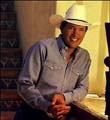
 When George Strait first visited Nashville, he was
told his music was behind the times. Looking back
it's clear the singer was a sighn of the times-a
bellweather who pointed the way to greater popularity
and prosperity for country music.
When George Strait first visited Nashville, he was
told his music was behind the times. Looking back
it's clear the singer was a sighn of the times-a
bellweather who pointed the way to greater popularity
and prosperity for country music.
In the early 1980's the prevailing attitude among thoes running the country music industry was that Strait's blend of western swing, traditional honky=tonk. and romantic ballads was old-fashioned and out of style. At various times he was told to throw away his cowboy hat,exchange his boots for leather loafers, and trade in his denim jeans for a pair of dress slacks. It was also suggested he do away with the fiddles and the steel guitars and bathe his mellow, deep-toned voice in the more contemporary sounds of strings and synthesizers.
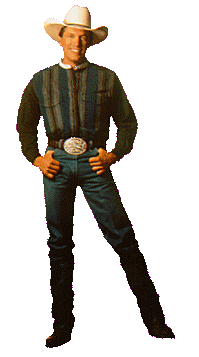
By the end of the 1980's however Nashville was singing a different tune and Strait now stands tallest among a handfull of artists who changed the sound and the look of country music. Strait's brand of traditional country led country to new heights of success and helped convince Nashville music executives to give other young traditional sounding country artists an opportunity-a trend that has provided country music with it's biggest sales boom in history. "I think there was always an audience out there craving traditional country music" Strait contends "they just werent geting it untill recently. Then a few of us came along who were doing music with this kind of flavor, and country music has gotten bigger and better. If I had a small part in helping that happen then hell I'm proud of it."
In the fifteen years that have passed sicne the release of Strait country, the texan's 1981 debut album, the singer has racked up more than 25 number one songs and seen each of his albums go either gold or platiuum. Twice he has recieved country music's most prestigious annual honor the country music association's entertainer of the year award. And he is cited as a parimary influence by nearly ever successfull Nashville newcomer.
Through it all Straits boots stayed firmly planted on the ground and his head never outgrew his trademark Resistol hat. He's still the soft-spoken down-to-earth family man who finds too much foo stage attention unconfortable and who remains dedicated to preforming the kind of music that got him where he is todasy.
Strait was born May 18 1952, the second of three children. His farther was a jounior high school math teacher and part-time rancher in Pearsail Texas a tiny settelment in the south Texas brush country located about 60 milles sout of San Antonio. In his youth Strait learned to ride horses and rope steers-an interest he still holds today. His initial music experience was singing "Louie Louie" and other rudimentary rock songs with a garage band made up of high school buddies. Shortly after graduation Strait and his high school sweetheart eloped in Mexico. Now more that 22 years later he and wife Norma still reside in south Texas with there son, George Jr, born in 1981.
Strait enrolled in the army in 1971 to help out with family finances. A year later, while serving as a clerk at the Schofield Barracks in Hawaii, he taught himsellf to play guitar by studying a Hank Willams songbook. Before long the base commander recruited the young Texan to lead a country band. Strait's duties during his last year in the service consisted largely of preforming country music on millitary bases.
Upon returning home, Strait enrolled in Southwest Texas State University in San Marcos. On campus he pinned a note to a bulletin board advertising himself as a singer in serch of a country band.He got a call from a group called Ace In The Hole. With Strait as lead singer, the band began performing nightly in honky-tonks within a 200 mille redious of San Marcos.
In 1978 Strait received a bachelor's degreein agriculture and began maintaing the family ranch, which by that time had grown to more than 100 head of cattl. He worked from sunup to sundown on the ranch, then quickly cleaned up and joined the other Ace In the Whole members for their nightly gig. The bands popularity steadily grew, and Strait's voice became more confident and flexible with his regular preformances of Texas dance hall music including a helthy dose of songs made famous by Bill Wills, Hank Tompson, Johnny Bush, Lefty Frizzell, Merel Haggard and George Jones. Years later Strait acknowledged a debt to the vocal phrasing of Haggard and Jones. He claimed he developed his style by singing their hits night after night and trying to mimic the way they brought out the emotions of the lyrics.
In the late 1970's Strait recorded a few songs for D records a Houston based company owned by Paapy Dailey, who had given George Jones his first big break more than two decades before Straits single "Ace In The Hole" receieved enough attention to give him the confidence to Nashville. He would make this trek three times without getting a response.
By 1979 Strait figured he had given his dream a shot and it was time to be more practical. He applied for several jobs, nearly accepting one with a firm in Uvalde texas designing cattle facilities, but his wife persuaded him to give music one more year.
Among Strait's other supporters was Erv woolsey a former music industry executive who managged a San Marcos, the Privite Rose, where the Ace in the Hole band often preformed. In 1979 after Woolsey had returned to the music business as a promotions executive for MCA Records, he helped Strait arrange a Nashville recording session with producer Blake Mevis. The songs recorded during that session earned Strait a recording contract with MCA Records less than six months after he had turned down the job in Uvalde.
The first hit from Strait's debut album, Strait Country was a striped down dymanic Texas two-steep titled "Underwood." It became the singer's first top ten hit confounding thoes who thought radio wouldn't acccept such a raw, traditional country style. Even champions of the back to basics sounds were skeptical about Strait's future.
More than a decade later Strait was still going strong and setting new standards. In 1987 the Texan's Ocean Front Property disc became the first in country music history to debut at number one on Billboard's country album chart. In 1988 Strait recieved a Grammy nomination for "All MY Ex-es Live In Texas." In 1990 Strait's "Love Without End Amen" became the first song since 1977 to remain in the number one position on the country charts for five consecutive weeks. His "Famous Last Words Of A Fool" was the next song to repeat that feat, staying at number one for five weeks in early 1991.
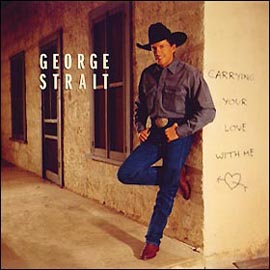 Strait's most recent ventures have included a major
role on the silver screen. He stared in Pure Country
(1992) a film writen specifically for him playing a
succsesful country singer who feels he has lost touch
with his musical and emotional roots. The film
features eleven songs preformed by Strait, and the
album by the same name whent platinum. Strait's disc
"Easy Come Easy GO" his eighteenth for MCA shows the
singer to be very much at the top of his game. The
album features Straits signature blend of swinging
honky tonk and romantic ballads.
Strait's most recent ventures have included a major
role on the silver screen. He stared in Pure Country
(1992) a film writen specifically for him playing a
succsesful country singer who feels he has lost touch
with his musical and emotional roots. The film
features eleven songs preformed by Strait, and the
album by the same name whent platinum. Strait's disc
"Easy Come Easy GO" his eighteenth for MCA shows the
singer to be very much at the top of his game. The
album features Straits signature blend of swinging
honky tonk and romantic ballads.
Of his music, Strait says, "I cant't realy see it changing very much. It's not that I set out to create a certain style or to change country music. It's just that I record the songs I like, and I do them in a way that feels right to me."
