

 ALL ABOUT RANDY TRAVIS

ALL ABOUT RANDY TRAVIS
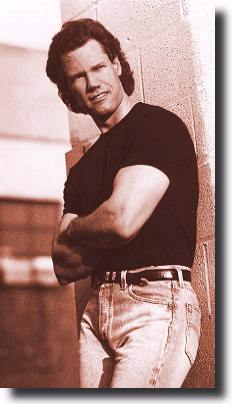 Minnie Pearl, country music's most famous hummorist,
once described Randy Travis as "a new vehicle with
old wheels." She meant he sounded good, he looded
good, and he was moving country music into the future
by harnessing the musical styles of the past. It was
a high compliment from a colorful lady who had worked
along side the greatest country music singers of all
time and she underlined her feelings about Travis's
talents by adding "a voice like his only comes along
once in a generation."
Minnie Pearl, country music's most famous hummorist,
once described Randy Travis as "a new vehicle with
old wheels." She meant he sounded good, he looded
good, and he was moving country music into the future
by harnessing the musical styles of the past. It was
a high compliment from a colorful lady who had worked
along side the greatest country music singers of all
time and she underlined her feelings about Travis's
talents by adding "a voice like his only comes along
once in a generation."
Travis turned the country music world around in 1986, the year he became the biggest overnight sensation in Nashville's long and ilustrious history. Storms Of Life his debut album on Warner Bros. Records ranks as the first debut album by a country music artist to sell more than a million copies within a year of its release.
Travis's success came at a time when country music sales were at an all time low, having steadily decreased during the early 1980's. John Anderson, Ricky Skaggs, George Strait and the Juds had already sent ripples of optimism through the industry by swimming against the flow of pop-influenced, cosmopolitan country music coming out of Nashville at the time. The meteoric success of Travis turned the tide completely opening the gates for the flood of successful traditional artists that followed.
Like most "overnight" sensations, Travis spent several hard working years paying his dues before getting his big break. The second of six children, Travis was born Randy Traywick on May 4 1959, in a small North Carolina town of Marshville. Located about 30 milles from Charlotte in an area known as the Piedmont Crescent. His father Harold Traywick, bred horses, raised turkeys and managed a small construction firm. His mother Bobbie Traywick worked in a fabric mill.
At age eight, Travis dilgently set to work learning chords on an acoustic guitar. Two years later he and his three brothers donned western suits, picked up their acoustic guitars and began performing as a country harmony act known as The Traywick Brothers. Even then say Randy's folks, the young man owned a voice that drew notice.
By the time he reached his teens, Travis had veered into trouble. He dropped out of school before finishing the nineth grade and got caught up in a life of fast cars, hard drinking and recreational drug use. Several scrapes with the law culminated in an arrest at age 17 for breaking and entering a felony carrying a possible jail sentence of five years. Some time before his scheduled court date the troubled 17 year old signed up for a talent contest at Country Music City USA, Charlotte's preeminent country music honky-tonk. There he met Lib Hatcher, the clubs manager amd part owner. Hatcher recalls dropping a load of papers she was carrying the first time she heard Travis's voice. She stoped what she was doing and listened. By the time Travis had finished singing, says Hatcher, she knew this skinny 17 year old had the stuff to be a star. Travis went on to win the contest. Hatcher imtroduced herself afterward, and with his parents consent she appealed to the court to put him on probation and in her care. Travis moved in with Hatcher and her husband and he took over as vocalist at Country Music City USA. Hatcher dedicated herself so completely to grooming the young roustabout that her marriage fell apart. Hatcher's husband left her and filed for divorce.

In 1978 singer Joe Stampley heard Travis sing and offered to help. He produced a handful of songs with Randy, two of which were released under the name of Randy Travick on the independant lable Paula Records. He also took tapes of the songs back to Nashville and presented them to several record companies, but no one showed any interest.
Hatcher and her protege weren't ready to give up. In 1980, Hatcher sold her nightclub and the two moved to Nashville, renting one floor of a threestory, yellow brick building on 16th Avenue near Music Row, where most of the Nashville music industry is located. The ground floor of the building housed the offices of the trade magazine Radio & Records. In the early days, Travis swept and scurbbed the offices once a week for $30.
Hatcher talked her way into a job managing the Nashville Palace, a tourist oriented music club and restaurant located in a strip of shops directly across from the enterance of the Opryland Hotel. Travis ent to work with her there mopping floors and flipping hamburgers. He also sang whenever he could, preforming under his new stage name Randy Ray. At first he had to sneak in a few songs at the invitation of the nightly headliner: eventually he worked his way into a full time slot, leading the band five nights a week, three sets a night.
Hatcher continued to work tirelessly to promote Randy's career. She organized shows at the club featuring performances by stars of the Grand Ole Opry, allowing Travis an opportunity to meet and mingle with several of Nashvilles well traveled veterans. Invitations went out to everyone and anyone involved in the recording industry encouraging them to visit the club, enjoy a free meal, and hear the featured singer. Through the early 1980's every record company in Nashville turned down a chance to sign Randy Travis. Not once but twice. That list included Warner Bros. Records, with whom Travis would later sign.
However Martha Sharp had yet to hear or see the Palace star. The top talent executive at Warners, she finally accepted an invitation from Hatcher in 1985. The singer was grilling steakes when sharp arrived and asked to hear him sing, Hatcher hurried into the kitchen to relieve him of his duties so Travis could take the stage. The moment Sharp heard Travis sing, she knew she wanted to sign him to a record contract. She also knew she would have a hard time convincing her superiors to back a singer so obviously devoted to traditional country music. In the face of strong corporate doubt, she succeeded.
Sharp introduced Travis to Kyle Lehning, an accomplished engineer who had worked with Ronnie Milsap and was moving into record production. Lehning produced most of Storms Of Life (two songs were produced by Keith Stegall). Before releasing the album, however, Warners wanted to test the reaction of radio listeners. The first single, "On the Other Hand" received a disappointing initial rating, climbing only to number 67 on the country charts. The next song "1982" fared much better, introducing Travis to the top ten. Warners, in an unusual move, decided to give "On the Other Hand" another chance. This time the tune took Travis to number one, a position he would visit more than a dozen times in the next five years. Storms Of Life in addition to its record setting sales pace, spent 12 weeks at number one. It also helped Travis gain induction in December 1986 into the Grand Ole Opry.
With his second album Always and Forever (1987). Travis sealed his status as a country superstar. The album spawned four numberone hits "Forever And Ever Amen", "I Wont Need You Anymore", "Too Gone Too Long", and "I Told You So" and spent an astounding ten months atop the country charts.
Along the way Travis set the mold for the new breed of male country star: clean-cut square-jawed and crisply attired with a pleasing traditionalism about his wardrobe and manner. He's humble,polite and respectful of the stars who preceded him. Travis is also a tee-totaler who monitors his diet and prefers a gym to a party. He sings with uncontrived sincerity, his lower register featuring a warmth and breadth that brings a mournfulness to all of his work.
Travis dominated many of the awards showsin the late 1980's winning more than 40 honors in his firs four years including two Grammys for Best Country Male Vocal Performance and several awards from the Country Music Association and the Academy of Country Music. His albums Old 8 x 10, No Holdin Back, and Heros And Friends extended his million selling streak into the 1990's. In 1991 as if to confirm his stardom and solidify his link to country music, Travis starred in a HBO cable-tv special with the legendary George Jones. In May the young star married Lib Hatcher in a privite ceremony in Maui Hawaii. Also that year the critically acclaimed High Lonesome was released. The album was a departure for Travis in that it featured five songs cowriten by Randy. Three of them "Together Forever", "Better Class Of Losers," and "I'd Surrender All" were written with Alan Jackson.
Travis continued to write and record his own compositions with his 1994 effort This Is Me. The disc features "The Box" a tune Travis cowrote with Buck Moore, as well as songs by Larry Gatlin, Jerry Philips and Max T. Barnes.
As the mid 1990's approached Travis spent less time in the highway. Touring is the backbone of the country industry, and performier can climb to stardom of fall from grace depending on the success on the road. Travis's decision to scale down his touring schedule shocked some industry insiders, but Randy had developed another interest he wanted to pursue.
Spending less time on the road allowed Travis to devote more time to reading scripts and acting. He is a veteran of several films, including A Holiday to Remember, Texas, and Frank & Jessie. Travis has also made guest appearances on television shows, such as Touched By An Angle.