Introduction
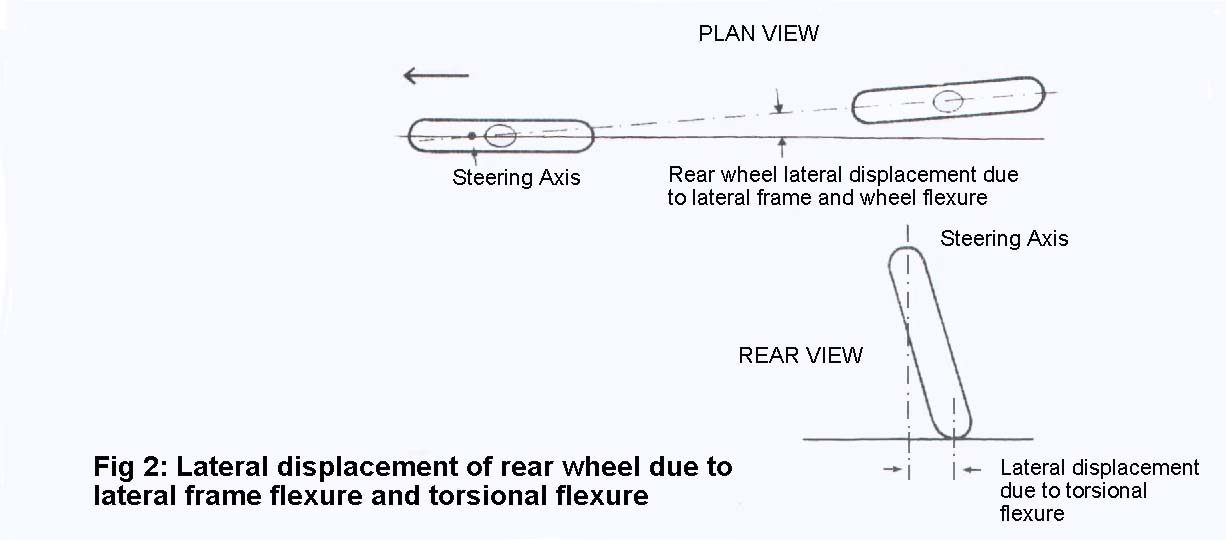
Diagnosing and then curing motorcycle handling problems is often not an easy thing to do. This is because motorcycles are single-track vehicles and are subject to all sorts of twisting and bending forces. Think about coming into a tight right-hand corner with your mighty Max. First you are hard on the brakes. A slight countersteer and you’re into a full lean. Next comes gentle acceleration, and as you push the bars to straighten up, you also twist the “go grip” to full lock. The rear wheel lets out a howl and the front tire rises in the air, like a speed boat jumping from wave to wave, with each changing gear. This type of action is what makes motorcycling so much fun. But it also puts tremendous strain on the frame and suspension components. In my example, you would have put your Max through three different types of rotational forces: yaw - left to right through the corner; roll - side to side as you leaned and came upright and; pitch - up and down as you first braked into the corner and then wheelied coming out of the corner. Through all this the chassis was trying to keep the front and rear wheel in line with each other both torsionally and laterally (figure 1 and 2). This is not an easy job to do. When things work right, a bike is controllable and fun to ride both fast and through the corners. However, if your chassis is not up to the task of keeping everything under control, your motorcycle can begin to act like a teenager at a beerfest. All sorts of wobbling, weaving and even falling over begins to happen. That’s what we want to prevent.
Chassis design
Notwithstanding the latest craze for “tuned flex”, most chassis builders rely on the assumption that the more rigid a frame is built, the better a bike will handle. Manufacturers however, often compromise chassis requirements due to cost and looks. After all, a machine must sell and also make a profit. In 1985 Yamaha took a big risk in introducing a new type of motorcycle line, the Vmax. They minimized the cost of that risk by using, as much as possible, the engine and chassis from an existing touring model, the Venture.
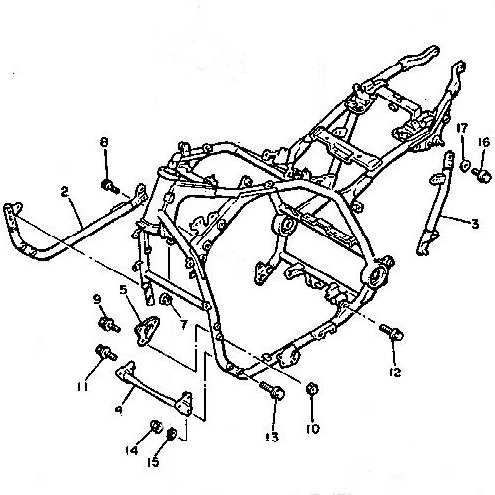
The Venture chassis was commonplace but outdated. It consisted of a double cradle mild steel tubular frame (Figure 3). Other late ‘70 / early ‘80 Japanese “rocket-bikes” that had this style of frame were characterized as having blazing acceleration but unable to stop or turn worth a darn. With the advent of the Vmax however, the term “acceleration” was given a whole new meaning. The older frame design was now being asked to “restrain” a new 225 lb. 140 horsepower torque monster of an engine. In addition, like with the Venture, the lower right hand cradle tube was bolted on. This provided clearance for engine installation and removal but it also reduced frame rigidity. Unlike the Venture, which needed mounting spots for panels, a small sub-frame cross brace was removed.
For suspension, standard 40mm air and oil filled front forks were attached up front (now 43 mm). They held an 18” aluminum rim with a 110/90 bias ply tire. Twin adjustable rear shocks were attached to an unbraced swingarm housing a 15” rim with 150/90 bias ply tire. The swing arm was attached to the frame with two independent pivot pins since the driveshaft did not allow for a full cross frame pivot shaft.
So in summary, Yamaha took a frame design that on other bikes wasn’t known for stopping or turning, beefed up the engine and decreased rigidity. Why would we expect problems??? In the real world, under “normal” operating conditions, this frame and suspension set-up works okay. But as most of us know, pushed beyond certain limits, the chassis inadequacies can jump up and bite you in the rear quicker than a pit bull on steroids.
The result of chassis inadequacies - Weaves and wobbles
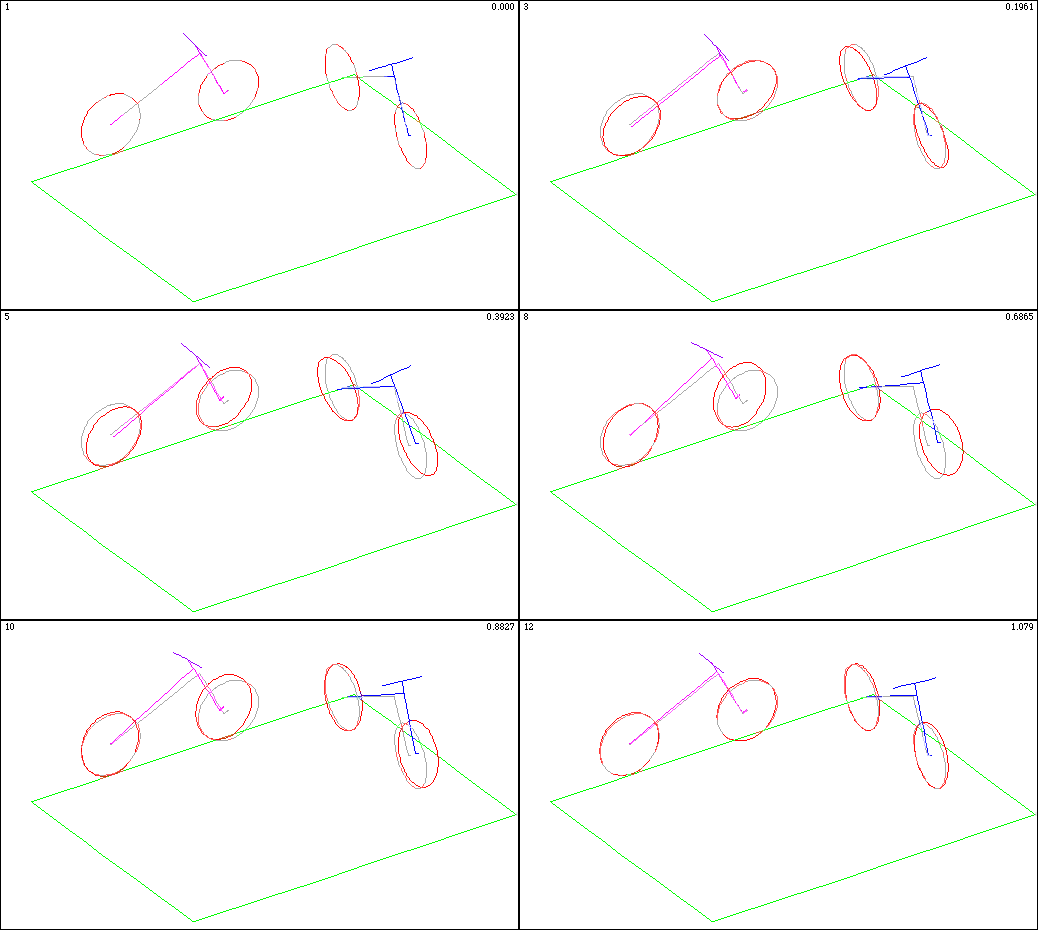
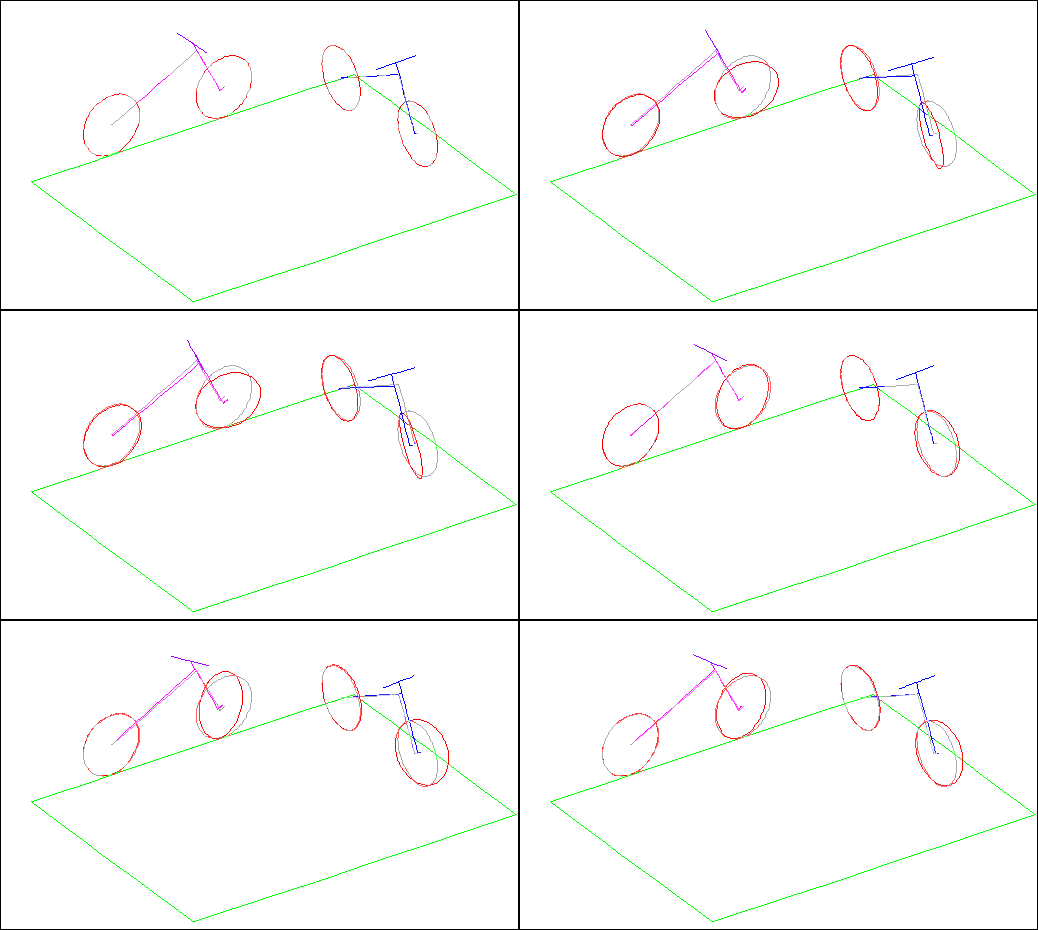
The most common handling complaint of a Vmax rider is a bad effect that starts at 115 mph on a straight stretch or at around 85 mph on a wide sweeper. (Of course this is only experienced on a closed race course). This effect, which I will call a weave, usually appears gently at first and often emanates from the rear of the machine. It shows up as a side to side motion, at a rate of 2-3 cycles per second (cps). While the cyclical rate doesn’t change, the amount of sideways motion or zigzagging increases dramatically with speed until the rider has to back off or risk losing control of the motorcycle. A less often complaint, but not with less consequence is a front-end wobble that occurs while decelerating (and sometimes accelerating) at around 35-45 mph. This wobble can arise suddenly and violently shake the front tire at a rate of 8-10 cps.
Underlying forces affecting both the wobble and weave are harmonic motion and resonant frequency. From Tony’s book (slight paraphrasing): “The best example of these is the pendulum. As we move the pendulum to one side gravity creates a force that starts to accelerate the weight back to centre; but by the time it gets there it is moving fast enough to carry on to the other side, and the whole process continues, with the pendulum swinging from side to side. This is harmonic motion. If we wait long enough the pendulum will eventually come to rest due to dampening from air resistance and pivot friction. The amount of dampening determines the number of swings before the pendulum comes to rest. In other words, dampening controls harmonic motion.
It is possible, however to have an oscillating system that doesn’t come to rest in this way or which actually increases the magnitude of successive swings (sometimes until the system is destroyed)...a child’s garden swing is an example. We have only to give it a gentle push each time it reaches a peak for the amplitude of the swing to increase very quickly.... Experiments with our swing will soon show that the number of complete oscillations in a given time is almost constant, regardless of the amplitude of the swing. This is called the resonant frequency (or natural frequency)...”
We can apply the same principles to our Vmax. Flexure in the frame, suspension, and imperfections in the tires etc can build up a harmonic motion or oscillations. If the motion is not dampened or if an input force matches the natural frequency of the oscillations then the bike will develop a bad wobble or weave.
The fix
Let’s discuss fixing the wobble first. . “Several factor contribute to the fact that all bikes don’t wobble in this way - and damping is an important one...such as friction in the steering bearings, wiring and control cables, tire friction and internal tire dampening (hysteresis). Often the decisive factor is the dampening by the rider’s body through the handlebar...The most important point to bear in mind is that the fundamental mechanism for causing this sort of wobble is inherent in the layout of a conventional motorcycle...”
However this does not mean we have to live with a wobble on a Vmax. Many riders experience no bad effects. For those that do, the first order of business is to look at all the front-end components to ensure they are in perfect working order. Wheel bearings should be checked for tolerances. Check that the front rim is both perfectly round and true in line with the hub. Make sure the tire is in good shape, with an even tread that is not cupped in any area. The wheel assembly should then be balanced as perfectly as possible. “It is often a small unevenness in the tire or rim that will give a kick each revolution. If the frequency of this off balance force corresponds with a natural wobble frequency of the bike then the bike may develop a bad wobble at this speed.” Some owners have cured a front-end wobble by simply changing brands of front tires. Many Vmaxers swear by a handling cure-all known as the Furbur fix (thanks John). This involves putting the rubber washer on top of the steering head nuts instead of between them. Others have replaced the rubber washer with an aluminum unit. Regardless of the approach it is very important on the Vmax to ensure the steering head bearings are in good shape and properly torqued (so the front fork falls to a gentle rest from center). Another fix is to replace the flimsy stock fork brace with a beefier aftermarket unit. If after all your checks and changes, the wobble problems still persist then install a steering damper.
The weave is a bit more of a complex problem to solve, however it is not insurmountable. Nor is it restricted to the Max. All bikes can be made to weave by going fast enough. Unfortunately, with the stock Vmax, “fast enough” occurs well under the top speed so as to be bothersome to many riders. Like the front-end wobble, the weave is created by an oscillation. Unfortunately, unlike the wobble, it is not dampened with speed. In fact just the opposite occurs.
The path to a smooth triple digit ride on your Max is to first reduce the source of any potential oscillations and second, to dampen those that do occur. Before we begin any mechanical alterations, let’s first consider that a weave can sometimes be attributed to or eliminated by the rider. Heavy riders, for example, will often dampen out oscillations in the frame by shear weight. (but honey, I have to drink all this beer so I can ride safely later..) Other riders, buffeted by the wind and with a death grip on the handlebars, may be inputting minor steering movements that lead to rear end chassis oscillations. As a tip, before under going any bike modifications try changing your riding style by planting your self a little more firmly in your seat and lightening up a little on the handlebar. Also try a couple of rides with the suspension and tire pressure set at various settings. Sometimes just a different tire pressure can provide the required dampening.
Having confirmed that you or your suspension set-ups are not the problem, begin your fix for the weave with the same approach outlined for a wobble. The one exception is the steering damper, which may not help, since a weave is usually cured by minimizing or dampening rear end oscillations. If your complete front-end system is in order, then closely check out the frame bolt-on pieces for tightness. Then ensure that the rear rim and tire are in good shape and well balanced. The tire should have a round tread profile. Too many smoke shows for the crowds flattens the center of the tread, which is not good for high speed tracking. Verify that the swing arm does not have any side-to-side movement. Re-torque the swing arm pivot bolts. Check to see that the front and rear wheel are true to one another. A 10mm rear offset is to be expected but both wheels must align along the same plane. If either wheel appears to out, then a visit to a frame shop is recommended
If the weave persists after all stock components have been adjusted, particularly your steering head and swing arm bearings, then some bike modifications are in order. Undertake a program to stiffen up the frame and swing-arm with
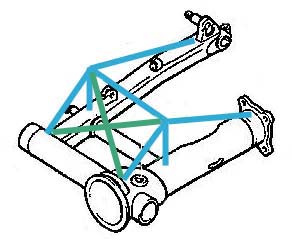 some bracing and gusset work. Solid motor mounts
are also a good idea. It may also be helpful to alter the weight
bias of the bike more towards the front. This can be done a
number of ways. One easy route is to replace the heavy stock
mufflers with lighter after-market units.
Another, on the newer models, is to slide the fork tubes up one
inch in the triple clamps. It is also easy to move or change out
the handlebars so the rider is positioned a little more forward.
some bracing and gusset work. Solid motor mounts
are also a good idea. It may also be helpful to alter the weight
bias of the bike more towards the front. This can be done a
number of ways. One easy route is to replace the heavy stock
mufflers with lighter after-market units.
Another, on the newer models, is to slide the fork tubes up one
inch in the triple clamps. It is also easy to move or change out
the handlebars so the rider is positioned a little more forward.