No stamped-on styling for
Firebird. The lines are so
clean, there isn't even a plain
old outside radio antenna to get
in the way. (It's in the
windshield.)
    That goes to show you what
experts can do with the way
economy looks. The significant
achievement, however, is that
our experts were able to put
those looks to work.
    Take the Endura front bumper
for instance. It not only looks
better... It is better. Because
it's a hard rubber-like material
that resists dings, pings and
dents. And it won't rust,
either.
    The longer, sleeker doors
enabled us to eliminate the rear
quarter windows. So one long
window covers the entire side
area. This reduces noise and
makes getting in and out of the
rear seat a whole lot easier.
That's pretty amazing in itself.
    The taillights, too. Nice
looking. But we spent
considerable time and effort
developing them to do a better
job. So they produce an even,
intense light free of "hot
spots."
    Too many people still cling
to the notion that the inside of
a sports car --especially a low
budget sports car-- is a wind
in-the-face, knees-in-the chest,
pain-in-the-neck. Things will
change. And this car will have a
lot to do with it.
    We took a long hard look at
the problem of noise. And then
turned the | Interior panel of the roof into
a remarkably effective
acoustical ceiling, by making
the inner panel one solid piece
and filling it with thousands of
holes.
We also cut out a lot of
noise by molding several body
panels in the rear-seat area
into one large panel. And by
reducing the number of bolt
holes under the floor.
There used to be a lot of
muttering about the rear seats
in sports cars. Three has always
been a crowd. We decided it was
better to make two people
comfortable than to squeeze in
three. So we put two bucket-type
seats in the back.
Funny, the move ended up
solving a rear-suspension
problem. The space between the
seats enabled us to increase the
height of the drive tunnel,
giving the suspension more room
for vertical travel. This
cushions the ride without
sacrificing cornering ability.
(Of course, it helps that
there's a new front stabilizer
bar to assist with the cornering
chores.)
We weren't about to sink all
that hard work with just about
any instrument panel. So we
covered the panel face with a
rich wood-grain vinyl. And we
included handy toggle switches
for the accessories.
But the clincher is the
supreme common sense with which
we designed the instrument panel
as a whole. |
    The gauges are utter
simplicity. Every switch and
control is right there when you
need it. And we engineered the
panel so that any bulb in the
instrument cluster can be
replaced in 60 seconds. Usually
less. Without your lying on the
floor.
    By now, you should have a
pretty good idea of how we
tackled everything else in the
car. Using common sense to make
the Firebird work better, so we
could keep the price down.
    How far down that price
stays is pretty much up to you.
The standard 250-cubic-inch
engine comes with a 3-speed
manual transmission.
    The standard brakes are
manual front discs and rear
drums.
    Other standard equipment
includes a pair of large
diameter, high-intensity single
headlamps, long-wearing bias
belted tires, a front stabilizer
bar and a stance that's wider
this year. A wider Wide-Track.
More than enough sports car look
and feel to satisfy most people.
    The rest might want to order
a 350-cubic-inch, 255-hp V-8.
With a wide-ration, Hurst
shifted 4-speed. A vinyl-covered
console. Variable-ratio power
steering. Sports-styled mirrors.
And any number of other
adventurous options available.
    Whether you add anything or
not, you'll have a head start on
tomorrow. |
Because the things that make the
basic Firebird such a
revolutionary American car are
all there to begin with. 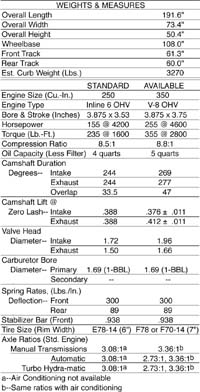 |
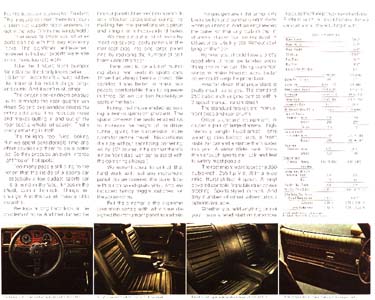 The captions below the pictures read (from left to right:
Exclusive soft-rimmed Formula wheel available.
Vinyl-covered buckets are part of the deal.
Two bucket-type rear seats instead of one bench.
New longer doors have handy storage pockets.
The captions below the pictures read (from left to right:
Exclusive soft-rimmed Formula wheel available.
Vinyl-covered buckets are part of the deal.
Two bucket-type rear seats instead of one bench.
New longer doors have handy storage pockets.