RADJABOV FINALIST AT THE
MOSCOW WORLD GRAND PRIX!!!
Clashes with Kasparov for the first time!
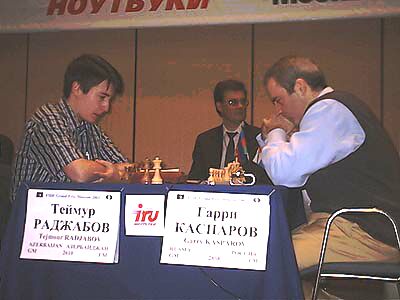 |
THE GRAND MASTER CHALLENGED BY HIS PADAWAN FOR THE FIRST TIME
in the finals no less of the FIDE Moscow World Grand Prix! |
It just happened too fast. It was at the very beginning of the new millennium, when little 12-year-old Teimour Radjabov emerged the winner of Kasparov.com’s Cadet Kasporov Junior Grand Prix when people thought this young boy would surely challenge Garry Kasparov’s dominance in maybe a decade or two. How about in just a little over 2 years?
Absolutely incredible but it just happened. Given a wild card entry to be able to compete with the very best players in the world at the International Chess Federation’s (FIDE) World Grand Prix in Moscow, Teimour Radjabov, now a tall handsome young lad at 15 trampled every opposition he met across the board and later found himself face to face in the tournament final against the old beast from Baku himself - Garry Kasparov.
Young Teimour, who also hails from Azerbaijan’s capital of City of Baku, was actually brought down to his knees by Kasparov in the tournament’s final – a final that somehow, merely looked like a ceremony that depicted an old beast welcoming the emergence of a young new beast to contend with. Like Loin King being challenged for the first by Lion Prince, who would be taught a stark lesson for now but who knew for certain that eventually in the end, he would emerge triumphant.
At such a tender age, Teimour should still be shuffling pieces with boys his age at the 16 and under championships. However, having already won the European 18 and under championship (technically and geographically though, Radjabov should proudly be an Asian) when he was only 12, it is quite understandable why he now prefers to wrestle it out with the big boys instead. Slugging it out with Grandmasters and doing well is already remarkable by any standard. But fighting the creamest of the crop? Battling the top ten players of the world, the world championship contenders - and obliterating them - is awesomely surpassing. Young Teimour just did that.
Thirty-two of the biggest names in the chess world today led by Garry Kasporov and reigning FIDE world champion Ruslan Ponomariov opened up the first round of the Moscow World Grand Prix. The only notable absentees from this big event were Peter Leko, Michael Adams, Einstein world champion Vladimir Kramnik and former FIDE world champions Anatoly Karpov and Viswanathan Anand. Leko had already won the first ever FIDE World Grand Prix which was held earlier this year in the UAE. There he smothered in the final Alexander Grischuk who tripped Radjabov in an earlier round.
So tough is the World Grand Prix that among those who were swept rather easily by 2-0 in the first round of this Moscow edition were Mikhail Gurevich of Belgium, Predrag Nikolic of Bosnia, Zurab Azmaiparashvili of Georgia and Etienne Bacrot of France. Other big names who missed the bus to the second round, though they gave it a tough fight were Sergey Rublevsky of Russia, Kiril Georgiev of Bulgaria and Viktor Bologan of Moldova.
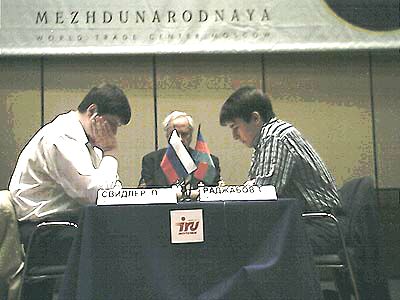 |
Young Teimour dropped a bombshell right in the very first round
by obliterating the highly ranked Peter Svidler of Russia. |
However the biggest surprise of the first round was Teimour’s demolition of Russia’s Peter Svidler, who’s ranked among the top ten. In the their first game, Svidler was lucky enough to get a draw with black after the young Radjabov got better mobility and center control after the tension on the center files that resulted in exchange of major pieces. In the their second game, Svidler opened up an aggressive attack led by his queen on Teimour’s Kingside. Radjabov however retaliated even more aggressively opening up his h-file for his rook as he relentlessly attacked the retreating white queen. Svidler attempted to counterattack but lost a knight instead forcing him into resignation and out of the tournament.
The veteran Alexander Beliavsky provided the shock in round 2 as the clobbered the reigning FIDE world champion Ruslan Ponomariov of Ukraine. Beliavsky, himself a native of Ukraine but who how represents Slovenia, blew away the young champion 2-0. Kasparov meanwhile had no problems disposing of Joel Lautier of France, 2-0. Other 2-0 winners in this round were Russian Evgeny Bareev over Alexander Onischuk, now of the USA, and surprisingly Ilya Smirin of Israel over Alexander Dreev of Russia.
Young Teimor proved to everyone his first round triumph was no fluke as he caught another big fish. This time he squeaked out a 2.5-1.5 victory over Vladimir Akopian of Armenia, finalist at the FIDE World Championship just three years ago. In their first game Akopian refused to take Radjabov’s challenge on the d5 square, castled on the queenside and paid dearly for it. He desperately sacrifice his bishop after Radjabov took a two pawn lead but Radjabov simply went on to go for the kill on the undefended king on a8.
Perhaps relaxing a bit, needing only a draw in the second game, Teimour was thrown off guard by Akopian’s 5. Qg4 forcing 5. … Kf8. Later, Akopian made another bishop sacrifice to a gain pawn control of the center and this time it proved lethal against Teimour in the endgame, leveling the match at one game apiece.
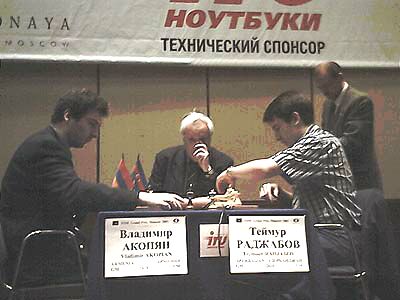 |
Former world championship finalist Vladimir Akopian
found Radjabov too hot to handle. |
In their third game Akopian fell for Radjabov’s 10. d5 paving way for 11. Qxg7. Akopian then traded his rook for a bishop and knight while trying to cover for his now wayward king but later lost his other rook as well for nothing at all. The Armenian made a last ditch stand with his connected pawns but had no more answer after Radjabov sacrificed his own rook for a knight. Radjabov secured match victory with a solid draw in the fourth game catapulting himself into the quarterfinals.
The final eight saw three of the four matches with similar results, 1.5-0.5. Kasparov blasted the young ambition Russian, Alexander Grischuk while in another all Russian match-up former FIDE world champion Alexander Khalifman got the better of Evgeny Bareev. Beliavsky continued his march to the semis by stamping his authority over Ilya Smirin.
Everyone’s attention nevertheless was Radjabov’s match against the highly touted Vassily Ivanchuk of Ukraine. Ivanchuk, last years finalist at the FIDE world championship and probably the strongest player today who is yet to win a world championship, emphatically challenged Teimour’s French Defense in their first game. He gave up a knight and bishop just to open Teimour’s kingside. Radjabov’s showed no sign of being intimidated at all as he easily thwarted the Ivanchuk attack and even threatened to rip his opponent off with his extra knight. Ivanchuk was lucky that his pawns were still able to even things up.
Earning the respect of his opponent, Teimour found no resistance from Ivanchuk who played black in the second game. Early exchanges lead to an even rook and pawns end game forcing another set of two games. It was a different story though when Ivanchuk played with white again in their third game. Ivanchuk’s wiliness allowed Teimour to get a pawn edge after a center exchange but grabbed it back later and even better, for it left his two bishops dominating the center. This paved the way for Ivanchuk’s pass pawn to finish off the fight.
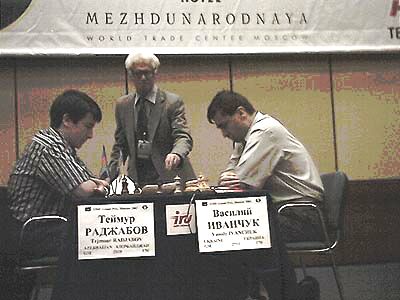 |
World championship finalist and former world no. 2 Vassily Ivanchuk had now
become, to date, the most highly rated player Teimour had ever beaten. |
Caught on the ropes, needing not less than a win, the fourth game exemplified just how exciting Radjabov fights. He gave up a pawn on the 12th move then castled on the wide open queenside. Ivanchuk quickly tried to capitalize on his opponent’s seemingly vulnerable king but Radjabov defended very accurately with the rooks, queen and bishop on b4. These same officials likewise served a double purpose for Radjabov as they relentlessly attacked Ivanchuk’s stronghold. Unable to resist, Ivanchuk succumbed and gave up after heavy material losesp paving way for a winner take all fifth game.
The cardiac game was fight. Radjabov on the black side, played the waiting game until suddenly he unloaded a bombshell with 59. … Nxg5! This not only gave him a pawn edge but more importantly opened the lines for rook and queen that later threatened an inevitable mate before Ivanchuk threw in the towel.
The final four saw Kasparov pitted against Khalifman and then the veteran Alexander Beliavsky with the young Teimour who now had exceeded all expectations way too far. It can be recalled that Kasparov had to overcome Beliavsky too at the candidates matches in the early 80’s enroute to challenging Anatoly Karpov for the world championship crown.
Kasparov and Khaliftman’s match up meanwhile, was just perfect to commemorate Russian’s victory at the Manila Olympiad ten years ago. These two players played boards l and 2 respectively as they lead their then newly independent country to the championship in the first ever Olympiad after the breakup of the Soviet Union. Ten years and four more championships for Russia in the biennial Olympiad, Kasparov and Khalifman now have to tear each other apart for only one of them can enter the final of the World Grand Prix. Khalifman battled Kasparov to three straight draws but that was all he can do as Kasparov captured the fourth game to claim his place in the finals.
Young Teimour opened up his semifinal showdown against the headstrong veteran Alexander Beliavsky with fierce but risky advances of his kingside pawns in spite of having the black pieces. Beliavsky, known for his Petrosian–like defenses even with white, was able to prevent complications though, after Teimour initiated a pawn lock. Beliavsky however surprisingly or stubbornly refused to draw until the 87th more even if both players just kept on playing a waiting game game. It can be recalled that once during the earlier mentioned Manila Olympiad, Beliavsky was the only player left in the huge International Convention Center as he stayed there late into the night just starring at his adjourned game.
With Teimour having the white pieces in the next game, Beliavsky initiated early exchanges that included the queen. The game still went all the way up into the endgame though as Beliavsky tried to create pass pawns on both sides but Teimour had no problems neutralizing it at all to force another set of two games.
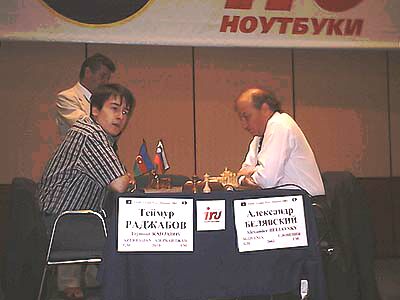 |
Stone-cold veteran Grandmaster Alexander Beliavsky unable
to prevent Radjabov from barging his way into the finals. |
Like in the first game, Radjabov played more aggressively despite having black pieces in the third game pressuring Beliavsky with rooks and queen on the g and h files aiming directly at the white king. Beliavsky to his credit, got away again however through an even rook and bishop endgame.
Teimour, even more ferocious with the white pieces, quickly opened up Beliavsky kingside in the fourth game. With obviously having the better position, it was definitely a surprise Teimour accepted a seemingly desperate draw offer by Beliavsky. For the second straight match young Teimour’s like being in another five setter of a tennis grand slam event.
Teimour went back to the Nf3 opening, his favorite during his childhood. The game went handsomely for him after he played a check with his knight on Nf6. Beliavsky played 21. … Bxf6 then Radjabov replied with 22. Qxf6. The Slovenian initiated a queen exchange with 22. … Qg7, which Radjabov took 23. Qxg7+ Kxg7 then suddenly, Radjabov played 24. d5+ winning Beliavsky’s knight on c6. Beliavsky still played on then finally acknowledged defeat on the 46th more setting the stage for a finals showdown between the Grand Master and his Padawan learner.
It’s the stuff everyone thought that can only happen in the movies. The news of 15-year old Teimour reaching the finals of the Moscow World Grand Prix against Garry Kasparov rippled through newspapers around the globe. Radjabov took everyone by storm last year after almost everyone who is not Chinese regarded him as the real youngest grandmaster in history. And just a few months ago, he became the youngest player ever to barge into the top 100 rankings of this game played by millions around the world.
Some say the biggest mistake one does when confronting an opponent with an awesome stature such as Garry Kasparov is that he doesn’t simply let his real game come into play. Instead, he tries other things and end up lost in uncharted waters. Anand learned that the hard way when he challenged Kasparov in 1995. The same cannot be said however when Radjabov played the Modern Defense against Kasparov’s e4 for he already has a handful of experience playing this opening. Nevertheless, many people wondered why Teimour abandoned the French Defense– an opening he had been using almost all his life - during what is to date the biggest game of his life.
After exchanging bishops on the 7th move, allowing Kasparov’s queen to stay on h6, Teimour was forced to castle on his partially open queenside. Kasparov gained control of the d-file and then penetrated Teimour’s queenside with his knights wiping out the pawns with only the king guarding it. Unlike some players who would play on just to get a higher official number of moves to be seen on paper, Teimour knew there was no sense in continuing the game.
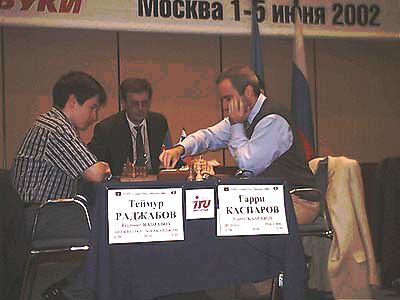 |
The beast from Baku, not yet ready to yield,
teaches young Teimour a neat lesson. |
Radjabov opened up forcefully with the white pieces in the must win second game of this final. He controlled more squares and forced Kasparov to open up his g-file disallowing him to castle. Teimour however chose not to castle either. Kasparov like a true champion was able to get back into the game when he strategically exchanged officials to succeed in neutralizing Radjabov’s positional advantage. Repeated moves ended the game and match with the final position showing locked pawns indicating a clear stand-off allowing Kasparov to squeak out a 1.5-0.5 result to claim the Moscow World Grand Prix Championship.
Whoever believes that there’s no glory in wining the silver should take a look at this tournament. Nobody is more happier here, not even Kasparov, than Teimour and all those who root for him. This tournament has completely justified Teimour’s decisions to abandon youth tournaments and play in the big leagues. His record in the youth tournaments had already been exceptional. His initial taste of Grandmaster tournaments had been amazing. And to those who further believe that Radjabov is in the footsteps of absolute legends who come once in a blue moon, like Botvinnik, Tal, Fischer and Kasparov, are now very much delighted to know that Radjabov is seriously fulfilling his destiny to take his place along side or even above these immortals.
Here are the complete results of the 2002 Moscow World Grand Prix. Matches shown in blue are the consolation matches for players who had already bowed out of the tournament.
Round 1
Ponomariov - Vlassov 1.5-0.5
Beliavsky - Rublevsky 3-1
Dreev - Georgiev 3-2
Smirin - Karjakin 1.5-0.5
Radjabov - Svidler 1.5-0.5
Akopian - Bologan 3-2
Sutovsky - Azmaiparashvili 2-0
Ivanchuk - Motyler 3-2
Bareev - Sasikiran 2.5-1.5
Onischuk - Vaganian 2.5-1.5
Kasimdzhanov - Bacrot 2-0
Khalifman - Ghaem Maghami 1.5-0.5
Grischuk - Seirawan 1.5-0.5
Polgar - Nikolic 2-0
Lautier - Guerevich 2-0
Kasparov - Ehlvest 2-0
Round 2
Beliavsky - Ponomariov 2-0
Smirin - Dreev 2-0
Radjabov - Akopian 2.5-1.5
Ivanchuk - Sutovsky 1.5-0.5
Bareev - Onischuk 2-0
Khaifman - Kasimdzhanov 1.5-0.5
Grischuk - Polgar 3-2
Kasparov - Lautier 2-0
Round 3
Beliavsky - Smirin 1.5-0.5
Radjabov - Ivanchuk 3-2
Khalifman - Bareev 1.5-0.5
Kasparov - Grischuk 1.5-0.5
Ponomariov - Dreev 2–0
Akopian - Sutovsky 3-1
Kasimdzhanov - Onischuk 2.5-1.5
Polgar - Lautier 1.5-0.5
Round 4
Radjabov - Beliavsky 3-2
Kasparov - Khalifman 2.5-1.5
Ivanchuk - Smirin 1.5-0.5
Grischuk - Bareev 1.5-0.5
Akopian - Ponomariov 2.5-1.5
Kasimdhzanov - Polgar 3-2
Dreev - Sutovsky 1.5-0.5
Onischuk - Lautier 1.5-0.5
Round 5
Kasparov - Radjabov 1.5- 0.5
Khalifman - Beliavsky 1.5 -0.5
Grischuk - Ivanchuk 2.5-1.5
Smirin - Bareev 3-2
Kasimdzhanov - Akopian 1.5-0.5
Ponomariov - Polgar 1.5-0.5
Onischuk - Dreev 1.5-0.5
Lautier - Sutovsky 1.5-0.5
Final Standings of the 2002 FIDE Moscow World Grand Prix(Top 16):
1. Garry Kasparov
2. Teimour Radjabov
3. Alexander Khalifman
4. Alexander Beliavsky
5. Alexander Grischuk
6. Vassily Ivanchuk
7. Ilya Smirin
8. Evegeny Bareev
9. Rustam Kasimzhanov
10. Vladimir Akopian
11. Ruslan Ponomariov
12. Judit Polgar
13. Alexander Onischuk
14. Alexey Dreev
15. Joel Lautier
16. Emil Sutovsky
|