Teimour Radjabov: A Future Champion
The interview below was conducted at the 2002 Eurotel Championship, just a few weeks before young Teimour's monumental performance at the Moscow World Grand Prix where he reached the finals to challenge Garry Kasparov for the first time.
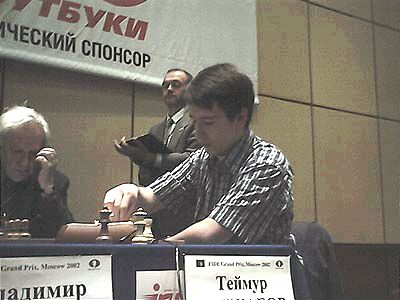
|
|
"I want to get as good as I can on my own."
|
In 2001, young Azerbaijani ace Teimur Radjabov became the world’s youngest grandmaster, aged just 14 years and 14 days. In conversation, the elegantly-dressed teen comes across as older than his years. If he seems nervous, checking his watch every now and then, it is only because he’s worried about missing an important move in one of the remaining games, underway as we talk.
You learned to play chess at the age of four. Is there any story behind that?
There’s nothing special about the fact I learned to play chess. I was three and a half when my dad who taught me. I got better quite quickly and became a member of a club and started training.
Who’s your trainer now?
My dad used to train me, but he’s not quite good enough any more. For the most part, I train all by myself. Actually, I like training alone.
How much time do you play every day?
Like other children, I go to school. When I come home I train some three or four hours every day. I have a special individual plan in school, but when I’m not at a tournament I have to go there. And I have to do my assignments.
Don’t you feel that, compared to your schoolmates, your childhood has taken a rather different direction? Do you feel deprived of anything?
I think my childhood is quite normal. Or at least for me it’s normal. In the future, I plan on training even more as I get better, and I’ll have to give chess even more time and energy.
What sports do you practice to stay in shape?
I like tennis most of all. And I play table tennis and soccer as well.
Do you prefer playing at rapid tournaments or ones with serious games?
I like playing both kinds of tournament. [In rapid], when a player is off his game and doesn’t play well, he can be out in the KO system after the first two rounds. In the classical system, he has to struggle with his form during all of the games. The player thus has a chance to pull himself together and fight.
Some chess players are superstitious – they believe in their winning pencil or T-shirt. Are you superstitious?
That’s a secret. I have no talismans and I’m not really superstitious. Sometimes I do believe in the winning clothes. But then, when you lose, you realize how stupid that was. Sometimes I have a winning pen or pencil, I admit.
What makes chess so interesting for you?
Maybe the spirit of battle. Of course, the tactics and strategy are also very interesting. But pitting your strength against others attracts me most. I want to win and play a good game as well.
The world elite is unanimous in saying that you are an exceptionally talented player who’s likely to become another world champ. Do you feel you have to show the world that’s true?
I don’t pay much attention to what other grandmasters and players say about me. I don’t care. I want to get as good as I can on my own.
How about your life in a year from now?
Chess, of course. My goal is to become a world champion and be in the top ten within a year.
In the last series of the FIDE world championships you were eliminated unfairly due to a controversial decision (the clock had the wrong time limit). How long did it take to get it over with?
I haven’t thought of it for a long time. It’s normal, chess is a sport. I stopped thinking about it at the very next tournament.
 2002 FIDE Moscow World Grand Prix 2002 FIDE Moscow World Grand Prix

|