|
Pay
It Forward
Gets
back at Critics!
Emphatic
as they are, makes it laughable to know how much these detractors have missed
the point!
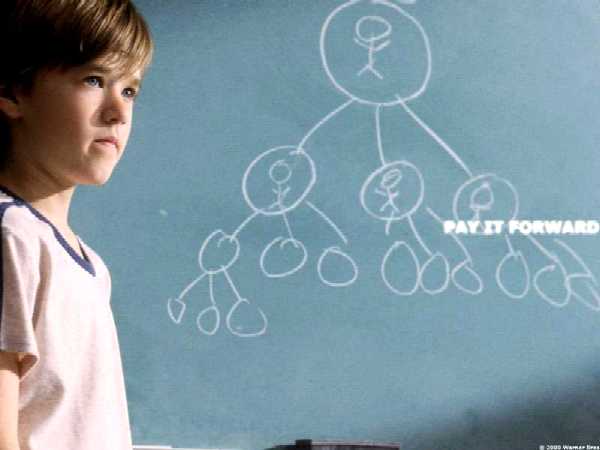 |
Haley Osment as Trevor
explains the simple yet
powerful scheme that
may really change the world. |
| Rules
of the game |
| #1 It has
to be something hard that really helps people. |
| #2 Something
they can't do by themselves. |
| #3 You
do it for them, they do it for three other people. |
|
You have
heard the concept before. You receive an e-mail or a letter in the
mail regarding a great new opportunity - you send one dollar to seven addresses
and they will send one dollar to seven others, and so on. Before
you know it, you will make thousands of dollars a month. The idea
forms a chain or a pyramid strategy, hence, chain letters.
Similarly, when a character
does you a good turn, don't pay the favor back. Instead pay it forward
by doing a kindness for three other people. Be sure you tell each
of the three other people to do something for three more. Pretty
soon, following a geometric progression, the whole world becomes a better
place.
The film
"Pay It Forward" was attacked by some critics for they believe people nowadays
have become just too damn cynical. This remarkable little movie dared
to assume that humanity isn't evil, selfish or ugly and, in a time when
Christian Bale's "American Psycho" is all the rage among the critical establishment.
With its very idea in question, Pay It Forward the film, surely took some
flack for it.
All the
critics who reviewed the film generously gave their acclaim to the film's
three central performances who did extremely well: Kevin Spacey as
the vulnerable and wounded man; Hellen Hunt as the woman no less wounded
in her own way, and Haley Osment, who once more proved himself the equal
of adult actors in the complexity and depth of his performance. Unfortunately
however, film critics were heavily divided when it came to grading the
film as a whole and this prevented any of the three worthy cast from getting
any Academy nominations.
Many people
would like to make it clear now if the categories of the Academy, or any
other award giving body, are independent of each other. Isn't it
the reason why there are so many categories in the Academy-- or any other award giving body-- is so that
anyone who is really worthy would be at least nominated even if all the
rest of the aspects regarding the film are all sloppy?
Chicago
Sun Times' Roger Ebert wrote Pay It Forward's idea fails because it is
"a seductive theory, but in the real world, altruism is less powerful than
selfishness, greed, nepotism, xenophobia, tribalism and paranoia."
He challenged, "If you doubt me, take another look at the front pages."
He wasn't the only one who had that opinion hence, the film will go down
on record as a film that was brilliantly acted, but was a drama that was
a dramatically inaccurate. Admittedly, the idea is not a terribly
realistic concept.
A. O. Scott
of the New York Times reviewed the film as "baldly manipulative and emotionally
counterfeit." Paul Tatara of CNN Showbiz, at the pedestal of his moronic arrogancy said, "It has to be the most oppressive 'feel good' picture in
movie history." Boy, there really must be something wrong with the Pay
It Forward idea.
First and
foremost, most common question among the reviewers is, "Just how do we
interpret 'do something for someone else?'" This is more of a common
sense query that makes the Pay It Forward idea seem very idiotic.
True enough, if you give up your seat in the subway car to an elderly person,
you're doing good, right? And if that person who just assumed your
seat says a really pleasant "Good Morning" to a neighbor, he's also doing
something good. The problem is that just about everyone does something
that benefits another person every day, and yet the world is still not
a utopia. Now, the critics who had this smart alec reproach hit the
nail right on the head right away, right? Not by a long shot!
They may
have accurately observed the most minute detail of the film but they carelessly
neglected what they should have looked at first. The very idea behind
Pay It Forward -- that when someone does an enormous good deed for you, you should pay it "forward" to three other, unsuspecting persons. "Enormous"
here means the good deed has to be something "hard for you to do."
A simple "Good Morning," hardly qualifies as hard at all. Better
still, these have to be favors that the other people "can't do for themselves"
-- certainly not a minor proposition!
One critic
sarcastically wrote that, "For every moment of true poignance and effectiveness
in the film, there are three that ring with a resounding falseness that
stops the whole picture in its tracks." Others called parts of the
film, as well as the film as a whole, "implausible" and even "absurd."
But then again, as Eugene Novikov of the Ultimate Movies sharply reiterated,
they need to watch the film again and realize by how much they have missed
the point!
Some critics
concluded that Pay It Forward is a good movie that could have surely been
a great one if the producers had "had the guts to present reality as it.
They did not present reality as it is? On the contrary, hadn't they
presented too much of the reality to that it drove the idea's originator
to the edge, fighting, trying his best to the point of painfully accepting
that it just doesn't work? More so, do these critics mean that the payoff
in film itself depended on the result and that has to be the failure of
Trevor's idea? Now, that's what's really manipulative and overwrought!
Mind you, the more of the so-called "reality" inserted in the film-- to
emphasize that the idea doesn't work-- the more "unrealistic" will it become!
For the world is not as totally paranoid as what some critics so emphatically
declared.
Even if
the grade of the movie depended on the failure of the idea, Haley Joel
Osment as Trevor himself, at the end, did not believe Pay It Forward would
work! Notwithstanding the fact that the reporter told him that there
already is a Pay It Forward movement. He humbly confessed that he
himself couldn't make it work! He said it's just too hard and people
are just too scared. So, what more about the reality are they asking
for? Did anyone among the very intelligent detractors of the film
listened, remembered and understood what he had said?
The real
and straightforward reason the idea does not work is because it feels like
a rip-off!! Plus whose to say that people will follow through and
pay it forward? The film Pay it Forward wants people to believe that
people repaying acts of kindness for kindness done upon them can work if
you make them believe in the idea. But how many people are genuinely
kind enough to follow through with such a plan? Do people want to
be forced to act kindly?
It's interesting
to watch people get suspicious and angrily shout, "I didn't ask for your
help,'" when strangers offer to go out on a limb. Let's all take
a closer look into the film. In the opening scene of the film, the
reporter, (played by Jay Mohr) whose car was bulldozed, was really stunned
when a lawyer gave him a Jaguar for free. He wondered why was the
lawyer so generous to him. Is there a movement going on out there
-- a movement involving a daisy chain of sudden, random acts of kindness
-- and if so, how did it start?
When the
lawyer's daughter had an asthma attack and was ignored in an emergency
room, the gun-waving African-American stabbing victim whom himself, was
being prioritized first by the nurse, forced the nurse to give the kid
oxygen. He was arrested for his action but he was able to save the
life of the girl. When the lawyer asked him how he could ever repay
him, he told him to pay it forward. Thus, that was how the reporter
got himself a free Jaguar.
In that
story, the lawyer was "forced" to pass on a hard kindly act. But
to put it more accurately, he "chose" pay it forward due to the fact that
he simply could have not. One might say that the lawyer was just
genuinely kind enough to do what he was told to. What if he wasn't?
In real life, far too many people would take advantage of the first part
of the idea without doing the next. Shouldn't it take someone who
is really genuinely kind enough to follow through with such an imposition?
Yes, someone
who gives his Jaguar for free certainly has to be genuinely kind enough.
Now listen here: If you were placed in a position like where the
lawyer was when he was about to lose his daughter and somebody helps out,
you have to believe that you WILL be genuinely kind enough. You really
have to experience being in that kind of situation. Only then will
you really believe.
Trevor's
first attempt was when he tried to help an outcast man. While in the process, he wanted to know
if his idea would work by checking on the man if he would indeed keep his end
of the deal, but the man avoided him. So, he concluded that the man won't be paying it forward and his first attempt was a failure. At
least that was what he thought. He was wrong and never did he knew it.
But how
anyone can just say they're a changed person and the film failed to fully
detail this. For example, the man did saved the girl's life but you
still never believe he's about to become the next Mother Theresa of the
ghetto as he claims he would be. In fact, he didn't, for he became
selfish enough to tell the reporter that Pay It Forward was his idea.
That's correct but nonetheless, he still made that selfless act when it
counted most. And isn't that what really mattered?
The very
idea behind Pay It Forward requires what is described in the film as "an
extreme act of faith in the goodness of people." Idealistic?
Yes. But it is more erroneous to forget it is also common nature
to eventually repay someone who does a good deed for you. Just what
if, that very act of kindness led you to, instead, pay that very good will
to three other people-- under the condition that they will do the same
for three more-- won't this make this world just little bit more perfect?
Pay It Forward
is indeed, a rich experience, smart, courageous and bracingly powerful.
Its message is unabashedly positive but it's not cuddly or cloying. As
Jay Carr of the Boston Globe puts it, "The film is likewise admirable simply
for the way it squares its shoulders and plunges into a message of unfashionable
idealism." It is honestly and unabashedly driven by its own earnestness.
Kenneth Turan of the Los Angeles Times was certainly more in tune with
reality than some of his contemporaries when he commented that, "the combination
of restrained writing and direction and top-of-the-line acting is enough
to make even confirmed agnostics want to believe in this unashamed fairy
tale."
Those who
criticized the film made all made it sound like in reality not even one
out of the 6 billion people in the world would pass-on a good deed.
Their authoritative assumption is disgustingly frightening. There
are even some who critized the similarity between Trevor and Spacey's character
when he was a child-- they both had dads who beat-up their moms.
Is that too much of a coincidence? Don't they have any idea how common
broken families are these days? Yet they accused the film as detached
from reality.
The overwhelmingly
earnest quality of the film did in fact, dared the audience to be cynical.
Susan Wloszczyna of USA Today who said that the concept
"scores a direct hit to the reflexes," was clearly more knowledgeable
about human nature than the film's detractors. This was unfortunately because those critics are already filled-up with cynicism that it wasn't just peeking through them but unblushingly pouring out.
If there's
something in the film that may justly deserve enough criticism, it is the
sudden twist near the end of the film that comes out of the blue. Surely,
not even the cynical detractors of the film sat through that scene unaffected.
Perhaps, this was the real reason why some of them chose not to like the
film. Because, come to think of it, just like the rest of the story,
it could actually happen in reality. To some degree it was necessary
to "complete the film." But it still was not funny.
"Pay it
forward" is a great idea and one that could easily be put into practice
in the real world if people were willing to give it a chance and swallow
their pride. Why do humans think of personally helping the
less fortunate as a humbling and embarrassing duty? It's one thing
to write a check to charity, it's a much different thing to volunteer your
time and actually perform labor in the name of kindness and goodwill.
Sometimes
don't you wish you could once again see the world through the eyes of
a young boy like Haley or Trevor? To be in that state where everything
is new and wondrous. To be ignorant of the ongoing trials, tribulations
and the appalling things that humans are capable of doing to one another.
Not burdened by past experiences or a deeper awareness of daily life, a
child's simplistic and innocent outlook is a thing of beauty to be admired
by adults who wish we didn't know some of the things that they do.
Tired, frustrated
and self-absorbed, some adults have come to accept the way things are and
refuse to take action wrongly thinking that even the smallest of circumstances
are beyond their control. Children, however, still believe in the
"power of one." In their minds, there is no limit to that they can
do or achieve.
"You
may say I'm a dreamer,
but
I'm not the only one.
I hope
someday you'll join us,
and
the world will live as one."
-- Lenon
|
|