|
Critics' consensus
Pay It Forward: Manipulative
but worthwhile for the performances
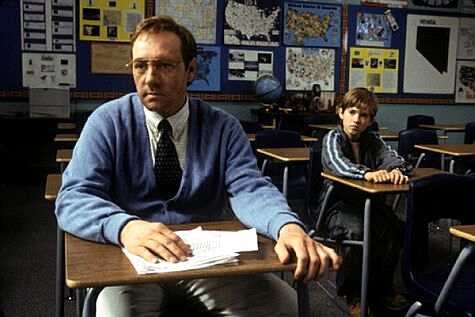 |
You witness
the first, testing, tension-packed conversation between Spacey and Osment,
as pregnant in its silences as in its words, and you are ready to go wherever
this movie leads you.
Below is a conglomeration
of the reviews on the film from the leading and respected film critics
Robin Clifford, Eugene Novikov, Mark Leeper, Roger Ebert, Brian Webster,
John Sylva and Susan Stark
"Think of an idea to change our world -
and put it into action" - that is the first assignment posed by Eugene
Simonet (Kevin Spacey) to his new seventh grade social studies class.
The kids come up with ideas ranging from putting up recycling posters to
encouraging Chinese children to all jump at the same time and thereby knock
Earth off its axis. One young boy, Trevor McKinney (Haley Joel Osment),
has a simpler, yet more powerful scheme. He takes the assignment
to heart and begins a cycle of good deeds that may really change the world
in "Pay It Forward."
Pay it forward. What is it?
If someone does you a decent turn, don't repay it, pay it forward.
Do something good for three other people. Then, if they do three
good turns and so on and so on. Before you know it, the world is
a better place for everyone.
Trevor begins his own campaign to "pay
it forward" when he befriends a homeless junkie named Jerry (James Caviezal)
and brings him home, much to the chagrin and fright of Arlene McKinney
(Helen Hunt), Trevor's mom. Arlene, a cocktail waitress in Las Vegas, is
a single mom fighting her own demon - alcohol. She was married to
an abusive drunkard (Jon Bon Jovi) who beat her regularly before she split
for Vegas with Trevor.
When her son's attempt to save Jerry fails,
the boy selects his teacher, the fire-scarred Mr. Simonet, as his next
pay it forward target. The lonely Eugene is drawn to the troubled,
pretty Arlene and the couple begins to form an emotional bond when her
ex suddenly shows up - triggering one of Trevor's greatest fears.
The chivalrous Eugene bows out of his budding relationship with Arlene
without a word, leaving Trevor with another failed attempt to pay it forward.
The boy's last effort, to help a meek kid at school stave off bullies,
ends up being the one action that does, in fact, make the world a better
place, even if the cost is fatally high.
Concurrent with this tale about Trevor
is the search, by reporter Chris Chandler (Jay Mohr), to find the source
of the idea of paying it forward. The film actually began when, Chris's
vintage Ford Mustang is wrecked by the fleeing perpetrator while trying
to get a scoop on a hostage story. A stranger who happens by hands
the puzzled reporter the keys to a brand new Jaguar and leaves with just
the words that he'll be in touch.
When they get together later, the man tells
Chris the true story of a street hood who did him a kindness, in a hospital
emergency room, that helped his daughter, maybe saving her life.
The gangster's word to the man, instead of accepting thanks, is to just
pay the favor forward. Now, Chris is required to fulfill his own
pay it forward obligation and becomes obsessed with finding the source
of this remarkable philosophy. His search is the twine that binds
his quest to Trevor's own story.
Director Mimi Leder takes a turn from her
first, action feature entrie "Deep Impact," that starred Elijah Wood,
with the much more character driven material of Leslie Dixon's (The Thomas
Crown Affair) original screenplay. The helmer benefits from the acting
talents of the key players and is able to give some life to the preachy
script. The fairly economical film tries to cover too much territory
as it delves into Trevor's attempts to save the world, the multiple relations
of those around the boy, and the reporter's quest for the truth.
It's a bit too ambitious a job and may have been better handled by a director
with more experience dealing with character, rather than plot. Certainly
a tighter screenplay would have befitted the efforts of the cast and crew.
The talented cast is led by three Academy
Award legends, with Spacey, Hunt and the astonishing 12-year-old Haley
Osment playing the challenged protagonists of the tale. All three
show they deserve the acclaim gained in their recent efforts, though Spacey
has proven his greatness as a superb character actor many times before.
Made up as a burn victim of many years
before, Spacey bears the heavy, uglifying makeup with dignity, showing
Eugene as a complex, mostly dour character who has an inherent kindness
that just wants to pop out and let him love Arlene and Trevor as his own
family. When he is rejected, by his own sense of honor, your heart
goes out to the man. Spacey makes you want Eugene to be happy.
Helen Hunt's work in Pay it Forward is
undoubtedly the strongest aspect of the film. She took a character
that could have been an obnoxious stereotype (an alcoholic working two
jobs to pay the bills), and turning her into a fully-developed, strong
individual who the viewer grows to appreciate and sympathize with.
Surpassing even these Oscar winners, though,
is Osment. It is the performances that will gradually win everybody over
-- and this is due less to the adult castt than to Osment, who is riveting
and completely believable, and definitely proves that "The Sixth Sense"
was no fluke. He displays an intensity and authority that people
can't ever demand from a child actor.
People usually suspect that great youth
performances are the result of careful casting and manipulative direction.
Haley, though, is already a superb actor. He seems to have been born
with a face that just seems earnest and intense and he holds his own against
adults, not with cuteness, but with genuine acting intelligence.
You witness the first, testing, tension-packed
conversation between Spacey and Osment, as pregnant in its silences as
in its words, and you are to go wherever this movie leads you.
Pay It Forward is a rich experience, smart,
courageous and bracingly powerful. Its message is unabashedly positive
but it's not cuddly or cloying. Some critics call parts of the film, as
well as the film as a whole, called "implausible" and even "absurd."
They need to watch the film again and realize by how much they have missed
the point.
With a cleaner story line, the basic idea
could have been free to deliver. As it is, we get a better movie
than we might have, because the performances are so good. The people
believed in them and cared for them. Critics simply wish the movie
could have gotten out of their way.
Optimistic, yet painfully honest, "Pay
it Forward" is an excellent film for those who look for hope amidst the
world's seemingly overwhelming bad news. Its finale is more shocking
than the twist of "Sixth Sense" at the end. Only the most unrecoverably
cynical and hard-hearted will sit through the movie's final scenes unaffected.
Critics would want to hate "Pay It Forward"
and tell people not to go see it but unfortunately, those superb performances
have made it impossible for them to do so. The film is worthy of
your time, money, and, perhaps, tears.
|