* W O M E N A N D C H I L D R E N F I R S T *
Fifth officer Lowe, waking to noises outside his cabin, looked through the window and noticed people about with life belts on. He immediately got up, dressed, and went on deck. Walking out of his room, he received a better picture of the events happening around him. The passengers were standing around in life belts and the crew were busily trying to get the lifeboats ready for lowering. Lowe soon found someone who was aware of the situation and they informed him that the Titanic had struck an iceberg. Lowe could also feel the downward motion of the bow. From what he observed, the Titanic was well down by the bow and the deck had a slanting motion. Lowe went back to his cabin and grabbed his revolver. He wasn't sure if he would need it, but he wanted to make sure he had it if he did. Then he walked over to the starboard side of the boat deck and began to help in the loading.

Harold Lowe
Shortly after 12:00 pm, the Titanic's orchestra, led by Wallace Hartly, began to play in the First Class lounge on A-deck. Soon after, they moved to the Boat deck, just outside the entrance to the First Class grand stairway on the port side. On the Starboard side, many of the passengers escaped the cold of the night by testing out the machinery in the Gymnasium. Instructor W. T. McKawley took this time to show a few passengers the different machinery. Nearby, seated on a mechanical horse, First Class passenger John Jacob Astor IV [one of the richest members of the Titanic's First Class] cut open a life belt to show his newly wed wife, Madeline, what was inside.
Fourth officer Boxhall was told to work out the position of the Titanic and brought it to the wireless operators once worked out. At 12:15 am the first distress signal, C.Q.D., went out over the air. Still, the urgency of the situation escaped the two operators until later. Within a few minutes, the liner Frankfurt responded, and soon after, at 12:25 am, the Cunard Liner Carpathia received the signal. Carpathia seemed to be a light at the end of the tunnel. She was only 58 miles away from the Titanic and her captain, Arthur Rostron, was turning her around and heading at full steam for the Titanic's position as worked out by Boxhall..41*46' N, 50* 14'W.
After the collision, the lookouts had resumed their watch until they were relieved by their replacements, Hogg and Evans. Now, a light could be seen off of the Titanic's port side. The light looked to be from five to nineteen miles away. Forth officer Boxhall, standing on the bridge, had heard the warning bell rung and scanned the horizon with his binoculars. Seeing the light and taking it to be a ship, he began to use the morse-lamp to attempt to contact it.


Lookouts Hogg [left] and Evans [right]
At 12:45 am the first lifeboat, number 7, was launched from the starboard side. Launched by First officer William Murdoch, it held only 28 people and was under the command of Lookout Hogg who was now off-duty, having been told to help with the boats. But had room for 65 persons. What none of the officers seemed to have realized that evening was that the Titanic's lifeboats could actually be filled to capacity and perhaps even be over-filled to save more lives. This, and the urgency of the moment escaping from everyone's minds, caused the boats to leave half empty. As the boat creaked downward, it tipped at one side and then the other. Reaching the water a few minutes later, the crewmen cast off and rowed away from the sinking liner.
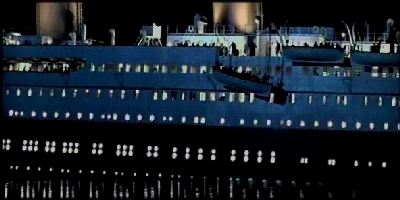
Boat 7 is lowered from the starboard side at 12:45 am
As Boat 7 rowed away from the Titanic, Quartermaster Rowe was still stationed at the docking bridge on the poop-deck and noticed the boat in the water. Telephoning the bridge and being acknowledged by Boxhall, Rowe asked if the bridge knew of the boat in the water. Boxhall's reply was to come to the bridge immediately and to bring along a box of flares with him. Rowe walked down to the crew lockers, grabbed the flares, and headed for the bridge with them.
On the boat deck, the attention now went to loading and lowering lifeboat 5. During the loading, Third officer Pitman was approached by J. Bruce Ismay and told "There is no time to waste!" Pitman, who had never seen this man before, told Ismay to stand back. When Ismay continued that the boat should be loaded with women and children, Pitman told him that he awaited orders from the senior officer [Murdoch]. Pitman went to the bridge, alerted Smith that Ismay wished to get the women and children away, and Smith told him to "go ahead and carry on." Pitman then returned to boat 5, stepped in, and called out "Come along, ladies!"
Ismay helped to get women into boat 5, and the boat was almost filled. Pitman cried out for any more women and when none were seen Pitman allowed a few men into the boat as well. Pitman jumped back onto the ship, and was told by Murdoch "You go in charge of the boat, old man, and hang around the aft gangway." Pitman hesitated, not wanting to go in the boat, but Murdoch's orders soon won. Pitman never saw Murdoch again.
" So Murdoch told me, he said, 'You go ahead in this boat, and hang around the after gangway.' He then shook hands with me and said, 'Good-bye; Good luck.' and I said, 'Lower away.'"
Soon after, Rowe arrived on the bridge. He and Boxhall set up, and the first rocket was fired into the sky. The rocket rose high over the funnels, masts, and rigging, and burst with a loud report and a trail of colorful stars. With a gasp, the crowd looked up at the rocket and knew that something was wrong. Titanic was stopped, and calling for the help of any vessel near enough to see the rockets.
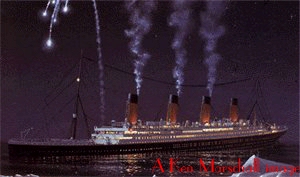
Fourth officer Boxhall and Quartermaster Rowe began firing rockets to hail the ship on the horizon.