
* L O W E R I N G A W A Y *
As things progressed on the Starboard side, Second officer Lightoller and Chief officer Wilde continued to prepare the boats on the Port side for lowering. When all the boats were out and ready, Lightoller suggested that Wilde and himself begin getting the passengers into the boats. But Wilde was reluctant and told him to wait. Lightoller went to ask Captain Smith who responded to get the boats away.
"I made for the Captain and happened to meet him near by on the boat deck. Drawing him into a corner, and, cupping both my hands over my mouth and his ear, I yelled at the top of my voice, 'Hadn't we better get the women and children into the boats, sir?' He heard me and nodded reply."
At Lifeboat number 6, Lightoller had a hard time filling the boat due to the women's reluctance to leave their husbands. The venting steam had finally stopped and Lightoller and the crew tried the hardest they could to fill the boat. One of the more prominent people put aboard the boat was Mrs. Margaret Brown from Denver. Lightoller also appointed Quartermaster Hichens into the boat to command and Lookout Frederick Fleet to man the oars. Lightoller took the order of "Women and Children First" as gospel and would not allow any men into the boat except those needed to help row. Standing near-by as he filled the boat was First Class passenger Major Arthur Peuchen.
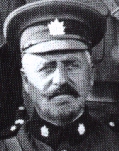

Left: Major Peuchen Right: Margaret Brown
"The second officer stood there and he carried out that [order] to the limit. He allowed no men except the sailors, who were manning the boat."
The men at the boat called out for more women, and Major Peuchen observed that a few would still not leave their husbands. He then recalled seeing a few women pulled away from their husbands and set into the boat. At 12:55, Lightoller gave the order to lower the boat. After lowering a short distance, Quartermaster Hichens called up that he only had one sailor and would need another to assist in rowing the boat. Lightoller asked if anyone in the crowd was a seaman and Peuchen stepped forward. He had been a yachtsman, and was told by Lightoller to climb down the falls to the boat.
"We got hold of a loose rope in some way that was hanging from the davit, near the block anyway, and by getting hold of this I swung myself off the ship, and lowered myself into the boat. On getting into the boat I went aft in the lifeboat, and said to the quartermaster 'what do you want me to do?' He said 'get down and put that plug in'"
Peuchen was unable to find the plug until the boat was almost in the water. He found it, and shoved it into the draining hole quickly. Lifeboat number 6, the third boat to leave, landed safely into the water and cast off away from the Titanic. A capacity of 65 people, it held only 24.
On the Starboard side, the men began to fill lifeboat number 3. Put in command of Able Bodied Seaman George Moore; the boat held, among it's occupants, the Spedden Family. Of the boat's capacity of 65 people, only 38 to 40 people occupied it when it rowed away at 1:00 am. Mrs. Daisy Spedden kept a diary and recorded her family's escape from the foundering Titanic.
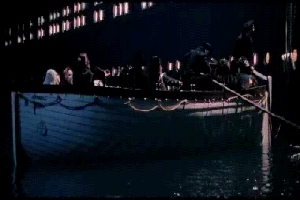
Boat 3 casts away from the Titanic
"When no more women responded to the call, we were lowered a distance of 65 feet, and at times the boat tipped so that we thought we would upset, but everyone remained quiet, and after what seemed an eternity, we struck the water and rowed off."
At the side of lifeboat number 8 on the Port side, First Class passengers Isador and Ida Strauss stood by watching as men filled the boat. Near-by them was First Class bedroom steward Alfred Crawford. He observed as Mrs. Strauss crossed over into the lifeboat but then returned to the deck. Her maid, Ellen Bird, went on ahead of her, but Mrs. Strauss would not leave her husband. When the offer was made to allow Mr. Strauss a seat in the boat with Mrs. Strauss, he said he would not go before the other men. With that, the couple decided to stay with each other.
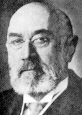
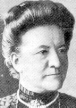
Isador and Ida Strauss
Crawford and a cook were ordered into the lifeboat by Captain Smith and the boat was lowered away by Second officer Lightoller. Among it's occupants were the Countess of Rothes and her maid. At 1:10 am, with a capacity of 65 people and occupying 28, Able Seaman Thomas Jones took command of the boat and it rowed away from the Titanic.
At the same time that boat 8 was launched on the Port side, Lifeboat number 1 was launched from the Starboard side. Approaching the boat, a bit agitated, Mr. Henry Stengel noticed that not many people were around and asked First officer Murdoch if he might join the few people in the boat. When Murdoch agreed that he could join them, he hopped onto the rail and rolled into the boat.
"There was no people working the boats, and he said 'jump in.' The railing was rather high -- it was an emergency boat and was always swung over toward the water -- I jumped onto the railing and rolled into it. the officer then said 'That is the funniest sight I have seen to-night.' and he laughed heartily. That rather gave me some encouragement. I thought perhaps it was not so dangerous as I imagined."
Also in Boat number 1 were Sir Cosmo Duff Gordon, his wife Lady Lucille Duff Gordon, and her secretary Ms. Francatelli. All-together there were only 12 people of 40 spaces in boat number 1 when it was launched from the side of the Titanic at 1:10 am under the command of Lookout George Symons. Of all the boats launched from the ship, this one was the least-full.
Boats continued to be launched and rockets continued to be fired. Many people could still see the far-off light off the port bow. But it continued to loom off on the distant horizon with no sign of rescue. The two radio operators, Bride and Phillips, continued to work at the key to try to contact any vessel near enough to help. And their best bet was still the Carpathia, which had radioed that they were coming as fast as possible and at full steam but were still more than four hours away. Suddenly Bride had an idea to send the newer distress signal SOS, and sometime earlier at 12:45 am the signal went out.
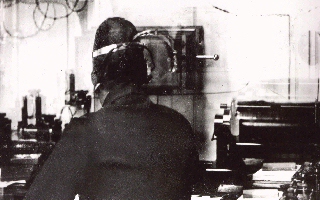
Phillips continued to toil away at the key
"Then the captain came back. 'What are you sending?' he asked. 'C.Q.D.' Phillips replied. The humor of the situation appealed to me. I cut in with a little remark that made us all laugh, including the captain. 'Send S.O.S.' I said, 'It's the new call, and it may be your last chance to send it.' Phillips with a laugh changed the signal to S. O. S."