* C O L L I S I O N *
As the Titanic continued to speed ahead, the lookouts in the crow's nest strained their eyes to see ahead of them. Fleet and Lee, although told to watch for ice, had seen none yet. But there was a clammy smell in the air that one smells when nearing ice flows, and the temperature had dropped drastically. Still, the night was calm..the sea was like glass, and the ship continued steadily on her course.
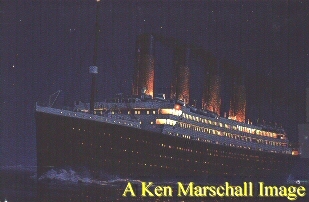
Titanic sails Westward
Because of the shuffling of officers in Southampton, no one knew where the binoculars for the crow's nest were stowed. One belief is that they were still in the locker in Second Officer Lightoller's room, where they may have been placed by David Blair, who was originally appointed second officer, before he left Titanic. None-the-less, the crow's nest did not have them and the lookouts had to rely on their own eyes.
At 11:39, while peering ahead of the ship, Frederick Fleet noticed a small object that he took to be no bigger than two dinning tables put together. But as he continued to watch, it began to grow in size and blackened out the stars on the horizon. Realizing that he was instead looking straight at a giant iceberg lying directly ahead, Fleet rang the crow's nest bell three times [the warning for danger ahead] and immediately picked up the telephone to contact the bridge. Meanwhile, on the bridge, Sixth officer Moody picked up the telephone and a brief trade of words took place.
Fleet: Is there anyone there?
Moody: Yes, what do you see?
Fleet: Iceberg ahead!
Moody: Thank you
After hanging up the telephone, Moody proceeded to warn First Officer Murdoch. Murdoch had been standing on the Starboard bridge when he heard the sound of the warning bell from the crow's nest. Moody did not need to inform Murdoch of the berg looming ahead. Murdoch had already seen it for himself. He quickly issued a series of orders that would seal Titanic's fate. Murdoch's first order was for Hichens to turn the wheel "Hard to Starboard". This would swing the ship's bow to the port [left] side. Immediately after ordering the wheel turned, Murdoch rang the engine room telegraph to have the engines stopped and then reversed. An error was made in reversing the ship. Due to her three propeller design and the size of her rudder, she would have turned faster if she had been going full ahead [forward] instead of full astern [backward].
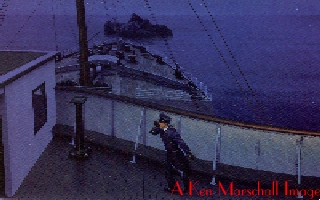
On the bridge, Murdoch ordered the wheel "Hard to Starboard"
The engine room toiled to carry out the order to reverse the engines, they had to cut off the turbine engine [which controlled the center propeller]. The turbine engine could only move forward. They also had to stop the two massive sets of reciprocating steam engines and then reverse them. All-in-all, with the iceberg growing closer, they had a total of 37 seconds to carry this order out. From the bridge, the Titanic's bow seemed to be plowing straight for the iceberg. It seemed to the men on watch as if a collision was unavoidable. The lookouts seemed to have had the same thought and braced themselves for a head-on collision. The whole time, the ship still continued to move straight ahead.
Then, very slowly, the bow began to move to Port. The engines had been put into reverse and the rudder was moved hard over. Now, it was possible that the Titanic could actually avoid the berg all-together..suffering nothing but a VERY close shave. But as the berg moved along the starboard side of the vessel, a faint grinding noise could be heard from down below and a vibration shuttered through-out the ship. Knowing that the Titanic was coming into contact with the berg, Murdoch immediately ordered the wheel turned "Hard to Port" to try to clear the stern hitting the berg. As well as ordering this new change in direction, Murdoch hit the alarm and proceeded to close the watertight doors.
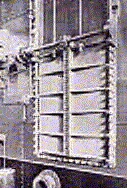
One of Titanic's watertight doors
In Boiler room number 6, Frederick Barrett and Junior Second Engineer James Hesketh had been conversing when they noticed the warning light on the stoke hole clock face read STOP. Immediately the order went out to shut all dampers. Shortly after this, there came a shrill noise from the watertight bulkhead door and the wall directly in front of Barrett and Hesketh caved in with a cascade of water. Running for the watertight door, which was descending at the moment, the men in Boiler room 6 found the conditions almost exactly the same in Boiler room 5. A gash ran into the compartment about 2 feet from the bulkhead. Barrett's account was recorded in "The Daily Sketch":
"There is a clock face in the stoke hole and a red light goes up for 'Stop.' I was talking to Mr Hesketh when the red light came up, and I shouted, 'Shut all the dampers.' That order was obeyed, but the crash came before we had them all shut."
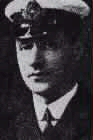
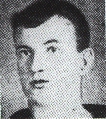
Left to Right: James Hesketh, Frederick Barrett
In the First Class Smoking room, a few men were seated around a card game while others were quietly having a drink before turning in or relaxing and taking advantage of the room being opened later than usual. Spencer Victor Silverthorne of St. Louis sat reading in a large lounge chair. Suddenly he, as well as others in the room, felt a slight jar and heard a crunching noise. The jar spilt one man's drink and the men ran out of the room to investigate. Among them was Hugh Woolner:
"We sort of felt a rip that gave a sort of a slight twist to the whole room. Everybody, so far as I could see, stood up and a number of men walked out rapidly through the swinging doors to the Port side, and ran along the rail that was behind the mast. I stood hearing what the conjectures were. People were guessing what it might be, and one man called out, 'An iceberg has passed Astern,' but who it was I do not know. I never have seen the man since."
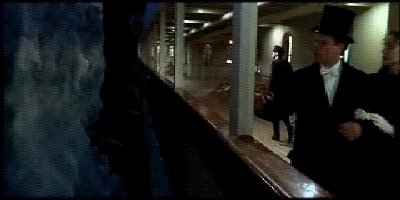
The berg passes the open A-deck promenade
Onboard the Californian, Charles Groves had been watching the light to starboard for the better part of the hour. The ship had overhauled the small craft but had not responded to the morse lamp. Suddenly he noticed that some of the ship's lights seemed to have been extinguished. He also noticed that she seemed to have stopped as well. Groves had spent time on the Far East Trade and was accustomed to the liners dimming their lights to encourage the passengers to turn in for the night. He assumed that this must have been the case with the ship he was now observing. It never occurred to him that the ship may not have put out her lights, but instead suddenly turned to port.
"EVERY THING WAS AGAINST US" The quote given by Second Officer Lightoller on the subject of the conditions of the night of the disaster. The conditions, Lightoller said, would never be seen again in 100 years. Many things came together to cause the ship's demise. The sky was absolutely moon-less and full of stars, the sea was smooth as glass, and the Iceberg was an extremely rare berg known as a "Blue berg" or a "Black berg". This is a berg that has turned over in the water and the clear ice is above the water. With the conditions of the night, this berg was virtually invisible until it was too late. |