* A S E R I O U S S I T U A T I O N *
As the berg glided by the poop-deck, on the stern of Titanic, Quartermaster George T. Rowe [stationed on the docking bridge] took a double take as he watched what he took to be a wind jammer with sails set pass by and almost hit the docking bridge. As the stern cleared this obstacle it became apparent to him that what he had seen wasn't a wind jammer at all...but an enormous iceberg. Surely, to him, this must have been a VERY close shave.

Quartermaster George Thomas Rowe
But other members of the crew, and passengers who were not asleep, had a much harder time finding details as to what it was that had disrupted them. Some of them felt slight jars. Others heard scraping noises. And some were even shockingly startled when ice fell into their open portholes! First Class passenger Lady Duff Gordon later stated that, to her, the collision was "as though someone had drawn a giant finger along the side of the boat."
Second Class passenger Lawrence Beesley's interpretation of the collision was much different from that of Lady Duff Gordon's. Beelsey had been reading in bed when he felt what he called "a more than usually obvious dancing of the mattress on which I sat." He did not know what this meant, but did not feel that it was much of an alarming circumstance.


Left: Lawrence Beesley Right: Lucille Duff Gordon
Approaching the bridge, at 11:40 pm, Fourth Officer Boxhall heard the warning bell rung three times. Along with this, he also heard Murdoch's voice order the wheel "Hard-to-starboard" and the engine room telegraph chime. He continued to walk towards his destination, which was only a short way up the deck from where he was standing, when he felt the impact.
"At the time of impact I was just coming along the deck and almost abreast of the captain's quarters, and I heard the report of three bells. That signifies something has been seen ahead. Almost at the same time I heard the first officer give the order 'Hard astarboard' and the engines telegraph rang. [There was] a slight impact. It did not seem to me to be very serious. I did not take it seriously."
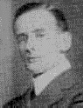
Joseph Groves Boxhall
Arriving on the bridge, Boxhall found Sixth Officer Moody, First Officer Murdoch, Quartermaster Hichens, and Captain Smith. Murdoch was just then closing the watertight doors and Smith, who had felt the collision while in his quarters, had just arrived. "What have we struck?" Smith asked as he walked into the wheelhouse. "We have struck an iceberg. I put her hard-to-starboard and ran the engines full astern, but it was too close. I intended to port-around it, but she hit it before I could do anymore." was Murdoch's grim reply.

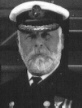
Left: W. M. Murdoch Right: E. J. Smith
The four officers walked out onto the starboard bridge-wing and peered aft for any trace of the fatal berg. Boxhall thought he saw it, but he could not decifer it's size or it's shape. To him, it was just a big black mass disappearing rapidly astern. Coming back the wheel-house, Smith ordered the watertight doors closed, to which Murdoch replied "The doors are already closed, sir." Smith's next order was for Boxhall to inspect the bow area of the ship and come back with a report of any damage that Boxhall had seen.
Boxhall went down into the lowest decks of the Titanic without going into the cargo areas. But from what he saw, everything in the ship seemed to be allright. He returned to the bridge about fifteen minutes later to report this, and Smith told him to get the ship's carpenter, John Maxwell, to sound the ship. Boxhall went to fetch the carpenter immediately, but met up with ship's joiner John Hutchinson on his way. Hutchinson told Boxhall "The ship is making water." Hutchinson went ahead to the bridge, and Boxhall then encountered John Richard Jago Smith, one of the Titanic's five Postal Clerks, going in the same direction. Jago Smith told Boxhall that the mail room was filling up with water. Boxhall went down to take a look.
"I looked through an open door and saw these men working at the racks, and directly beneath me was the mail hold, and the water seemed to be then within 2 feet of the deck we were standing on."
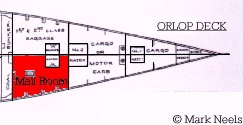
The mail room was located on two floors and the water was now on the second of the two floors [the Orlop deck ] and rising fast. Still, the postal clerks were busy trying to save what they could from the rapidly rising water.
Shortly before 12:00 J. Bruce Ismay, managing director of the White Star Line, also stepped onto the bridge. Ismay had been asleep in his B-deck cabin when the collision occurred. He awoke to the sound and first thought that the ship had lost a propeller blade. Throwing a robe over his pajamas, he headed for the bridge and breathlessly demanded an answer from the Captain as to what had happened to the ship. Captain Smith's reply was that the ship had collided with an iceberg and that, after looking at the ship's commutator, she was listing 5 degrees. "Is it serious?" Ismay asked. "I'm afraid it is. I've called for Mr. Andrews to find out just how serious it is." was Smith's reply.
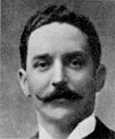
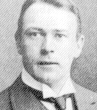
Left: J. Bruce Ismay Right: Thomas Andrews
After hearing the reports of the damage, Smith had sent for Thomas Andrews, one of eight representatives of the Harland & Wolff shipyard in Belfast [the company that built the Titanic] onboard. Andrews had been in his cabin for most of the evening and was so engrossed in his work of pouring over the blue-prints of the Titanic that he did not notice the jar or the scraping noise at all. As he was given the complements of the Captain and asked to join him on the bridge, Andrews now realized something..the engines had stopped.
Andrews arrived on the bridge and was told the situation by Smith. Together, they decided to take a tour of the bow and see the damage for themselves. Together, the two inspected the flooding mail-room and the other damaged compartments. They walked along the crew-corridors so as not to cause commotion among the passengers. Seeing the damage done to the ship, the two returned to the bridge and, along with Ismay, analyzed the damage.
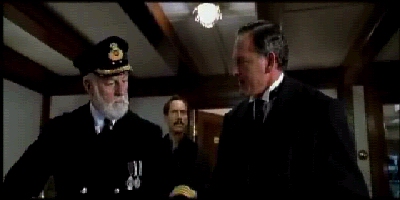
Smith, Ismay, and Andrews analyze the damage
Andrews explained it to them clearly. The Titanic had been damaged along an area of 300 feet of her starboard bow. The iceberg had ruptured the forepeak, numbers one, two, and three holds, and numbers five and six boiler rooms. This equaled up to six watertight compartments flooding. Ten minutes after the collision the water was fourteen feet above the keel and still rising. The water was low in boiler room five and the pumps were keeping it down, but the others were flooding rapidly. Titanic's design specified that damage could be done to any two of her sixteen watertight compartments. Damage could also be done to the first four compartments directly in the bow and the ship would still float. But under no conditions could she possibly float with the first six compartments flooding. Although the doors were closed immediately after impact it made no difference to the first six compartments. Titanic was going to founder. Andrews went on to say "There is nothing we can do to stop us from sinking."
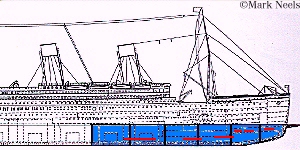
The damage by the iceberg, although rather small, was enough to sink the Titanic. The red area on this diagram shows the actual punctures of the iceberg. The blue area shows the compartments effected by this damage.
Captain Smith asked "How much time do we have?". To this, Andrews made up a calculation of the amount of time it had taken for the water to rise fourteen feet. This calculation told Andrews that the flooding was occurring at a rapid rate. "I give her an hour...possibly two. But not much more than that." was Andrews' reply.
By now, Fourth officer Boxhall had returned from below. He confirmed that water was rapidly filling up the mail-room. No hesitation could be made. Smith's orders to this situation....wake the passengers and prepare the lifeboats for lowering. Smith, Andrews, and Ismay were among the few people to realise that the Titanic only carried enough lifeboats to seat 1,178 of it's 2,228 people onboard.