The Meaning of Hindu
The word Hindu is not a religious word. It is secular in
origin. It is derived from the word Sandhog, which is the name of a major river
that flows in the northwestern region of the Indian subcontinent. The ancient
Greeks and Armenians used to refer the people living beyond the river Sandhog as
Hindus and gradually the name struck. When the Muslims came to the sub continent
they called the people living in the region as Hindustanis to distinguish them
from the foreign Muslims. Subsequently when the British established their rule,
they started calling the local religions collectively under the name of
Hinduism.
It is interesting to note that the word is neither Sanskrit
nor Dravidian and did not originate in India. It was not used by Indians in
their descriptions or writings till the 17th century. If we go by the original
definition of the word Hindu, any one who lives in the subcontinent is a Hindu
and whatever religion he or she practices is Hinduism. The word Hindu is a
secular word and literally translated it means Indian and the word Hinduism
denotes any religion or religions that are practiced by the multitude of people
living in the land beyond the river Indus.
|
The Meaning of Hindu
Qquestioner
1:
It
really seems strange to me that even in the East, yoga is confused with
Hinduism. I think this shows how little of yoga is lived these days, and how
little of its ancient discipline has been transmitted. I also find the ways and
means of so-called Theravada Buddhist yoga—especially
its attention on breath—to
be very close to Patañjali’s yoga. What do you think?
Troy
Harris:
What you say is perfectly true.
But
merely talking or reading books will never reveal these things to anyone. To
understand yoga, it has to be lived.
Questioner
2:
Then
Hinduism and Buddhism are not opposed to each other?
THE:
No,
nto
at all. Why should they be? Minus its profusion of anthropomorphic deities, the
highest vision of Aviate Vedanta, or so-called Hindu Philosophy, is precisely
the vision of Buddhism Liberation. These are not two currents. Cultural and
political influences have only made them appear so. You see, what we take to be
“Religion” is largely just the elaboration of superficial rites and rituals, the
costuming, the graphic design, the ribbons and the bows, the politicized press
releases. “Religion” in this way is just so much cultural accretion. But what
the soul seeks is an unadorned simplicity, an intimate transparency of knowing
peace.
Q2:
What
does Hindu actually mean then?
THE:
As
a modern term, Hindu has evolved from the Indo-Iranian root sandhog. This
Proto-Indo-Iranian word *sandhogs
literally refers to the “Indus river” and the culture pertaining to its long
expansive valley. This is where Hindu culture first developed.(1)
Historically, however, at a very early date, Persian explorers entered the
Indian subcontinent from the far Northwest. After they returned, they published
chronicles. But due to the phonetics of their native Persian language, the ‘S’
of Send became an aspirated ‘H.’ This is how the people of the Indus Valley came
to be known generically as “Hindus” by the Persians. This flawed intonation
inevitably stuck(2)
and was later re-imported when the invading Moguls conquered India. Since they
always referred to the locals as “Hindus,” the term was adopted by the Indians
themselves as a way of distinguishing native culture from that of the foreign
Muslims.(3)
But it should be noted that still today there is a region, a people and a
language called Send.
Q2:
Then
where does the word “India” come from?
THE:
The
Modern term “India” is simply ancient Greek, though pronounced a little
differently than in English, of course. It is an early Hellenism whereby the
Persian ‘H’ was changed to ‘I.’ This further lends knowledge of the ancient
Greek
indices
and Latin
indices,
equivalent adjectives meaning “Indian, pertaining to India, having to do with
India,” etc. Similarly, the botanical term for Indian hemp is
Cannabis indicia.
Hindu,
then, and I emphatically state, simply means “Indian,” “Made In
India”—“A
Product of Hindustan.”
Q1:
It’s a little confusing though. You seem to be implying that “Hindus” are simply
the people born in India, and not the followers of a religion. One must make up
one’s minds whether Hindus are a religious community or not, and then speak
consistently.
THE:
My
mind is clear. “Hindus” do not make up a religious community. “Hindu” has little
to do with “religion,” per se. At best, “Hindu” implies a tentative community.
Q1:
‘Tentative?’
THE:
By
“tentative” community I look to the fact that, fundamentally, “-isms” need not
at all be conjoined to the various religious sectors of India, especially in so
far as they attempt to discern the degree to which there is retention of, or
origin in, a Brahman cal field; hence the traditional schemata, “Brahman cal,”
“heretical” and “foreign.” But as I have written, “gurus”
are actually the main religion in Indian society because people don’t normally
“belong” to churches or temples but honor a personal
guru.
I would further suggest that the “institution” of the
guru
is fundamentally “heretical,” or perhaps more civilly expressed,
“heterodox cal.” That is to say, it is a tradition contrary to the Brahman cal
institution of hereditary priesthood, and does not accept the Vedas as
inviolable scripture.
Indeed,
the traditional heretics of the
guru
in India is at the very heart of Hinduism.
And
it should be. It’s so beautiful.
Q1:
To
some extent, I agree with you. But this nonetheless takes us to a fundamental
methodological problem, does it not? Under the general description of “Hindu” as
an inhabitant of the land east of the Indus (especially true for around 500-300
BC), Janis and Buddhists would be “Hindu” in origin. That apart, could you offer
a consistent and comprehensive statement of “Hinduism” as defining “a” religious
community? I would at least enjoy hearing your attempt.
THE:
Again,
sir, “Hindu-ism” can only imply a religious community in a “tentative” sense.
But the culprit here is “-ism,” I feel. I find that attaching the suffix “-ism”
to the end of all sorts of words is one of the most unacademically sound
penchants we of the academic breed exhibit; and which indeed makes Hindu-“ism” a
catchall term that ultimately defies any definition. I assume (correct me if I’m
wrong) that Western “scholarship” contrived the term in the early part of the
19th century.
The
Oxford English Dictionary
traces
“Hindooism” to an 1829 reference in the
Bengalese,
45. It also refers to an 1853 usage by the German Ideologist Max Muller. But the
point worth
reiterating
is that as a modern term, “Hindu” simply means “Indian” or “Made in India”—“A
Product of Hindustan.
Notes:
(1)
Sandhog
thus evolved into Old Persian ‘Hindu’
and was consequently borrowed from Persian into Greek as
Indus.
Greek thereafter formed the name of the country from this stem ‘and-’
with the suffix ‘-air,’ a typical method of forming the names of countries in
Greek. Our
name for the river ‘Indus’ is the Latin form of the Greek name and isn’t
original.
(2)
Perhaps it is really not a ‘flawed intonation,’ then. In ancient Ironic, ‘h’ is
the normal outcome of an Indo-Iranian ‘s’ in this position.
(3) “The
Arabic ‘Al-Hind’
is therefore a term denoting a particular geographical area. Although indigenous
use of the term by Hindus themselves can be found as early as the fifteenth and
sixteenth centuries, its usage was a derivative of Persian Muslim influences and
did not represent anything more than a distinction between ‘indigenous’ or
‘native’ and foreign (lecher).”
Richard King, “Orientalism and the Modern Myth of ‘Hinduism’” (1999). See also
David
N. Lorenzo, “Who Invented Hinduism?” (1999), 630-659.
|
Why do
Hindus worship many Gods?
As a
universal formulation, Hinduism accepts all formulations of Truth.
According to the Universal view, there is only One Reality, but it
cannot be limited to a particular frame or form. The various Gods
and Goddesses of
Hinduism represent various functions of this One Supreme Divinity
and are not separate Gods.
Why is the Goddess
worshipped ?
As Sanatana Dharma or a
Universal Tradition, Hinduism recognizes that the Divine contains
both masculine and feminine attributes. Without giving proper honor
to the feminine qualities, a religion must be incomplete and one
sided . The worship of God in the form of Mother is a unique feature
in Hinduism. Today Hindus worship the Divine mother in many popular
forms such as Durga, Kali, Lakshmi,Saraswati, Ambika and Uma. To a
Hindu, the motherly aspect of God in nature is full of beauty,
gentleness, kindness and tenderness. The natural love between a
Mother and her child is the best expression of the Lord’s
unconditional love for us as children of God. Through the worship of
God in the form of Mother, Hinduism offers a unique reverence to
womanhood.
What is the
significance of MUHURATA – sanctified time ?
Muhurta is nothing but the fixing of a particular time for an-event to
be performed in the future. We understand that making a judgement
about the future has to be based either on forecasting techniques or
on astrology. During performance of any important function whether it
is a naming ceremony (namakaran vidhi or barasa), thread ceremony
(janeu sanskar or munja) marriage, etc., an essential part is to ask a
pandit to work out the auspicious moment or 'muhurat' when the
ceremony should be performed.Astrology is a gift of its close sister
discipline astronomy. There could be no astrology without astronomy,
as astrology predicts the turn of events in the future with the real
or imaginary changes in planetary and star positions. We know that the
firmament i.e. the observable universe, has a mechanics of its own.
The earth and sun being part of the firmament go about their own
movement as per the mechanics. The rotation of the earth on its axis
causes day and night and its revolution round the sun causes weather
changes. This co-relation between a change in star patterns and a
change in weather which repeated itself year after year, germinated
ideas that star patterns decide weather changes. This interpretation
gave birth to ideas that
appearance of a particular star spelt prosperity while that of another
spelt doom. In India the appearance of a comet (Dhumketu) was looked
upon as portending doom. Following this it was not a difficult step to
believe that changes in an individuals fortune are also decided - by
changes in star patterns. Thus the development of astronomy lead to
astrology and to beliefs in the auspicious or inauspicious. Henceforth
the practice of consulting learned pandits for derivation of
auspicious dates or time in the future could evolve naturally.
How did YAGNA come
into practice ?
The Yagna was central to life
in Vedic times. It had not yet become a ritual then. The Yagna was the
central fireplace of the Aryan Gana (tribe). Fire has since then
played a central part in Hindu religious ritual. Even the Hindu (and
Sikh, and Buddhist) flag seen above has the colour of fire. This is so
as initially, it was the actual fire that was carried from one place
to another as a sacred object.The ancient Vedic Aryans had some people
from the Gana (tribe) who had the specific task of preserving the
fire. They were called 'Agnihotra'. According to Sanskrit philology
this term is an amalgam of the two terms Agni and Troo. 'Agni' means
'fire' and 'Troo' means 'to preserve'. The Central Fireplace of the
Aryan tribe became a ritual to be performed at any important occasion
as in a marriage. The Saptapadi (Seven Steps) was a ritual to be
performed around a central fireplace called agni-kund. The sacred fire
was Vedi. The couple to be married had to go around the Vedi seven
times, representing seven days of the week. Dana and Dakshina are
given in Cash and Kind, but never as free Physical Labour
How did
the custom of HAVANA begin ?
The way of life both during
peacetime and war was based on collective activity. In the tribal way
of life even during peacetime the share (Havi) of every member of the
tribe was distributed in a function called the Havana. Whatever was
gathered, hunted or cooked was shared among all members of the
tribe.The same principle was applied to the distribution of the booty
of war. This distribution which was carried out in festive atmosphere
after a successful campaign is perhaps the progenitor of our custom of
offering dana especially on festival days and other auspicious
occasions.
What
are the symbols of SAUBHAGYAVATI - The Blessed One ?
This term is used to refer
to a married Hindu woman. The symbols associated with a woman being
married are the Laxmi padas (Goddess Laxmi's Footsteps). The Goddess
Laxmi is believed to have entered the house of a married woman who
performs poja after drawing the Laxmi Padas. Other symbols of a
woman being a Saubhagyavati (Married) are a vermilion powder pot,
bangles, a comb, and a looking glass.
Why do
we greet people with NAMASTE ?
Namaste could be an amalgam
of Namsya (or Namaha) meaning obeisance and 'Te' which means you or
to you. Thus Namaste as an amalgam of Namasyate could be translated
as obeisance to you. Namaste involves the joining together of both
palms at the level of the breast. If the person being greeted is a
senior or if it is addressed to God, the Namaste is accompanied with
a slight bow. The meaning implies a submission of one person to
another. Thus, Namaste as a salutation could have originated as an
acknowledgement of submission or surrender of one person to another.
Hence, it would not be erroneous to infer that Namaste was in fact a
declaration of submission. The fact that both hands have to be
displayed to the person being greeted could have its origin in the
practice that when a person submits to another or when two strangers
hail each other they have to prove that they are unarmed and that
their intentions are peaceful.
What is
the significance of the TILAK ?
The Tilaka is normally a
vermilion mark applied on the forehead. This mark has a religious
significance and is a visible sign of a person as belonging to the
Hindu religion. The Tilaka is of more than one colour although
normally it is vermilion. It also does not have any standard shape
and form and is applied differently by members of different Hindu
sects and sub-sects.
It is applied as a 'U' by worshippers of Lord Vishnu and is red,
yellow or saffron in colour. It is made up of red ochre powder
(Sindhura) and sandalwood paste (Gandha). Worshippers of Lord Shiva
apply it as three horizontal lines and it consists of ash (Bhasma).
Soot (Abhira) is also used as a pigment for applying a Tilaka.
Why do Hindu women apply
KUMKUM OR BINDIYA on their forehead ?
Sindhura
which is also used to describe a Tilaka means red and Gandha which
is also a term for Tilaka means pleasant odour. Hence, Tilaka
normally connotes, a red mark with a pleasant odour. Some scholars
have seen the red colour as a symbolism for blood. We are told that
in ancient times, in Aryan society, a groom used to apply his blood,
on-his bride's forehead as a recognition of wedlock. The existing
practice among Indian women
of applying a round shaped red Tilaka called Bindiya or Kumkum could
be a survival of this. The third eye of Lord Shiva stands for
omniscience or wisdom. When Hindus wear kumkum or sandalpaste on
their forehead, it is to remind themselves of their latent power of
wisdom which they should awaken.
What do
we understand about SWASTIK ?
This is also
revered by Hindu and ranks second only to OM
Did the Swastika originate as blueprint for a fort called Su Vastu?
In the conventional type of a fort, the fall of one of the gates to
the attacking army would lead to the Enemy's pouring into the fort and
lead to massacre or capture of all or most of its inhabitants. But
under the Swastika grids fall of one of the four gates could still
keep, at least three-fourths of the fort safe. The understanding of
the Swastika as a blueprint for a fort can also be etymologically
corroborated. In Sanskrit, Vasa means to inhabit and Vastu means
habitation. While Su means good. The word Swastika might be an amalgam
of the terms 'Su' and 'Vastu' pronounced as as 'Swastu') meaning 'a
good habitation'.
What is
the symbolic importance of PURNAKUMBHA ?
Purnakumbha literally means a
"full pitcher" (Purna = full, Kumbha = pitcher). The Purnakumbha is a
pitcher full of water, with fresh leaves of the mango tree and a
coconut (Sriphala) placed on the top. The Purnakumbha is an object
symbolizing God and is regularly used during different religious
rites. One instance of the Purnakumbha itself used as an object of
worship is the Satyanarayana Puja or the worship of Lord
Satyanarayana. The water in the jar is said to be the divine essence.
Water has been an object of worship since a very early age among the
Hindus.Water plays an important role even today in Hindu religious
rites. During all purificatory rites, water is sprinkled on the object
to be purified. Before starting his meal a Hindu sprinkles water
around the the banana leaf from which a meal is traditionally eaten.
In ancient times before coronation a king was sprinkled with water so
as to ensure an auspicious beginning to his reign.
.
Festivals
Hinduism takes many forms from
serene private prayers to public festivals. There are festivals and
ceremonies associated not only with Gods and Goddesses but also with the
sun, moon, planets , rivers, trees, animals etc. The innumerable festive
occasions lend Hinduism its amazing popular appeal and the Indian
tradition rich and colourful.
Many of our festivals, we are told, owe their origin to acts of the
Gods; the birth of Lord Rama (Ramnavami), his return from exile (Diwali),
the birth of Lord Krishna (Krishnastami or Janmastami) and so on.
But, two aspects about festivals that are evident are that they are
occasions for rejoicing, and that they are social in character.
Festivals arose out of some
necessity of day-to-day life of the hazy past and were later transformed
into customs, due to which they obtained a changeless character What
began as at habit was transformed into a custom. This way, different
customs and traditions came to be associated with different festivals.
And once, habits arising out of necessity of the environment were
transformed into customs, they obtained a changeless character. It was
this character that was responsible for perpetuating the existence of
customs even after the environment that had given birth to them no
longer existed. What had begun as a social necessity, changed into a
custom, had now become a ritual. A ritual that was continued to be
performed not because the way of life or the natural environment demand
it, but because it had been performed so far and had been handed down
from generation to generation, till human memory could recollect.
Raksha Bandhan
This festival falls during
the month of Sawan on Purnima (full moon) It heralds the
arrival of monsoon. Raksha Bandhan or Saluno represents
one of the most sentimental festivals of India. It is based on the
emotional ties that bind the brother and sister in a very close bond.
- the most sacred relationship of life, without any ulterior motive or
demand of any kind. - that nature has bestowed on mankind.To symbolise
this profound relationship, the sisters tie a rakhi on the right hand
wrist of all her brothers on this day and they acknowledge this
relationship by accepting it with grace and love. With this rakhi ,
the sister bestows deep affection and blessings on her brothers so as
to guard them against all harm, and prays to the almighty to give the
very best to them.
The story goes that a
couple wanted a child very much and prayed to God to give them a son.
The son born was called Shravan Kumar and he was a very dutiful boy,
full of love and joy. With age, his parents grew old and blind and
realised that they wished to go on a pilgrimage at a place where
Ganaga flowed so that they could take a dip in the holy water. Wanting
to fulfill his parents wishes, Shravan built a baingi - a long pole
with two baskets hanging on both ends for carrying his father and
mother. On the way , his parents felt thirsty, so Shravan took a
pitcher to get water from a nearby stream. At this very moment, King
Dasarath was out hunting. On hearing the sound near the stream and
presuming it was a deer , he shot an arrow into the thicket. The arrow
pierced Shravan's heart and he fell down in pain. Unable to speak he
barely managed to tell the King about his blind parents waiting for
him to quench their thirst. Soonafter, Shravan died in the arms of the
King. When the King approached his parents they pushed the pitcher and
cursed him that the King should also die of agony waiting for his son,
so that the King may know how much pain and agony he had caused to
them. So it happened that Ram was sent to exile and the King died of a
broken heart.
The crux of the story is that
Shravan did not have a sister and no one ever tied a rakhi to protect
him at the time of danger. The truest protection comes from truest
prayers.
Raksha Bandhan affords a most
auspicious occasion to recharge ourselves every year with the true
spirit of service and sacrifice for the welfare of the society, and
find therein the highest spiritual fulfillment of human life.
HOLI
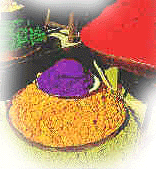
This festival falls on the
full moon during the month of Phagun. The festival of Holi
begins on Duvadashi , three days earlier to Puno - on the
12th day of the waxing moon of Phagun. Holi marks the end of winter
season.
The story dates back to
the days of Hiranyakashyapa, when he ordered his son
Prahlad ( the great bhakt of Lord Narayan) to be burnt
alive, because Hiranyakashyap was an Asur and hated
Lord Narayan. He asked his sister Holika, to wear the
set of clothes she possessed which could not catch fire. She was
told to hold Prahlad in her lap tightly, so that he could not
escape while in flames. Holika was a very good soul; she quietly
transferred the clothes onto Prahlad and got burnt herself, thus
saving Prahlad to grow up and become the greatest bhakt of Lord
Vishnu.
Holi is celebrated
over two days.To celebrate this great event , the bonfire is lit
and people worship.On the next day, the fires lighted on the
previous night are extinguished. The ashes left over are considered
sacred, therefore this day is known as Dhulivandan ( dhuli is
dust , here it means ashes; vandan means to bow down).The people
throw gulal, a colour powder and drench each other with
water. Holi is the most colourful festival of India. The second
day of Holi is called Dhuleti or Rangapanchami (Ranga
- colour; Panchami -fifth day). This is so called as previously
this festival used to be celebrated over five days.
DUSSEHRA
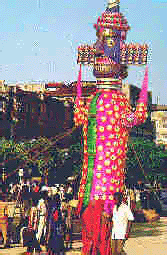
The Dussehra festival
falls during the moonlit fortnight , i.e on the 10th day of the waxing
moon in the month of Kwar. This comes as a finale of the nine day
festival called Navratri. This festival signifies the victory
of the forces of righteousness over those of wickedness. Navaratri
itself means nine nights (Nava = nine, ratri = night).The term
"Dassera" or "Vijayadashmi" which is the last and tenth
day are derived from the word for number ten i.e. Das (in Hindi) or
Dasha (in Sanskrit)
It is on this day in the
Treta Yug, Ram the seventh incarnation of Vishnu, killed
the great demon Ravana who had abducted Ram's wife Sita to his kingdom
of Lanka. Rama along with his brother Lakshmana , devoted follower
Hanuman and an army of monkeys fought a ten day battle to rescue his
wife Sita. The story of Rama and Sita is recounted with affection and
love in the great epic Ramayana.
Rama was a great believer in
the powers of Goddess Durga, and he prayed to her for the ninth days
before he himself entered the battlefield on the tenth day. On this
day he killed Ravana, Meghnad and Kumbhakaran -- signifying the
greatest victory of good over evil. This day became known as Dussehra,
also called Vijayadashami. Songs describing the heroic deeds and
virtues of Rama are sung and effigies of Ravana are burnt on Dussehra.
In Bengal, the occasion is
celebrated as the day on which Durga Ma killed the terrible
demon Mahishasur. Dussehra puja is done in the morning, on this
day all weapons, tools, instruments, pens and pencils are worshipped
because they are the means of fighting injustice, ignorance and evil.
The Dussehra festival is
one of the greatest and most important festivals in India and with it
comes the winter.
MAHA SHIVRATRI
This
festival is celebrated on the thirteenth day of the waning moon
in the month of Phalgun. This festival symbolises the
wedding day of Lord Shiva And Goddess Parvati.
This is
the night when Shiva is said to have performed the Tandava
or the dance of creation, preservation and destruction
Shivratri
is a very auspicious day. The married and unmarried girls perform
puja with great faith, fervour and feeling, since Parvati is
considered "Gaura" -- the giver of Suhag. They pray
to the Goddess to give them a good husband,marital bliss and a
prosperous married life.
On this
day every member takes a bath early in the morning and wears clean
clothes.Devotees fast during the day and maintain a long vigil
during the night.The puja room is cleaned and the images of
Ganesh, Shiva and Parvati are cleaned and placed in the centre of
the room.
When going
to the temple, people take a vessel ( usually made of
copper) filled with water with a little Ganga jal and
milk mixed. The other things taken are leaves of bel tree (
belpatra), a bel fruit, dhatura , bhang, aak, and bits of
flowers, fruit, aipun, roli and rice , a small katori with oil and
a wick of cotton all nicely set in a thali which can be carried
easily.
In the
temple the devotees bathe the Shivling with water mixed with milk
by pouring the liquid slowly on top of the ling.
The puja
is done then with water, roli, aipun, rice and flowers and fruits
are offered. A small jyoti is lit and arti is performed by
circling with the thali 3 to 4 times in front of the ling.
Parikrama is then performed three times. In the case of Shivling
the parikrama is half only; one returns from where the water falls
away from the ling. This water is given as charnamrit to the
devotees but the prasad is not eaten as it contains poisonous
substances.
Maha
Shivratri is the most revered festival of the Kashmiri pundits and
is celebrated for full sixteen days.
DEEPAWALI
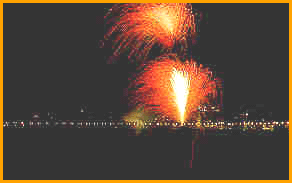
Deepawali also called
Diwali -- the Festival of Lights
is celebrated exactly 20
days after Dussehra on Amavas(moonless night) during the dark
fortnight of Kartik. Diwali means an array of lamps (Deep =lamp.
Vali =Array). Illumination - Deepotsavas - in temples and all
sacred places of worship and on the banks of rivers symbolize the
scattering of spiritual radiance all round from these holy centres.
It was this day that Lord
Rama , the incarnation of Lord Vishnu in Treta Yug returned to his
capital Ayodhya after an exile of fourteen years, thrust upon him
by his grandmother Kaikeyi in jealousy because Rama and not her
son Bharata would have become the king. This festival signifies
the victory of divine forces over those of evil forces and is
spread over four days.
Dhanteras (Dhanatrayodashi)
is the first day or rather the eve of the day on which the
festival begins. Dhanteras ( Dhan meaning wealth and teras
means the thirteenth day of dark fortnight). On this day a new
utensil is purchased . Narkachaturdashi which is also known
as Kalichoudas or Bali Pratipada is the second day.
Laxmi Pujan and New year (Padava) normally occur
(depending on
the
Hindu calendar)
simultaneously on the third day and Bhaiya-duj is the last
day.
ONAM
Onam is
an important festival of Kerala. It celebrates the bounties of
nature and a year of good harvest. Ten days of feasting, boat
races, song and dance are a part of the festivities.
This is
Kerala's most colourful festival. Onam celebrates the mythical
King Mahabali and his golden rule. It welcomes the spirit of
King Mahabali, and assures him that his people are happy and
wish him well. The story says that gods feared the wise and good
rule of Mahabali, the asura (demon) king, thinking
that he might become too powerful. They sought the help of
Vishnu or the preserver in the Hindu trinity, to curb
Mahabali's power. Vishnu took the form of a dwarf called Vamana
and approached Mahabali. Pleased with the dwarf brahmin's
wisdom, Mahabali granted him a wish. The Vamana asked for three
paces of land and the king agreed to it. Vishnu as the dwarf
increased his size and with the first step covered the sky,
blotting out the stars, and with the second, straddled the
nether world. Realising that Vamana's third step will destroy
the earth, Mahabali offered his head as the last step. He was
pushed to the nether world but as Mahabali was so attached to
his kingdom and the loved by his subjects, he was allowed by the
gods to return once a year. Onam (Thiruonam) is celebrated on
the day when King Mahabali comes from exile to visit his people.
Practice
: Onam (Thiruonam) is celebrated as the day of
Mahabali return from exile. The festivities begin ten days in
advance and floral decorations (Pookkalam) adorn every home.
Caparisoned elephants in a spectacular procession, fireworks and
the Kathakali dances, are an integral part of the festivities.
The Vallamkali (boat race) is one of the main attractions
of Onam, and is best seen at Aranmulai and Kottayam. About a
hundred oarsmen row huge and graceful odee (boats) with scarlet
silk umbrellas. Their number denotes the affluence of the family
owning the boat. Gold coins and tassels hang from the umbrellas.
Oars
dip and flash to the rhythm of drums and cymbals in each boat.
In the evening girls perform the Kaikottikkali
PONGAL
Pongal is
a harvest festival honouring the Sun God and the God of Rain ,
Indra. Pongal means "boiling over" ; symbolising the
boiling over of bounteous crops in the fields. It is
celebrated to mark the withdrawl of the southeast monsoons as well
as the ripening of the harvest.
Pongal
denotes a sweet preparation made of rice.
This
festival is spread over three days
First day : the Bhogi pongal
Second day : the Surya pongal
Third day : the Mattu pongal
The first day, is a day for the family. This day is dedicated to
Lord Indra who is also called Bhogi i.e one who enjoys
the good things of life. It is said that on this day Lord
Krishna who got annoyed with the erratic ways of Lord Indra,
directed the people not to pray to him, but to "Lord Narayan"
who was in fact Krishna himself. Indra lost his temper at this
insult and sent down the rains in torrents. The people got
scared and looked towards Krishna for succour. Krishna then
lifted up the Great Govardhan mountains on one finger and
provided shelter to human beings, animals and beasts who
gathered beneath this mountain. Everyone sang Krishna's praise
and Lord Indra realised that he could never get the better of
Lord Krishna who was the reincarnation of Lord Vishnu, the
protector. Indra apologised to Krishna but also pleaded that he
be also prayed to since, in any case, he had always looked after
the beings on Earth as well. Krishna relented to this request.
The second day, is dedicated to the worship of Surya, the Sun God.
Boiled milk and jaggery is offered to the Sun God,
and friends greet each other asking, "Is it boiled?" The answer:
"Yes, it is."
The third day of Pongal, Mattu Pongal, is for worship of the
cattle In Tamil maatu means cow or bull.Cattle are bathed,
their horns polished and painted in bright colours, and garlands
of flowers placed around their necks. The pongal that has been
offered to the Gods is then given to cattle and birds to eat.
The advent
of Pongal is associated with spring-cleaning and burning of
rubbish, symbolizing the destruction of evil. Decorative designs
or rangolis are traced on floors and on the day of the
Pongal, the newly harvested rice is cooked in homes to acclaim the
bounty of the gods.
In Madras, a rath yatra procession is taken out from the
Kandaswamy Temple. In Madurai, Tanjore and Tiruchirrapalli,
where Pongal is known as Jellikattu, bundles of money are
tied to the horns of bulls, and villagers try and wrest the
bundles from them. Community meals are made from the freshly
gathered harvest and enjoyed by the entire village.
This
festival has become a national festival as it is celebrated not
only in South India, but also in North India. It is fostering a
feeling of togetherness not only within the family or
neighbourhood but also in the whole of India.
GODS AND GODDESSES
There are numerous
gods and goddesses worshipped by Hindus all over India. The
invisible deities are represented by a complexity of images and
idols symbolizing divine powers. Many of these idols are housed
within ornate temples of unparalleled beauty and grandeur. The Hindu
gods are very much alive and live in temples, snow capped peaks, in
rivers and oceans and above all in the very hearts and minds of the
Hindus.
Brahma
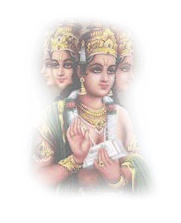
Lord
Brahma is the first of the Hindu Trinity. He is the Creator
God. He is regarded as the Supreme being, the God of Gods.
In the beginning Brahma was the Universe, he created Gods. After
having created Gods, he placed them in these worlds eg: AGNI in
this world, Vayu in the atmosphere and Surya in the sky. Brahma
generated the Gods and the entire world. Within him is the
Universe.
He is a
four headed God.
He has
four hands , each hand is holding a sacrificial tool (sruva), the
Vedas(knowledge), a water pot(kamandalu) and a rosary
respectively.
He appears
seated on a lotus which is a symbol of glorious existence.
His
vehicle is the goose(hans) which is known for its judgement
between good and bad. His consort is Saraswati, the Goddess of
learning.
Vishnu
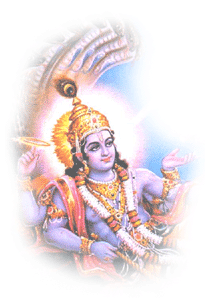
He is the second
member of the Hindu Trinity. He is said to be the
Preserver
or Sustainer of life,
especially in his associations with the principles of order,
righteousness and truth(dharma). Every now and then, when these
are threatened, he comes out of his transcedence in order to
restore order. He takes on an earthly form and becomes incarnated.
He is also known as Hari, the remover.
He is described
having a dark colour representing the passive and formless ether ,
a great quality for a pervading God.
He has four hands :
* First hand
holds the conch shell(sankha) indicating spread of the divine
sound"Om",
* One hand holds
a discus(chakra) which is a reminder of the wheel of time, and
to lead a good life,
* One holds a
lotus(Padma) which is an example of glorious existence and
* The fourth hand
holds a mace(gada) indicating the power and punishing capacity
of the Lord if discipline is broken.
Out of his navel
blossoms a lotus which holds Brahma, the God of Creation whose
responsibilities Vishnu has assumed.
His vehicle is Garuda
, the swift flying bird - which can spread the Vedic knowledge with
great courage. He is often depicted reclining on a coiled and many
headed cobra(sheshnag) which rests on the cosmic waters. This
represents the sleeping Universe.
There are a total of
ten incarnations(avatars) of Vishnu. These include -- a fish,
tortoise, man-lion, boar, dwarf, Parasu-Ram, Rama(of Ramayana),
Krishna, Buddha and Kalki , who is yet to come.
Lord Vishnu's consort is Goddess Lakshmi, the Goddess of Wealth.
Shiva
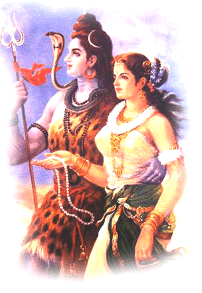
He is
the third member of the Hindu trinity. He is believed to be the
Destroyer God, his destructive leads ultimately to
good for he removes impurity for the sake of protection. He is
also known as "Nataraj" - Lord of the Dance - who
dances the world into and out of existence.
The Lord's attributes represent his victory over the demonic
activity, and calmness of human nature. As is seen in other
places in Hindu religion, Shiva shows the union of opposite
principles which make him a representation of the totality of
life. He is at the same time -- the Creator and
Destroyer; ascetic and erotic ; life
denying and life affirming; spiritual and
material.
Lord Shiva has matted hair that holds the flowing
Ganga river and a crescent Moon ; a cobra snake
coiled round his neck, a Trishul(trident) and Tiger
skin cloth and ashes all over his body.
Shiva-Linga, a sign of the Lord is adored instead of him and
Shiva temples have ShivaLinga as the main deity. In ShivaLinga,
God is sought to be represented as having form as well as
without form; Saguna as well as Nirguna.
The symbolic significance of Shiva's body :
· His
arms: In one of his upper arms, Siva holds the kettle drum(
damroo) whose sound symbolizes creative energy. The other upper
arm holds the fire pot of destruction. The lower right hand
shows abhaya (Do not fear) mudra . The lower left hand points to
the Lord's lifted foot saying "Your salvation lies in
worshipping my feet !"
· At the
base of the crown of hair on Siva's head is a skull
- this is symbolic of Siva's destroying energy.
·
River Ganga on his head denotes fertility.
· The
crescent moon on his head ( Siva is Chandrasekhara)
signifies Siva's grace and also Time.
· The
cobra on his head indicates Kundalinishakti at
Sahasrara-chakra
· His
third eye stands for omniscience or wisdom.
· On his
right ear, Siva wears makara-kundala, signifying
the male principle and on the left, the tatanka (
being Ardhanarisa) denoting the female principles.
· His
necklace of skulls of Brahma, Vishnu and others proclaim
that he is the arbiter of numberless creations and destructions
· The
ashes smeared all over his body are symbolic of purity. It
reminds us that in the love of transient Samsara we should not
lose sight of the God. The body will end up in ashes.
·
Beads of Rudraksh he wears represent the solidified tears of
pity Shiva sheds at the woes of his bhaktas.
· He
wears the Upavita or the sacred thread consisting of
96 strands representing the 96 tatvas , this represents that
he is the arbiter of all actions.
· The
Tiger skin he wears on his loins tells us that we must strip
ourselves of ahankara or pride which is equated to the tiger.
Siva's Nataraja according to some is the same as
Pancha-kshara.

His feet is Na,
Navel - Ma;
Shoulders - Si;
Face- Va
Head -- Ya
Siva as
Dakshinamurti is another beautiful concept. He becomes the
cosmic preceptor. His chinmudra where the right thumb and first
finger meet while the other three stand away has great
philosophical significance.
· The thumb represents God
· The forefinger the individual self
· The other three fingers are delusion, toil and egoism.
The meaning is : relieved of these three doshas, the individual
self unites with the cosmic self
His wifes include Parvati and Sati and his sons are
Ganesh(elephant headed) and Kartikeya(many headed). His vehicle
is a bull (Nandi) - which is a symbol of happiness and strength
Saraswati
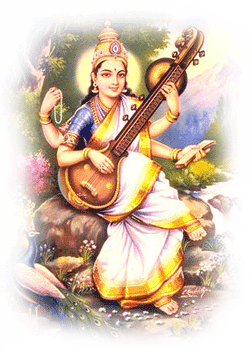
Goddess Saraswati is the Goddess of Knowledge.
She possesses the power of speech, wisdom and learning.
She is the consort of Lord Brahma. She is shown as dressed
in white - a sign of purity and rides on a white goose.
She has four hands which represent four aspects of
human personality in learning -- mind, alertness, intellect
and ego.
She has sacred sculptures in one hand and the
other hand holds a lotus - a symbol of true
knowledge . Her other two hands are shown playing
voilin ( veena), the music of love and life.
Lakshmi
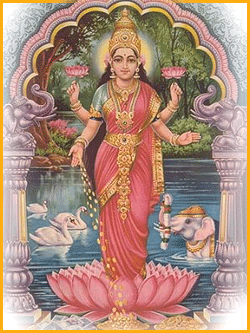
She is
the Goddess of Prosperity and wife of Lord Vishnu, mother of
Kama. The other names of Lakshmi are Haripriya - the beeloved of
Hari ; Padma - the Lotus ; Padmalaya - she who dwells on a
lotus; Jaladhija - the Ocean born; Chanchala - the fickle one;
Lokamata - the mother of the world.
She is
believed to have sprung from the
froth of the milk ocean
when it was churned by the Devas and Asuras, in full beauty with a
lotus in her hand. In the descents of Vishnu, she was his
associate. When Vishnu was born as a dwarf, she appeared from a
lotus as Padma (Kamala), when he was born as
Rama (Parasu) she was Dharini; when he was
Raghava (Ramachandra) she was Sita;
when he was Krishna, she was Rukmini.
When
Vishnu takes a celestial form, she appears as divine; if he is a
mortal she becomes a mortal too, transforming her own person
agreeably to whatever character it pleases Vishnu to assume.
Durga

Goddess
Durga is the consort of Lord Shiva. Her other names are
Parvati or Lalita.She exists in
various divine - both friendly and fearful forms. Two of
her very powerful forms are Durga - the Goddess beyond
reach and Kali - the Goddess of destruction.
She has a charming personality and is adored by married women
for a happy married life.
Both the forms have eight hands and
great power and Energy (Shakti). Durga rides
on a lion and Kali rides on a corpse
of a demon. Kali is the destructive aspect, she is time
personified, hence the garland of skull, blood etc. She
is dark because future is beyond one's ken. Her
disheveled hair and robes show her non-stop activity. She holds
a drawn sword affirming that your and my life is mortal. Her
unraised hand shows abhaya for one who has controlled his
senses. Her lower hand shows varada-mudra or boon
to her devotee.Parvati was called Sati in her previous divine
incarnation.
The family of Lord Shiva, Parvati and their sons
- Ganesha and Kartikeya is an ideal example of family love and
unity.
Venkateswara

Lord Venkateswara is a very popular
Hindu deity and is another form of Lord Vishnu.
He is also known as Balaji or Bithala,
Venkateswer or Venkatachalapathi.
He is described as having a dark complexion and four
hands.
In his upper hands he holds a discus
- which is a symbol of power and a conch shell -
a symbol of existence.
The lower hands are extended downwards
to ask devotees to have faith and surrender to him for
protection.
Satyanarayana

He is worshipped commonly by Hindus in
their homes with family and friends, usually on a full
moon (purnima) day of the month.
In this puja, people worship by
reciting the gracious story of Lord Satyanarayana, this
story was told by Lord Vishnu himself to the sage
Narada for the benefit of humankind. He is another form
of Lord Vishnu; he has four hands but his fourth hand does
not hold a lotus, this is held up to bless the devotees.
Rama

Lord
Rama, represents qualities, such as honour, courage and valour
and is held up as a model of manliness. He is one of the most
commonly adored Gods of Hindus.
He is called Maryada-Purushottama, the Great one who
never deviated from the norms set by Dharma. In the eyes of the
Hindus, the touchstone of human excellence is Dharma.
He
upheld the supremacy of Dharma in every one of his human
relationships and hence became an ideal son, an ideal
brother, an ideal husband, an ideal disciple,
an ideal friend, an ideal kind and even an
ideal foe.
He is always shown holding a bow and arrow indicating his
readiness to destroy evils; with his wife Sita, brother Lakshman
and devotee Hanuman who is sitting near Lord Rama's feet.
Krishna

Lord
Krishna is another of the most commonly worshipped deities in
the Hindu faith.
He is considered to be the eighth avatar of Vishnu. His
incarnation brought about a profound influence upon Indian
thought and life. He plays a very important part in the Hindu
epic Mahabharata, where he is a friend, philosopher and
guide to Arjun. The wise philosophy of Krishna and his
teachings have been embodied in the Bhagwad Gita.
He is
also known for destroying evil powers throughout his life.
Lord Krishna is shown as blue in colour and wears
yellow clothes. The blue colour is always associated
with infinity ( both the sky and ocean are blue),
the yellow colour represents earth.
The
blue form of Krishna clothed in yellow suggests the Infinite
reality reduced to a finite human being.
He is
usually shown with his pet cow, playing the flute which
symbolizes the spread of the melody of love to the people.
Along with Radha, his childhood devotee, the
pair is worshipped as Radha-Krishna. This association
symbolizes the eternal love between people and God.
The
birth of Krishna in a prison, and the manner in which his father
took him out of the prison inspite of all security, signifies
that the infinite being can never be restricted or limited to
the human form.
Kartikeya

He
is the second son of Lord Shiva ( Absolute reality) and
Goddess Parvati (Transcedent reality). He is also called
Subramaniam, Sanmukha, Guha, Shadannana , Skanda. He is
a picture of human perfection, through symbolism he
indicates ways and means to reach that perfection.
He is the war God, and was created by all the Gods to
lead the heavenly hosts and destroy the demons.
While Lord Ganesha removes all obstacles, Kartikeya bestows
all spiritual powers, particularly the power of knowledge.
He has six heads corresponding to the five
senses and the mind.
Kartikeya carries on one hand a spear called Shakti,
which symbolizes the destruction of negative tendencies
in humans; his other hand is always blessing
devotees.
His
vehicle is a peacock which grips a snake
with his feet. The peacock is capable of destroying
harmful serpents - this symbolizes harmful ego and desires
of people.
Ganesha

Ganesha,
also called Ganapati, is a god of wisdom, prudence and
salvation.
Ga means "knowledge", na means " salvation",
isa and pati mean "lord". Ganesha is also
said to mean "lord of the ganas", Shiva's multitude of
attendants. In south India, Ganesha is worshipped as
Pillaiyar. He is also called Vinayak(
knowledgeable) or Vigneshwar (God
to remove obstacles)
Philosophical significance of Ganesha's form:
There
have been many interpretations of Ganesha body. Mugdala Purana
explains that Ganesha's human body represents "tvam". His
elephantine countenance representing "tat" and their
joining together signifies the non difference of "tvam"
(You) and "tat"(Brahman) .
Thus the
body of Ganesha is the visible representation of the highest
reality, Brahman, realised from "tat tvam ast"
Ganesha is represented as a short. pot-bellied man with an
elephant's head with one tusk, four arms and a yellow skin. His
vehicle is a tiny mouse. In his hand he holds a conch shell, a
discus,a club/axe and a lotus.
In mythology:
· The
elephant symbolises devotion, patience and truth.
· The Modaka or cake he holds in his trunk
indicates that, beneath the outer layer of sordid self, lies the
Atman which is sweet and which must be discovered by everyone.
· His corpulent figure conveys prosperity
· the laddoos he is always shown with are meant to
reward devotees for spiritual activity.
· Ganesha rides on a mouse, signifying the unity
of the small with the big.
· Ganesha's mouse, by gnawing its way
through everything, is said to symbolize the god's ability to
destroy all obstacles. Ganesha is also known as
Ekdanta, or the one with one tooth., because one of his
tusks is broken.
· In his upper hands he holds a hook
and a noose. The noose is for
pulling man along the right path, the hook is for
goading forward the recalcitrant. In this manner Ganesha
helps us in overcoming obstacles and ensures success.
· The fourth hand's palm is always extended to
bless people.
· Ganesh'a ears, which appear like large
winnowing baskets, have a philosophical significance too.
Just as one uses a winnowing basket to separate grains from
dirt, one must use discrimination (viveka) to
separate the real (Brahman) from the unreal (Maya).
· The snake that runs round his hip is
indicative of Energy in all forms.
Ganesha is unmarried because he reveres womanhood as his own
Mother.
A unique
combination of his elephant - like head and a quick moving
tiny mouse vehicle represents tremendous wisdom, intelligence
and presence of mind. Ganapati meaning leader of the
ganas(public) represents the qualities that a leader should
have.
A
leader should listen to everybody, therefore the
large ears.
He
should have nose to scent out the smallest problem ; which a
large trunk does with sensitivity.
A
large forehead is an indicator of a brilliant mind.
It is
important for a leader not to let out all that he knows or all
that he has been told ; that is why Lord Ganapati has a
large stomach.
Also,
his corpulent body , awkward gait, broken tusk and guffaw
tell us that outward beauty has no relation to inner
perfection.
According to Padma Purana, one day when Shiva was
sleeping, Parashurama came to visit him. However
Ganesha would not allow Parashurama in for his father's sleep
would be disturbed. When Parashurama insisted, a
fight broke out, in the course of this struggle,
Parashurama threw his axe at Ganesha. This has had been
given to him by Shiva. Recognising the axe and out of
reverence for his father, Ganesha refused to intercept the
weapon. He bowed and took the impact on one of his tusks, which
broke.
Why
does Ganesha have an Elephant's head?
According to Padma Purana, Ganesha is the younger son of Shiva
and Parvati, while according tomShiva Purana, Ganesha was
created by Parvati from her own soil and water of Ganga. This
makes Parvati and Ganga his mothers, and he is sometimes
therefore known as Dwimatri. Once when Shiva was away, Parvati
wanted someone to guard the door while she bathed. From the
scurf of her body, she moulded a boy and gave him life. She told
him to attend the door and not allow anyone to enter. Shiva
returned, and when he tried to enter, was stopped by Ganesha. An
argument arose, and enraged, Shiva cut off Ganesha's head and
entered. When Parvati discovered that Shiva had entered by
beheading her son, she was inconsolable. Repentant, Shiva
ordered that the head of the first living being that was found
should be brought to him. This happened to be the head of an
elephant calf. He placed this on Ganesha's head and restored him
to life.
Why
we pray to Ganesha before undertaking any important task?
A legend
explains that once Shiva asked Kartikeya and Ganesha to circle
the world and return. Kartikeya hurried off on his peacock, but
Ganesha walked around Shiva and Parvati. He explained that for
him, his parents constituted the world. Pleased, Shiva granted
him a boon, saying that before undertaking any important task,
people would pray to Ganesha. Therefore, no matter what the
occasion or ceremony be, Ganesha is worshipped before all
deities.
The
Puranas say that the fourth day of the month, known as
Chaturthi, is specially Ganesha auspicious for Ganesha
worship.It is believed that Ganesha was born on the chaturthi of
Bhadra.
Worshipping Lord Ganesha
The peculiar manner in which we worship him by rapping at our
forehead with our knuckles and pulling at the earlobes with
crossed hands etc. helps nadi-suddhi or purification of the
nadis and puts our psychic powers in proper tune for his
worship. The materials of worship for Ganesha, the dhruv-grass,
arka-flower and leaves etc. which are the least coveted by
common people, have a lesson. No part of creation is repellent
to God. He is much pleased with the lowest of creation as with
the highest.
Breaking coconuts before Ganesha coaxes us to break the hard
nut of our ego before God.
Lord Ganesha the world over
Lord
Ganpati has a widespread presence the world over.
· In Greece, the Greek God of wisdom is known as Janus,
is pictured with the head of an elephant.
· In Mexico, the elephant headed, human torso God
is worshipped.
· Nepal : Lord Ganpati is known as Suryanganpati
· Cambodia : He is known as Prahaganpati
· In Japan : Vinayakshra
· Java : He is worshipped as Kalantak
Hanuman
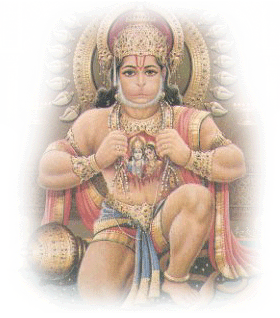
Hanuman is the
monkey God, a noble hero and a great devotee
of Lord Rama. He is also called Mahaveera (
the great hero), Pavan-suta (son of air) or
Bajrangbali , Hanumat ( because he had large
jaws)
Lord
Hanuman is a provider of courage, hope, knowledge ,
intellect and devotion. He is shown as a robust monkey
holding a mace(gada)-which is a sign of
bravery ; and has a picture of lord Rama tattooed
on his heart - which is a sign of devotion to lord
Rama.
Gayatri
According to the sacred
texts, The Gayatri is Brahma, Gayatri is Vishnu, Gayatri is
Shiva, Gayatri is Vedas. Gayatri later came to be personified
as a Goddess. She is another consort of lord Brahma.
She is shown as having five heads and is usually seated
on a red lotus - this signifies wealth. She
is wearing crowns on all five heads , the crowns bear
nine types of gems, which signify lusture of Divine Light
flowing into the heart of the aspirant. The four heads
of Gayatri represent the four Vedas, the fifth head
represents the almighty God. In her ten hands she holds
all symbols of Lord Vishnu. The weapons held by the ten
hands of Gayatri give a divine protection , desired boon to
the aspirant, at the same time all the enemies and bad
elements working unfavourably against the devotee are killed.
Gayatri is the name of one of the most important Vedic
hymes consisting of twenty four syllables. The hymn
is addresses to Lord Surya (Sun) as the supreme
generative source.
Significance behind
the five faces:
A darshan of these five
faces of Gayatri idol is capable of removing Five
Great Sins we have committed if any. While this darshan
removes great sins committed by the aspirant , it grants at the
same time Five types of Divine grace from Lord Shiva
Significance of Ten
eyes:
The eyes of Gayatri are
watching at the ten directions ( 8 directions + sky
and Earth) for performing Dushtanigraha (killing
bad people) and Sishtaparipaalana ( protecting the
good)
Significance of Ten
hands :
The first five hands
signify five types of Sukhas( comforts) obtainable
from this earth and the other five hands signify five types of
Divine BLISS obtainable from the Divine and Spiritual
lokas.
He is often referred to as the
Hercules of Hindu mythology.
He is a classical example of a King and
warrior god. He is also called "Slayer of Vrtra"
as he killed the demon of drought Vrtra ia a famous
battle
|