The following text
from: "Antecedents and Descendants of Margaret Ann Rhoads Smith (1860-1949",
Created primarily by Frances Smith Brownlee with later help for subsequent
printings from Mary Ellen Philips and George Willson White
Other sources were gathered from this very
good Scott
McGee GenWeb site, on which I have searched, added the results to the
end of this page, and referenced as found:
-
A History of Muhlenberg County,
Otto A. Rothert, John P. Morton & Co., 1913.
-
Perrin's "History of Kentucky"
-
Henry Rhoad's will written April
15, 1812.
-
Bud Newman, Correspondence, Feb
1996.
-
Jean Rhoads Camas, Correspondence,
May 1996.
-
From: "Gary Hiles" [email protected]
Date: Sun, 29 Mar 1998
Henry Rhoads II was a man of some distinction. After an early
trip to Kentucky, during which time he pre-empted and marked out land for
himself(1) , he returned home just
at the initial excitement of the Revolution. He immediately became captain
of a colonial company in Brothers' Valley, and he represented his county
in the General Assembly of 1778. There are no records of Henry's military
service after 1779, the year in which Wm. Tissue was serving temporarily
for Capt. Rhoads. Henry's service was under Col. Wm Parker and Gen. Peter
Muhlenburg, who gathered their troops along the disputed southern border
of Pennsylvania.(2)
Henry served two terms in the Kentucky Legislature,  one before(3) 1800 when he represented
Ohio Co. and one after 1800 when he represented Muhlenburg Co.He probably
moved his family (most of his children were now in their own homes) to
Ohio County when he was a candidate. Since the Indian problem had now become
less grave, his three brothers had probably brought their families to this
region also.
one before(3) 1800 when he represented
Ohio Co. and one after 1800 when he represented Muhlenburg Co.He probably
moved his family (most of his children were now in their own homes) to
Ohio County when he was a candidate. Since the Indian problem had now become
less grave, his three brothers had probably brought their families to this
region also.
(1) It is a family tradition that
the Rhodes came to Kentucky with Daniel Boone. There is some evidence that
some of the older Rhodes may have been in that region even earlier than
Boone. It also seems likely that they came with some of the earlier scouts
from their own country rather than with Boone. These Rhoadses did not bring
their families to Kentucky until about 1784. Their interest in the West
was probably aroused early by the Harrods, Stoners, and Bushes, their neighbors
in Bedford County. With the last two families, the Rhoadses had marriage
alliances. James Harrod was born in Bedford County in 1742 Michael Stoner,
b. In 1748, and Christopher Bush were, like the Rhoadses, Palatine Germans.
Henry Rhoads had married Elizabeth Stoner (b. March
25, 1744 in Maryland) in 1760. As early as 1767, Samuel Harrod and
Michael Stoner, described as a veritable giant in strength and physique,
explored Kentucky. In 1774, James Harrod laid out
Harrodstown, and in the next year, Boone and Stoner blazed the Wilderness
Trail. They also laid out Boonesboro,
which Black Fish attacked Apr. 24, 1777. Boone was hurt and Stoner was
shot in the arm. The German made his way to the fort and cried as he shoved
his rifle to another man, "Schoodt one tem Cot-tamm yellow rascals! " Capt.
Billy Bush tried to help the gigantic Stoner inside. "Push, Push, don't
make so pig a mark; we is too pig a lump to schoodt at " Stoner was a surveyor,
so large and strong that he never removed his pack when he carved a name
on a tree. He died in Wayne Co., Ky. in 1813. Henry Rhoads and possibly
some of his younger brothers, all of whom were surveyors, may have came
to Kentucky with Stoner on at least one of his early trips. We do not expect
to find any Rhoadses on the lists of the defenders of these earlier settlements
in Ky., as the Rhoadses were then in military service in the East. Henry
was fighting under Gen. Muhlenburg then, but the records show that he had
been in Kentucky a bit earlier. Two records of old Kentucky Courts read
as follows: "Henry Rhoads, ass'ee of Wm. Plummer by Wm. McConnell this
day claimed a pre-emption of 1000 acres at state price in the Dist. of
Ky. on acc't of marking and proving same in 1775, lying on the north fork
of McConnell's Run about 2 1/2 miles
from Stamping Ground and 3/4 mile above the forks of said run and a buffalo
road to include improvements. Satisfactory proof being made to Court, they
are of the opinion said Rhoads has a right to pre-emption of 1000 acres
location, and that a certificate be issued accordingly. " Also: "Michael
Stoner this day appeared and claimed a right of settlement and pre-emption
on Stoner's Fork of the Licking, twelve miles above Licking
Station, by making corn in the country in 1775 and improving said land
in 1776. 400 acres and pre-emption of 1000 acres adjoining same. "
(2) Gen. Peter Muhlenburg, b. in Penna.,
was a clergyman in the Lutheran Church. About 30 years old, at the opening
of the Rev., he was pastor at Woodstock, Va. near the Penna. border. In
1776, he was commissioned Colonel to raise a regiment of Germans in his
region. All school children used to be familiar with T. B. Reed's poem,
The Rising of 1776. The poet says that Muhlenburg entered the pulpit with
sword and cockade, preached his farewell serman, inflamed the people with
a passion for liberty, and next day marched out at the head of a whole
regiment, which became The Eighth Virginia. This corps behaved with honor
at Brandywine, Monmouth, Germantown, and in other campaigns.. In later
years, Henry Rhoads, then a member of the Kentucky Legislature, had Muhlenburg
county named for his friend and hero.
-
LDS film #1000053, A History of Muhlenberg County, Otto A.
Rothert, John P. Morton & Co., 1913.
Page (7): on the name of the county: Nevertheless, pioneer
Henry Rhoads, in 1798, very fittingly procured for the entitlement of the
county the name of the man who was a friend, pastor, and general to many
of its earliest settlers.
Page (8-9): After Pond Station
had been started and after Henry Rhoads began inducing more German-Americans
to locate near that station and in other sections of the country, and while
Caney Station was being built by Virginians, the inflow of newcomers began
to increase rapidly.
Page (10): The first of the early settlers of whom we
have any tradition or history were Henry Rhoads and his brothers, who settled
Rhoadsville, which later became Calhoun.
Of the original party who began this station only a few remained permanently
in the immediate neighborhood. Henry Rhoads was probably the first to leave
it. After living a few years near what later became Hartford,
Ohio County, he settled in the neighborhood of what is now Browder, Muhlenberg
County.
Page (29-35): ...Most of General Muhlenberg's soldiers
were born in America, but their fathers came from Germany and Holland long
before the Revolution. Among these was Henry Rhoads, "the Godfather of
Muhlenberg County," a prominent pioneer in Western Kentucky and identified
with the early development of Muhlenberg and the entire western section
of the Green River country.
Page(128): In some homes there were no Bibles other than
German -copies that had been brought by the German-American pioneers -
nevertheless the services were conducted in English. Henry Rhoads, it is
said, frequently addressed audiences and read chapter after chapter from
a German Bible, translating them into English with more grace and rapidity
than some of his contemporaries who on other occasions read a Bible printed
in English.
-
Perrin's "History of Kentucky," p. 997,
a brief sketch of Rhoads is incidentally introduced in a biography of Professor
McHenry Rhoads:
"Henry Rhoads was born in Germany in 1739 and died in Logan
county in 1814. [He died in Muhlenberg County. this and other emendations
by Rothert.] He and two of his brothers came to America about 1757 and
settled in Bedford county, Pennsylvania. In 1760 he married Elizabeth Stoner
of Maryland. He fought for his adopted country through the great struggle
for Independence, under the leadership of General Muhlenberg. After the
war for Liberty, having lost heavily in the cause, he, with his two brothers
and their families, came to Kentucky. They stopped first at Bardstown where
they left their wives and children, and then went out in the wilderness
to find a site to build a town. The place selected was at the falls of
Green river where they started a settlement and called it Rhoadsville.
After three years of peaceable possession an action was entered in the
Ohio circuit court, styled "John Hanley vs. Henry Rhoads and others," for
the possession of the land on which the new town stood. The suit was gained
by the plaintiff. Henry Rhoads and a few of his friends then removed to
Barnett's Station, on Rough Creek, where he lived five years, during which
time the present town of Hartford was laid out and a few houses built.
He next moved to Logan county and settled...where he owned 7,000 acres
of military land. He represented the county [Logan and what became Muhlenberg]
in the legislature of Kentucky in 1798, [and on its formation [in December,
1798] as a county, named it in honor of General Muhlenberg." 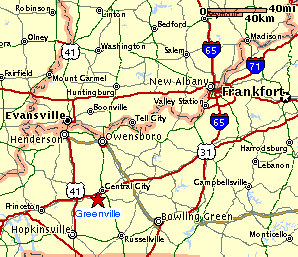
...It was on this 2,500-acre tract that he built his
home [photo, p.31], shortly after his arrival from Hartford. The original
dwelling has undergone many changes, but is still standing, near the Greenville
and Rochester Road about nine miles from Greenville. The farm on which
this house stands has passed from father to son for more than a century,
and is now owned by Professor McHenry Rhoads. Near this historic house
is the old family graveyard. In it, among five generations of Rhoads buried
there, is the grave of the "Godfather of Muhlenberg County," on which was
placed, almost a century ago, a sandstone about two feet high and marked:
"H.R., B.J. 5, 1739. D.M. 6, 1814." [photo of gravestone, p.32]
-
Henry Rhoads died on the 6th of March
or May, 1814, aged seventy-five. His "last will and testament" was written
April 15, 1812, witnessed by "J.W. McConnell and Wm. Sumner." It was recorded
in 1813 and probated in August, 1814, as attested by "C.F. Wing, Clerk,"
in Will Book No. 1, p. 194:
"In the name of God, Amen. I, Henry Rhoads, of the county
of Muhlenberg and State of Kentucky, being weak in body but of perfect
mind and memory, do make and ordain this my last will and testament.
"First, I recommend my soul to the Almighty God, and as
touching my worldly effects wherewith He has helped me, I give and dispose
of them in the following manner.
"First, I give and bequeath to my beloved wife Barbay
Rhoads all the property she brought with her after we were married, agreeable
to contract, and one cow, a large heifer and one iron pot and the corner
cupboard and chest and my large Bible, and the low posted bedstead, one
large and one small wheel including all the furniture we have got since
we were married. I also give and bequeath to my beloved wife Barbay all
that is allowed to her agreeable to the courts of a bond on my son David
Rhoads bearing date August 23, 1810.
"Secondly, I give and bequeath all my debts, dues and
demands and all the property I own in this world except what is expressly
mentioned in this my last will to my children, namely my sons, Jacob Rhoads,Daniel
Rhoads, Henry Rhoads, Solomon Rhoads, David Rhoads, Susanah Nighmyoir and
Caty Jackson, Elizabeth VanMeter and Hannah Jackson, all my daughters to
be equally divided among them, at the discretion of my executors at my
decease.
"Lastly I do hereby nominate and appoint my brother Daniel
Rhoads and Solomon Rhoads and David Rhoads as executors of my last will
and testament, hereby ratifying and confirming this and no other to be
my last will and testament, hereby revoking all other wills by me made
as witness and seal this 15th day of April in the year of our Lord 1812
and the presence of viz:
Henry Rhoads. "
(Seal)
-
Bud Newman, Correspondence, Feb 1996.
When Henry Rhoads settled on his tract of land Muhlenberg
was practically an unbroken wilderness. Many wild animals, large and small,
held sway. A number of stories are told about the game that roamed over
these hills in olden times. I here repeat two of these stories, because
they are characteristic of life in the wilderness and because they are
incidents from the life of Muhlenberg's first great pioneer, handed down
by local tradition.
When Henry Rhoads was building his log house his neighbors
were few and far between, but all came with a helping hand and a happy
heart to take part in his "house-raising." These old-time house-raisings
were attended as much for the sake of their social features as for the
purpose of building a house. One afternoon, while the crowd was busily
engaged on the roof of this building, a large bear leisurely wandered into
sight. When the men saw the animal they stopped work and immediately started
on a bear chase. Some ran after him with axes and others with guns. The
women of the wilderness always lent a helping hand. In this instance one
woman folled in the bear chase with a pitchfork. After an exciting time
old Bruin was finally killed. That night a large bearskin was stretched
on the new log wall and barbequed bearmeat was served in abundance at all
the other meals prepared for the house-raising party.
But the noise made by the bear-chasers evidently did not
scare all the wild animals out of the neighborhood. About a year after
that event Henry Rhoads, while walking in his wood, which is still standing
a short distance north of the old house, espied a large drove of wild turkeys.
He slowly raised his flint-lock rifle for the purpose of shooting a fine
gobbler strutting under a white oak within close range. When he was about
ready to pull the trigger he heard a rustling in the dry leaves behind
him. Rhoads looked around, and to his great surprise saw a huge panther
preparing to spring upon him. Without stopping to take sure aim he fired
at the threatening beast. Luckily, the bullet hit the animal between the
eyes and killed it instantly. A half-hour later Rhoads walked back home
with the panther skin on his arm and his trusty flint-lock on his shoulder.
These old flint-locks were, as a rule, fine-sighted and
unerring. They were slow but sure, although they did not kill every panther
they were aimed at. Compared with modern rifles they were slow in all the
operations that preceded and resulted in the discharge of the bullet. Most
of the local traditions are subject to a variety of versions. The old panther
story, as I have related it, has probably changed very little from the
original since Henry Rhoads' day. However, another version of this incident
has also crept into circulation, and shows to what extent some traditions
are changed. This new version has it that when Henry Rhoads saw the wild
turkey in the woods he took steady aim and then pulled the trigger of his
flint-lock. He had no more than pulled the trigger when he heard the panther
back of him. Rhoads turned, immediately swung his gun around and aimed
at the panther, then in the very act of making a long leap from a limb
down upon the hunter. But the old pioneer was quicker thant he discharging
powder or the charging panther, for he had the gun pointed at the animal
before the bullet left the barrel, and thus killed the panther with the
load that, a few seconds before, had been started toward the turkey! This
same version continues with the statement that the animal did not drop
to the ground after it was shot, but fell across the shoulder of the hunter,
who then leisurely walked home and did not throw the panther down on the
ground until he reached the front of his house. I do not adopt this version,
but merely record it for its vivacity and novelty. Henry Rhoads, as already
stated, was a member of the State Legislature from Logan County when, in
1798, Muhlenberg was formed, and he was the first man to represent the
new county in the House of Representatives. He was sixty years of age when
the county was organized. Although he declined various county offices offered
to him, he nevertheless continued to work for the good of the community,
and probably did as much for the county, if not more, than any of the other
early pioneers. He helped draw the plans for the first courthouse and also
did much toward promoting the interests of Greenville, the new county seat.
He was bondsman and adviser to a number of the younger men whom he successfully
recommended for office. Tradition says that many, and probably all, of
the German-American pioneers in Muhlenberg came to the county through his
direct or indirect influence. During his last years Henry Rhoads spent
much of his time looking after his farm, tanyard, and other personal affairs,
but nevertheless lost no opportunity to bring in new settlers and perform
such acts as he thought would advance Muhlenberg County and its people.
Today a small sandstone is all that marks the spot where rest the bones
of this influential pioneer. Some day his labors will be more fully appreciated
and an appropriate memorial will then, I dare say, be erected over the
grave of the Godfather of Muhlenberg County.
Sources of Information: New Testament of Henry Rhoads;
Gravestone at Rhoads Cemetery; Genealogical newspaper columns of Ohio County,
KY; Info compiled by Fonda Lawhead, 5301 Carriage Dr., Evansville, IN
-
Jean Rhoads Camas, Correspondence, May
1996.
He lived in Pennsylvania, Maryland, and Kentucky. By trade
he was a blacksmith. He was active in the Brethren religion (German Baptist).
He served in the Revolutionary War as a captain in the Pennsylvania Militia
of Bedford County.
I am a great grandson of Henry Rhoads. Thx for your fine
work. It might be of interest to you that Capt Rhoads, the founder of Muhlenburg
Co., was personal friends with Ben Franklin and others. He was in the inner
circle of our nation's founding. He was given the land of Muhlenburg Co.
by the Continental Congress and President Washington for his service furing
the American Revolution. My family has a document with his and Ben Franklin's
signature on it. Something else that may be of interest is that he was
a direct grandson of Charlemagne the Great Head of the Roman Empire and
author of the Magna Carta.
Capt Rhoads served with Col Hawes under Gen Muhlenburg.
He named your county after him because of his devotion and love for Gen
Muhlenburg.