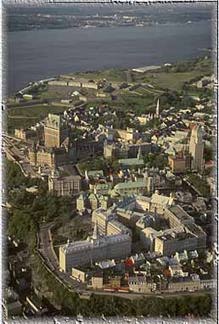
 Erected on an exceptional site atop a plunging cliff, the Fortifications of Quebec tower over the St.Lawrence River. Encircling Upper Town and covering 46 kilometres, their paths offer visitors many unique opportunities. Indeed, the Fortifications' picturesque charm and superb vistas did not only help the defence system to become a tourist attraction immersed in the past, but were also a deciding factor in the system's preservation. Moreover, the Fortifications are eloquent witnesses to Quebec's military and urban history.
Like nowhere else in North America, Quebec's defence system is of a classic urban style, characterized by the geometry of flanking, defence in depth, and the adaptation to the city's topography. At the heart of the Fortifications stands the Citadel, which was the ultimate recourse for the British garrison. Its design shows that the builders, living in turbulent times, foresaw both a potential revolt on the part of Quebecers and an attack from Americans.
To understand the engineers' intentions at the time, one must take Quebec's topography into consideration. In 1690, Quebec was already divided into two distinct quarters; Lower Town was laid out on a narrow strip of land running alongside the river. Upper Town was located on the headland which dominated the banks. Lower Town was not protected by a natural defence system. Consequently, several ambitious attempts were made by French engineers to build defence works near the port and link them to the urban layout of Lower Town. However, the quarter was to only be protected by various batteries built near the short, such as the Royal Battery set up in 1691.
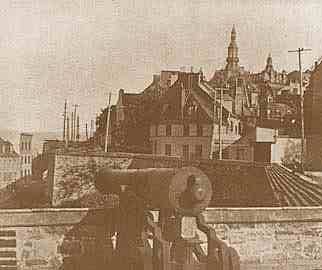 Unlike Lower Town, Upper Town was secured by a natural defence system on two of its three sides; Cape Diamond's steep slope, which rose to over 90 metres in height. As a result, only batteries were placed at different intervals to keep watch over the river and a wall that could be scaled. The city's west end faced the countryside and was open to enemy attack. Therefore, a classic rampart had to be built. Defending Upper Town on the west side against a potential siege became the top priority for Quebec's engineers.
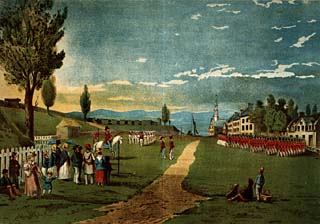 Shortly after the Conquest of Canada, the British victors were faced with new defence requirements. From 1760 to 1775, military authorities feared a reaction from the Francophone population. Furthermore, they were concerned that France would try to recapture Quebec. Due to England's economic woes, Quebec defence system was not to be strengthened. Instead, the British took the necessary precautions to preserve the fortifications. One idea nevertheless prevailed; a citadel had to be built. The city's enceinte, deemed inadequate, was virtually ignored for a quarter of a century.
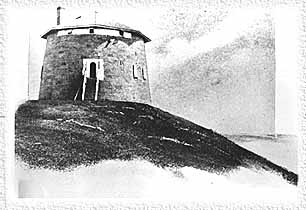 Between 1786 and 1812 under Mann and his successors, the city's ramparts were repaired and new structures erected. A masonry wall, jutting out over the cliffs and stretching from the Palace Gate to the citadel, was put up; with the 1745 enceinte, the completely enclosed Upper Town. During the same period, five new powder magazines were set up along the fortifications. The Martello Tower, which had only recently been adopted as a defence work for the coast of Britain, was also introduced into Quebec's defence system. The tower was circular in form, with thicker walls on the sides facing the sea.
To learn about other MUST SEE sites in this province continue onto the next page.


This page hosted by  Get your own Free Home Page