In June of 1994, we celebrated our Centennial Anniversary. For this occasion, one of our members, Nell Greever, wrote a detailed history of the church. Below is a synopsis of and excerpts from that history...
(The history of the Church dates back to the early 1800's when there was a Sulphur Springs Church and meeting ground. I begin the history in the 1890's when it was decided to move the church from Sulphur Springs to Chilhowie...)
In 1893, a lot had been obtained on Old Stage Road and preparation for the move began...
Residents of those times remembered that the building was literally moved, leaving only some of the foundation stones of the old brick church. The brick of the old building was used under the brick of the new structure. The walnut balcony railing of the old church is now the railing of the altar in the sanctuary. We are told that some of the wainscoting in the sanctuary was from the Sulphur Spring Church. One of a pair of marble topped flower stands believed to have been from the old church is in use in the vestibule.
Brick for the town church was pressed in the brick plant in Chilhowie and was intended for the Norfolk and Western Railroad Station in Lynchburg, Virginia. The builders there were not pleased with the color of the brick and it was rejected. The brick company then offered the golden brown brick to the church on the condition that the plant workers donate their labor. The offer was accepted and work on the church began in 1893.
The original church building consisted of only the present vestibule and sanctuary. The source of the cruciform plan, Late Gothic Revival style is unknown. However, considering the interest shown by the local brick plant, it is reasonable to speculate that the superintendent, Mr. E.J. Rutland, a native of Sheerness, England influenced the plan which was prominent in England at that time. Mr. Rutland designed his own unusual residence with mansard roof which was built in 1892 and still stnads near the church on Old Stage Road. The builder most likely in charge of the construction was Mr. Richard Bennet, a skilled craftsman of the time whose parents are listed on the early Sulphur Springs Church roll.
Before the automobile was in common use, transportation to church services and meetings was by horseback and horse-drawn vehicles. A large maple tree on the east side of this church was a convenient hitching post and horses were frequently tethered in back of the building. The church lot of .63 acres extended 45 feet into the present Church Avenue and included a section of Old Stage Road. A white picket fence fronted the church, protecting the lawn. (A picture of the church with the picket fence currently hangs in the fellowship hall.)
Church services were at times only on alternate Sundays, but for forty one years, an active Sunday School of children, youth, and adult classes were held in the one large room of the church, the sanctuary. The altar area was raised and fronted by the walnut railing which had been moved from the old Sulphur Spring Church. The railing had a very narrow kneeling bench, but no opening to the pulpit area in the center. The railing curved inward at each end leaving a space for access t the altar area. A pump organ was on the east of the pulpit with small pews on both the east and west sides. The piano sat in front of the altar rail. Mrs. Bradley Greever Wrenn played both piano and organ for many years.
Again, Mr. Early Bennett was called upon for adjustments necessitated by this new arrangement. The altar rail was removed and refinished, the kneeling bench made deeper and a shelf for communion glasses added in back of the rail. A space was left open in the center for access to the chancel area. A dossal curtain was hung behind the altar and the round window above was exchanged with the rose window on the bell tower.
Mr. John Mason, Sr., a skilled carpenter of the time, was the builder of the new parsonage. On one of his visits to the building site, the Rev. Carl Wright found mr. Mason greatly agitated by suggestions of the parsonage committee. "You must have the patience of Job," Rev. Wright advised, to which Mr. Mason replied, "Job never had to build a methodist parsonage." In 1954, Mr. Fred Rector, church treasurer for many years, reported the debt on the parsonage paid in full.
The 51 by 37 foot annex was begun in 1959 and completed in 1960. The Rev. George Wampler led the congregation in the Consecration of the Educational Annex and Rev. Eisenberg returned as a guest for the service on September 18, 1960. Cost of the building was approximately $35,000 and wa financed by donations of the congregation and sale of stock bequeathed to the church by Dr. Benjamin Sanders in 1936....The debt on the Educational Annex was paid by March of 1968. During the pastorate of the Rev. William A. Adams on february 9, 1969, Bishop L. Scott Allen led the congregation in a service of Dedication.
As the older section of the church, the sanctuary, began showing age many improvements and changes became necessary. The stained glass windows, which were once opened and closed at will, required some repair and were enclosed and protected by Plexiglas. A heating and air conditioning system for the sanctuary was installed.
(Toward the end of the decade)...there had been more problems with the tin shingle roof covering the older part of the building. Sealing and painting no longer controlled the leaking, which had become severe in the late eighties. After much discussion, it was decided to replace the entire roof with one of standing seam steel, leaving only the steeple in the original tin shingle. The Rev. David St. Clair, with the aid of his father, the Rev. Ben St. Clair, led the congregation in a fund raising drive for the $37,000 required. December 3, 1989, was designated "miracle Sunday" when gifts toward the project would be received. Success of the fund drive exceeded most expectations when approximately three-fourths was contributed in cash and the balance in six month pledges.
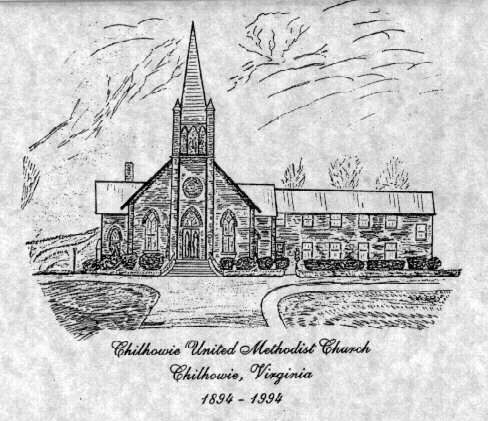
This line art drawing of the church was done by Dick Kegley and was placed on note cards and a commemorative plate in honor of our Centennial Celebration.
| Back to Our Purpose Statement |
|
Forward to Our Church Staff |
 Get your own Free Home Page