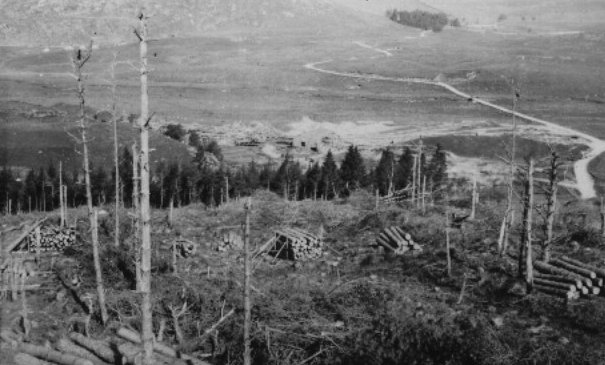
 in the UK, which was vital to the war economy.
The Newfoundland's Forestry Unit
When WW II was declared on the 3rd of September, 1939, Newfoundland's
Commission of Government " advised " the British authorities that Newfoundland was " anxious
" to help in the in the war effort. Britain quickly acknowledged the offer of assistance. On
November 9th the office of the Secretary of State for Dominions impressed upon the new
governor, in cable 416 [ appendix III ], the need of a labour force to cut pitprops in connection with coal production in the UK, which was vital to the war economy.
Responding to this, the Newfoundland Overseas Forestry Unit was formed by an Act passed by the Newfoundland Government, and dated 19th November 1939. The only problem in recruiting the two thousand men that was required - many more than that number offered their services - was to select the best men suited for the work.
Recruiting commenced in all parts of Newfoundland, including Bay D'Espoir. Many brave young men from this " Area " volunteered. Below is a list of some of these men. Click here to get some personal accounts of their experiences in the war
WW II Veterans:
Gordon Hoskins Samuel Hoskins, (Michael ) Charles Hoskins
Manuel Hoskins Owen Harding Celestine McDonald
Reginald Organ (Frank), Alexander MacDonald Gordon Willcott
Charles Willcott , Alexander Willcott , Leslie Gaulton
Wilson Collier , Edward Willcott , Raphael Dollimont
Walter Collier , Thomas Snook , Stanislaus Collier
Samuel Davis , Leo Collier (George) , Walter Walsh
John Drake , Eli Organ , Cecil Davis
Richard Davis , Daniel Hoskins , Pius Crant
Edward Skinner , Thomas Organ (William) , Paul McDonald
William Joseph Hoskins , Thomas Benoit , Hubert Collier (Joseph)
Raphael Willcott , Finton Willcott , John Gaulton
George Organ,Jr , Albert Collier (Albert) , Arthur Willcott (William)
Denis Coolier , Primus Snook , Maxwell Collier
William Walsh , Lawerence Benoit (WW II) , Archibald Mayo
Henry House , Clem McDonald , Sebastian Collier
Norman Hull , Andrew Crant , Leonard Collier
Freeman Hoskins, R. I. P.
The first draft of three hundred and fifty men, joined their ship off St. John's Narrows on December 13th, 1939 and arrived in Liverpool five days later. The second draft of three hundred men left St. John's on January 6th, 1940, and travelled across Newfoundland to join their ship in Canada for the journey to Britain arriving on January 23rd, 1940.
Subsequent drafts travelled to Britain as follows:
- Third draft consisting of two hundred men left from Bay Bulls On January 13th, 1940 and arrived in Liverpool on January 19th, 1940.
- Fourth draft consisting of nine hundred and fifty men left from St. John's on January 23rd, 1940, arrived in Glasgow on February 8th, 1940.
- Fifth draft consisting of two hundred men left St. John's on February 1st, 1940, and travelled across country to Canada to join their ship arriving in Liverpool on February 12th, 1940.
- During the next summer another one thousand men made a safe trip crossing in 1941.
- Over thirty four hundred men of the unit crossed the Atlantic at a time when the position at sea, due to enemy raiders and submarines, was at its worst, not a single life was lost.
Once ashore the drafts were moved by trains and bus to Ministry of Labour Centres.
These camps became the first bases of the Unit. The groups then moved to the stands of timber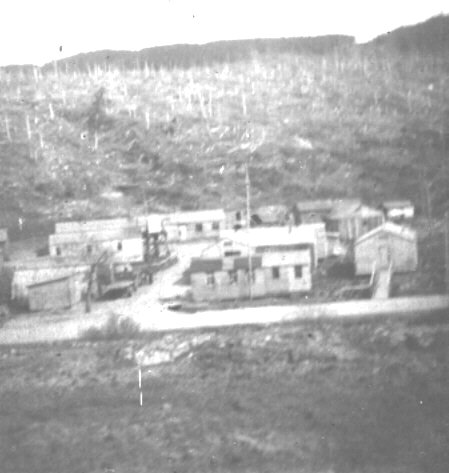 they were to cut timber, which was located in different parts of England and Scotland, from
Southampton to Ross-Shire.
they were to cut timber, which was located in different parts of England and Scotland, from
Southampton to Ross-Shire.
No part of the Empire has made a greater war effort in men and material than Newfoundland. The Newfoundland Overseas Forestry Unit is part of that war effort.