
7/22/98 This morning when I went to see my Gerbils Oreo was dead. He was fine except for last night he was laying down in the middle of the tank. At that time it was hot ( 80� in basement and 90� outside ) and the other gerbils in the other tanks were also laying down. So I didn't think anything was wrong. He might have had a stroke? I didn't know his age because I purchased him from the petshop. He is now with Sunkist :o) He leaves behind his first litter with April (grandaughter) a very pied gerbil and 4 babies almost motted and 1 black baby.
|
|

|
7/27/98 Cookie had two babies this morning.

7/29/98 Here is a picture of Pookie,Creamy,Wally and Nabisco playing with a coconut shell. I used my new Garage sale camera. The settings weren't correct, therefore the picture came out very yellow.

This is April and one of her babies.

Here are two more of April's babies. These pictures are not showing the pied markings on the rump very well.
Cookies 2 babies are one pink eyed and one black eyed. They are also very pink.
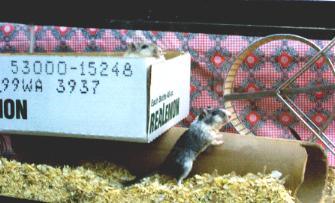
7/30/98 Creamy was fighting with Nabisco this evening. When I went to check on them ,I heard them trashing about. Nabisco was on top of Creamy and they were locked in a ball. Creamy has blood all over his right shoulder, a little on his chin,left shoulder and a spot on his chest. No blood was on his legs or base of tail. Nabisco also has blood on his shoulder but less than Creamy. Perhaps, Creamy's dominance was being challenged. Their tank had a box, that was put in about 2 weeks ago creating a second level with their food bowl. I think this may have caused them to fight? The fighting may have been a territory dispute. Now I have to redo my plans for a male group with different colors. :o( They were about 8 months old and have been together since they were babies.
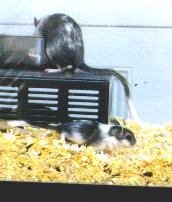
8/2/98 last night I put Creamy into a split tank with April and her babies. If all goes well Creamy will have a new family in 3-7 days.
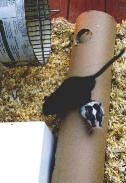
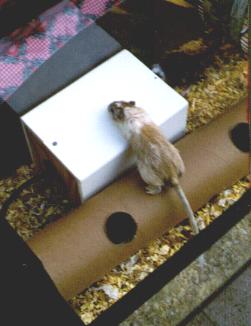
Nabisco,Wally and Pookie seem to be getting along without Creamy. I removed the box to avoid any more problems.


8/4/98 Creamy, April and babies have been living in the split tank for 4 days.They have been swapping sides several times a day.


This evening, I removed the divider and they are getting along. :o)

8/5/98 Creamy has adopted the babies.
Cookies two babies are Red fox and Nutmeg pied.
8/13/98 Cookies two babies (born 7/27/98) each have one eye opened. Right on schedule 17 days old.
8/26/98 Cookie's and Sunny-d's two babies, now have 2 baby brothers and 1 sister.They were born this morning.

I have also switched to using Aspen bedding cause its safer then Pine or Cedar.

This is Sunny-Delight. He is a Red Fox Pied.
8/29/98 Cookie and Sunny Delights 3 babies are pink eyed. April is getting plump. These babies would be Oreo's second litter with April. The next litter will have Creamy as the father.
9/1/98 April had 5 babies today.One of Cookies babies might be Lilac.
9/16/98 Cookies three babies are Lilac pied, Red fox pied and Red fox.They are 21 days old now.
April and Creamy's 5 babies are Nutmeg,Lilac pied, Argente spotted, Black pied,and DEH pied.Because of the colors in this litter, Creamy is the father.They must have mated very soon after the split cage divider was removed.Therefore, April only had 1 litter with Oreo. :o(
9/24/98 Because most of my Gerbils are pied or spotted/patched.I found this letter from the Gerbil Mailing List interesting.
Someone, asked -- .
I would like to know the genetic difference (if there is one) in the Pied, Patched, and Spotted. Julian Barker from the National Gerbil Society responded --
Basically, as far as is definitely known, there is one gene, Sp that controls white spotting in gerbils. Gerbils either have this gene or they don't. if they don't they are not going to be spotted, if they do, because it is a dominant characteristic, they are. Gerbils that are SpSp, in that they have inherited spotting from both parents, are reabsorbed in the womb because they never develop properly.
For many years after spotting appeared in the 60's this was the only form of spotting. The spots normally appear on the nose, forehead, neck and tail. In addition, the feet, and patches on the belly are white. This white spotting is caused by the cells that will eventually produce pigment failing to migrate properly during the development of the foetus.
Obviously the white patches cannot be seen on an animal that is already white, and the belly patches cannot be seen in a white bellied colour like Golden Agouti. The difference between spotted and patched animals is that under the NGS standard, for many years, there was a difference between the way white bellied spotted animals (spotted) and coloured bellied spotted (patched) animals were judged.
Last year an attempt was made to extend the patched standard to include other types of markings but there has been some dispute as to exactly what a patched gerbil now is! :-)
Many things can affect exactly how white spotting is expressed. Some of these factors are what geneticists call "environmental". This means anything that isn't genetic. So for example the extent of white marking could be affected by temperature, maternal nutrition, position in womb, etc etc.
In addition, we now know that there are also genetic factors in white spotting. The evidence for this I have seen with my own eyes is:
a) For over 20 years attempts ere made in the UK to breed spots that had more than the classic spots I mentioned above. Although the spots did increase slightly in size, no additional spots appeared.
b) In other countries, more extensively marked animals, known as pied, for example, with a complete collar, or with variegation on the back, existed. It was impossible to breed these in the UK until some animals just like that appeared in 1995, probably imported. Since the appearance of these animals gerbils descended from them have more expended markings just like Pieds seen.
c) If you take a pied gerbil, breed it to a non-spotted gerbil not descended from pied, you will get a mix of spotted and non-spotted gerbils. Rarely will the spotted gerbils have pied markings. If you then breed one of these non-spotted gerbils to a spotted gerbil descended from a pied gerbil, you will often get Pieds.
d) Inbreeding pied gerbils produces exceptionally marked animals that are often termed "mottled". Inbreeding pied gerbils is known to sometimes cause inner ear defects.
e) We have a family of gerbils which have a small amount of spotting, just one small spot on the forehead. The original gerbil came from a normal family of spotted/patched gerbils, others in the family were very spotted. All spots descended from one of these gerbils have always had a single small spot for two generations. These gerbil have the white feet that is normally expected in spotted animals.
From this I have deduced that:
a) There is a major gene (Sp) that "turns on" spotting
b) There are environmental factors that affect spotting
c) There is a series of polygenes that modify the spotting gene and thereby control the extent of spotting.
d) This model for the inheritance of white spotting is consistent with what is known about white spotting in other small mammals like mice.
Polygenes are a name given to a series of genes, maybe two or three, maybe anything up to a hundred, that control a characteristic. Polygenes often operate to modify another gene.
The genes represented by the letters in the normal genotypes you see represent major genes. It is difficult to represent polygenes because by definition, the individual affects of the genes is not fully understood. if it were it would not be necessary to refer to them as polygenes. Obviously , within a group of polygenes, some my themselves modify other polygenes, some may be dominant, some recessive etc etc. Clearly, with only 4 or 5 polygenes the permutations become difficult to keep track of.
In addition to the spotting described here. A new form of recessive spotting may have also appeared recently in the UK but it is too early to tell. This link is Julians Web page about the pied/spotted/patched gene in Gerbils.
 Get your own Free Home Page