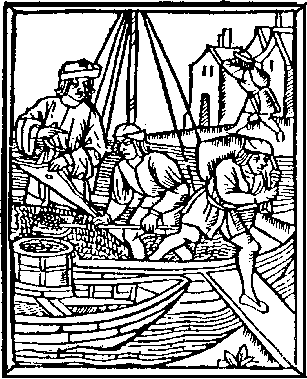
"Bought at L'Houmeau, a riverboat to transport salt together with navigation tools, for the sum of 300 pounds, by Michel Tabuteau" 27 Mars 1641.
What follows is a summary of the research and study, spread across more than half a century, on the genealogy and history of Tabuteau families by Philippe Edmond Yves Pierre TABUTEAU. His work is based on documents; the commentaries and conclusions are his alone.
Philippe passed away on Thurday, 19 October 2006, aged 83. RIP
POITOU. That originating in Poitou (France) seems to be the oldest, and maybe the most numerous. I have not researched it. This work has been done by others, descending from this line. The name in this actual form has been found on documents dating back to 1138, at Montmorillon, and in 1413 at Nanteuil. There is a place named 'Tabuteau', in the region of Montmorillon, near Lathus, which is marked on maps.
LA ROCHELLE. I have researched in great detail, the line of the Huguenots (Protestants) from La Rochelle, from 1550.(See below.)
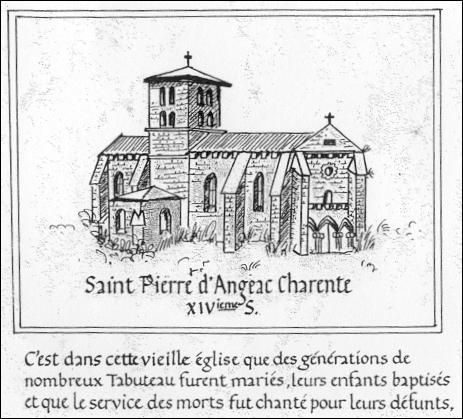
ANGEAC-CHARENTE. The line from La Charente is the one to which I belong. Originating from Angeac-Charente, it is documented from 1610.(See below.)
GUYENNE. I have found evidence of other branches of Tabuteau in the region of Bordeaux. They have left their name near Saint-Emilion in a vineyard, Château Tabuteau, which is well enough appreciated to be bottled under this name.
GIRONDE. There is probably also one or several lines in Gironde, of which I have only uncovered a few traces here and there.
HAITI. There are also some branches arising from the Tabuteau of La Rochelle, Angeac and Bordeaux, transplanted to Saint Domingue, which today are represented in great number in Haïti. (See below.)
Lastly, I also have a few folders of unplaced Tabuteau family groups.
I have not been able to connect together these lines of descent in France, because we cannot go further into the past to find a common ancestor, or to find a document which establishes such a connection, such as a legal document. They were being produced at that time, when parish registers did not yet exist, and when surnames were not being systematically passed on to the offspring.
Another possibility, which I think is more likely, is that Tabuteau is a surname, ascribing personal qualities, which have been applied to individuals at various places and times, who had no family relationship.
TABUTEAU is a descriptive term, made up of three parts: one is a verb, indication an action, followed by an ending to make it a noun, with a prefix indicating repeated action by the doer.
Thus BUT means to hit, or to fight (butter, bouter, buster). EAU refers to the individual doing the action (like 'er' in 'teacher', in English). The 'eau' ending is from the Poitevin/Charente region, similar to the current usage of the ending 'eur' ('galopeau' = 'galopeur'; 'chicaneau' = 'chicaneur'). A 'buteau' (variation 'butor') is someone who harasses, physically or verbally.
Finally TA indicates an element of repetition.
The qualifying 'tabatte' is still used today to describe a gossip who tires everyone with her incessant chatter. There may have been a 'Tabusteur'in many villages in the same way as there was a 'Hardi' (Hardy) or a 'Vaillant'(Valiant), a 'Léveillé' (Alert) or a 'Tardif' (Tardy').
The line from La Rochelle is documented starting with the birth of little Marthe Tabuteau in 1582. (It was the year in which the calendar was shortened by ten days.) Marthe's father was a master cooper, an occupation essential to the economy of the period. Those of the next generation became merchants.
The Tabuteau's of La Rochelle were decimated during the
siege of 1627-28. They recovered and re-established themselves there until 1685. The Revocation of the Edict of Nantes affected them badly.
There were at this time two brothers, Pierre and Louis. Pierre went into exile with his wife, daughter of a pastor, taking with them a son, Etienne. We know nothing of his other son, Pierre, born in 1671.
His brother, Louis, remained in the town. He lost his possessions. He had a son, Louis, born in 1677, about whom nothing was known. (See the genealogical chart: La Rochelle 1550-1880.)
We know from other sources that at the same period, in La Rochelle, a Pierre Tabuteau had altercations regarding damages caused, with the captain of a boat called Le Serpent, and that a Louis invested in deals known as La Grande Aventure. They were both involved in the slave trade, as were the majority of the inhabitants of La Rochelle at the time.
The were probably the same two brothers, Pierre and Louis, sons of Etienne Tabuteau and Suzanne Mahaut.
Pierre went into exile in Holland with his wife, his sister, and his son, thus starting the line of Protestant English Tabuteau's. They ended up going to Ireland, to Tullamore and to Portarlington. Three generations later, three sons formed three branches:
From the first branch, the youngest son produced the General Grant Tabuteau, RAMC, and Elliott, paymaster Royal Navy. They left no male descendants.
The eldest son established himself in Australia, there developing a family whose descendants, held a reunion in the Joe Tabuteau Park in the town of Moe in Victoria, attended by about 70 people in March 1991.
The second branch produced the colonel, Tom Tabuteau, who had but one son, who had no male children. From this same branch, three sons left Ireland around 1900, to settle in Canada. The Tabuteau name was not perpetuated there.
The third branch settled in Dublin and produced fifteen children. The eldest and one of the younger children migrated to New Zealand. The eldest, settled in the South Island, did not leave a male descendant. The youngest son, settled in the North Island, left a long line of descendants. Two brothers married two Maoris.
There no longer remains anyone carrying the surname today in Ireland, in England, nor in Canada.
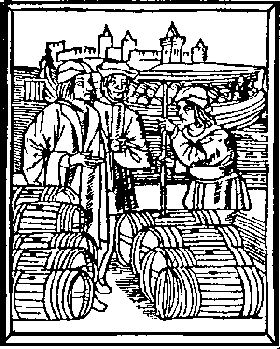
"At the port of Tanarat wine had been sent for their journey", by Jean Tabuteau, known as Gourdeau, 21, from the village des Roys. 17 Nov 1655.
The Tabuteau brothers were 'gabariers', river boatmen. They plied the river Charente between Tonnay-Charente up to Loumeau, the port of Angoulème. I have only established the basic genealogy for the first two branches, but I have researched in great detail the history of the youngest of the three. The occupation of 'gabarier' was followed by the next three generations. In the fourth, we find a son who has become
notary ('notaire royal'), a profession embraced by his sons up until the revolution of 1789. The last 'notaire royal' was Jacques Tabuteau de Gademoulin; he was 'Conseiller du Roy' (Adviser to the King), 'Juge Prévot Royal' (royal judge provost) and 'Lieutenant Assesseur de la Prévoté de Bouteville' (Lieutenant Assessor for the Bouteville district). He
had 18 children.
During this period to differentiate between families, the males added 'de' ('of')and a placename, to their surname. Thus we find Tabuteau d'Hauteroche, de Birac, du Breuil, des Touches, de Balzac, named after their estates or properties, without pretensions of nobility.
The contemporary line of descent of Tabuteau des Touches, du Maine-Charles de Birac, has been assured by two of his three sons.
The eldest, at Birac, has retained the title of 'des Touches'. The second, at Bordeaux, had no male descendants. The line of the youngest son , the 'contre-amiral'Tabuteau, is assured by the sons of two
of his grandsons. The Admiral Tabuteau was made a baron of the Empire in 1869.
Tabuteau's have left their name in Charente, at a location on the map, Chez Tabuteau, between Berneuil and Poulignac.
Another interesting and important outcome, are the Creole families in Haiti. At least one is still in existence today, and is well represented.
Coming back to La Rochelle. Two Tabuteau settled in Saint Domingue, a very important French colony under the monarchy. I have rediscovered the Louis, son of Louis born in 1677, who married at Léogane. A Louis-David, probably his son, has several children by two free mulatto women. He died at Verrettes and was buried at Mirabalais in 1759.
A Pierre Tabuteau, perhaps his cousin from La Rochelle, born in 1671 also had children with a free mulatto woman. He acknowledged paternity for both of his sons at the time of their birth.
According to the contemporary Tabuteaus from Jérémie, a family tradition reports that they come originally from L'Anse-à-Veau where this Pierre Tabuteau had his plantation, the 'habitation' of Haut de la Grande Rivière. There is a place-name Tabuteau, near Baradères, next to l'Anse-à-Veau.
Another Pierre Tabuteau, born at Angeac-Charente, cooper by trade, embarked at Nantes for Saint Domingue, in September 1787, with his wife and five children. They settled at l'Islet, near Bainet, on the south coast. Two daughters married there in 1790. There was a son. I have found no trace of him up to now. An Elisabeth Tabuteau escaped from the same region at the time of the revolt of the slaves and found refuge in New Orleans where she married.
I have also found several Tabuteau's from Saint Domingue, who come from Blaye in Gironde, who embarked from Bordeaux. There are also a number of Tabuteau's as yet unlinked to any family group.
The civil registers of the period are very incomplete, their destruction due to a range of reasons. In addition, the registers are deficient in that they often omit to mention first names, or to include the name of the father. It was often necessary to guess whether they were referring to Creoles or to settlers.
I am in ongoing, cordial correspondence with several Haitian Tabuteaus. I hope in the future, sooner or later, to discover a link between the families from Saint Dominigue and Haiti. It will probably be through one of the sons of Pierre from Hauts de la Grande Rivière at L'Anse-à-Veau.
Tabuteau famillies around the world in the year 2000:
The Tabuteaus in France are too numerous to mention here.
Numerous Tabuteau famillies, descendants of Huguenots from La Rochelle via I'Irelande, have settled in Australia and New Zealand.
Descendants of the Tabuteaus from Angeac-Charente have also settled in Australia.
Numerous creole Tabuteaus are in Haiti, formerly Saint-Domingue; a number of these have migrated to the United States and Canada.
There may still be some Tabuteaus in the Indies.
There is one Chinese Tabuteau in New Zealand, and two Aboriginal Tabuteaus in Australia, all adopted and carrying the name; as well as some part Maori Tabuteaus in New Zealand.
It appears likely that the name will not continue to be carried on to the next generations in England, in Ireland and in Canada.
Click here for a short biography of the following Tabuteaus:
Auguste TABUTEAU (1696, Amsterdam – 1755, Chinsura, Bengal)
Louis Lazare TABUTEAU, Contre-amiral (1814 – 1872)
Augustus Elliott TABUTEAU (1880 – 1915)
George Gerald Grant Tabuteau, General, RAMC, (1881 - 1940)
Maurice TABUTEAU (1884 – 1976)
Marcel TABUTEAU (1887 – 1966)
Joe TABUTEAU (1906 – 1980)
François TABUTEA (1921 – 2000)
Click here for information about the Tabuteau Masonic Collection
.
Contact: Marie-Colette Tabuteau
Email: [email protected] Le Brûlis
4 Adam Street
NARARA NSW 2250
AUSTRALIA