Dilemmas of Ambiguity and Vagueness
By Leon Felkins
Email: [email protected]
Copyright 1996
Written December 12, 1995
Revised Mar. 20, 1997
Sorry, this is a draft and will be modified as time permits.
"All the limitative Theorems of metamathematics and the theory
of computation suggest that once the ability to represent your own structure
has reached a certain critical point, that is the kiss of death: it guarantees
that you can never represent yourself totally. Godel's Incompleteness Theorem,
Church's Undecidability Theorem, Turing's Halting Problem, Turski's Truth
Theorem -- all have the flavour of some ancient fairy tale which warns
you that `To seek self-knowledge is to embark on a journey which...will
always be incomplete, cannot be charted on a map, will never halt, cannot
be described." - Douglas R. Hofstadter
Introduction
In this essay, I shall provide an introduction to the concept of Vagueness and Ambiguity. As a convenience to the reader, the major points will be covered here and will be expanded in detail in the companion essay, "Understanding Vagueness".
1. How to 'Explain' what you mean
Often we cannot. Many terms are inherently vague and cannot be precisely explained. Many definitions are circular. Examples abound in the dictionary and the law
books. We develop an understanding of what we think the terms mean through
culture and context. I will try to convey to you what I know about the
subject. The explanation, of course, will be vague :-)
In the natural world, almost everything is analog not digital, continuous
not discrete. Humans in a natural environment have little difficulty with
this (but it gives computers and bureaucrats fits!). If it gets too cold,
we put a coat on. But there is no precise definition of "too cold"
-- so how do we know when to don a coat? While environmental temperature
is a continuum but a coat on or off is a discreet event, we have no serious
difficulty in managing the problem. There is no precise temperature for
putting on a coat and that is just fine with us.
In the figure below, I will illustrate three possibilities for how phenomena may go from "Cold" to "Hot", "Tiny" to "Large", "Bad" to "Good", etc. (For more on this type of representation of vagueness, see "A Fuzzy Fairly Hpppy Face" by Patrick Grim.)
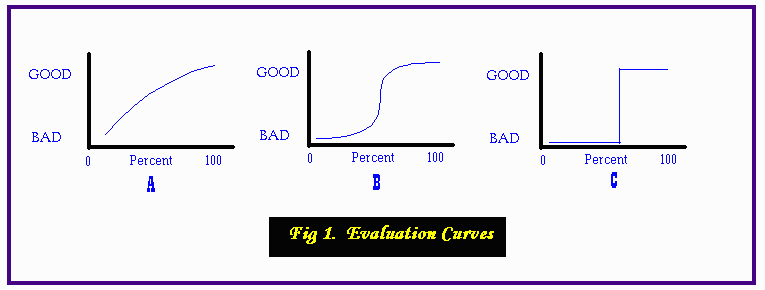
The "C" curve is the way many of our leaders -- particularly those pushing "absolute morality" -- would like for you to think the world runs: things are either black or white with no shades of gray. For example, the government sets a maximum cholesterol level beyond which you will be unhealthy. Same with alcohol percentage in the blood: you're drunk if it is more that 0.1% (now being changed to 0.08%). More than that level is bad, less is good or at least "OK".
The "A" curve is the way most things are: a smooth transition from cold to hot, black to white, bad to good. No particular point is obvious as a point to set a break. An example would be the qualifying term, "bald headed". The number of hairs on head varies from none to many. At what minimum quantity of hairs do you become bald? We call people that still have hairs "bald headed", so "none" must not be the answer.
Curve "B" represents a situation where the parameter of interest varies smoothly but there is a small area in which it changes rapidly. When we have such a situation, it would be reasonable to set the "Good/Bad" break point somewhere in that region of rapid change. An example of this type of phenomenon is the temperature my body perceives while in my hot tub. There is a very narrow range between hot and cold. An even better example is death. While we would like to think that organisms, particularly humans, are either dead or alive, there actually is a small region is which there is vagueness. In fact, legal issues result from this narrow range of vagueness.
Problems develop when we have a situation that is best described by Curve "A" but we arbitrarily force it to look like Curve "C" by assigning an arbitrary breakpoint. An example is a speed limit on a road. Above a certain speed, the government says it is "BAD" and below that speed, it is "GOOD". Now, really, the damage to property resulting from a crash varies smoothly over quite a wide range of speeds. Therefore the speed limit as assigned by the government, is purely arbitrary.
"So what", you say. Unfortunately, the forcing of continuums (typically, Curve A) into a step function (Curve C) does cause problems in large structured societies
such as those we live in. Left to free individuals, putting on a coat is
not a problem but what about controlled groups such as the military? Soldiers,
as a group, are ordered put on their coats. To avoid problems, this order
will most likely be based on some arbitrary but fixed temperature (or an
arbitrary date). A much more serious example is the arbitrary assignment of the legal age for voting. The right to vote probably ought to be determined by a person's knowledge of the issues -- not some arbitrary age. Note that the government, in its infinite wisdom, has determined that it is ok to get killed in some meaningless, politically inspired, war at a younger age than the legal age for voting!
Most of us have heard the old saw about a lecherous man propositioning a young lady, that goes something like this:
A man offers a virtuous young lady a million dollars to go to bed with him. She says, "Well, it would be a disgusting act, but for a million dollars, I will do it just this once, as I do need the money". But then he says, "Well then, would you do it for twenty dollars?". She screams back at him, "What do you think I am? -- a whore!". He responds, "What you are has already been established -- what we are doing now is negotiating the price."
In general, even though the world is naturally continuous, we find we must
quantize our view of much of nature in order to avoid difficulties in rule-based
societies. We quantize the age for buying alcoholic drinks, getting married,
getting into school and the military, drawing pensions, watching movies,
driving cars, and leaving home. We quantize test scores to determine school
grades. We quantize poverty, illness, pornography, speed limits, and allowed
intoxication levels.
All this quantization is done to make it easier for humans to get along
with each other, bureaucrats to do their job, and/or to avoid the strain
of having to make a judgment. But there is a price to pay: you would like
to put on your coat when you feel cold not because some temperature
had been met. And so it is with all the rest of the quantized decisions.
Persons receive welfare not because they need it but because some arbitrary
monetary income has been met. Students receive grades not based on their
true understanding but because of some arbitrary test score.
Further, all quantizations result in the Vagueness Dilemma which
is:
Whenever a continuous event or characteristic is converted to a discreet
function, the value chosen for the breakpoint is arbitrary and cannot be justified.
(This aspect of vagueness is examined in more detail in the section, "Understanding Vagueness").
Let us look at some easy examples:
- Exceeding the speed limit
Let us say that the speed limit is 65 mph and it is a clear day and a straight
road (note that the speed limit will -- most likely -- also be 65 on a
cloudy day!). Let's say you're doing 65.1 mph and a cop pulls you over.
Should you get a ticket? Certainly. What about a "tolerance",
you say? OK, lets have a 5 mph tolerance. All that means is that you must
get a ticket at 70.1 mph.
What if the cop says, "Alright, I suppose I will allow you to
go one tenth of a mph faster than 65". "Well then", you
say, "if 65.1 has, in effect, now become the speed limit, how would
you feel if I exceeded that by .1 mph?". The cop, like most bureaucrats,
quickly realizes the errors of her ways. While the limit is purely arbitrary,
it must be absolutely complied with! To allow the slightest inflation is
to invite an infinite series of incremental increases. So, like the "Voter's
Paradox " (Also available in UXU #219 at "http://cgi.algonet.se/htbin/cgiwrap/daba/ftpetext?267)
a dilemma results from the fact that the problem can be viewed microscopically
or macroscopically. That is, for all practical purposes, one small incremental
change is insignificant but the accumulation of many of these small increments
can cause trouble.
All the other quantified aspects of our lives are subject to the same difficulties.
Depending on what it is being quantified, the results can sometimes be
very serious.
- The "Communications Decency Act"
In this act, recently passed by the US government, there is a prohibition
against "indecent" materials being transferred over the internet.
The word "indecent" is used as if it were as precise as "dead".
In this case, it appears that they haven't tried to define the term. That
is the way such laws start. As lawsuits and bad justice proliferates, they
will find it necessary to try to define the term. More laws will be created.
Of course, they will be unsuccessful but will only make matters worse since
the term -- as currently used -- is undefinable.
- Click here for a few additional vague terms
we use daily:
2. Why is Vagueness a problem?
For several reasons -- a big one being that it is notoriously abused
by bureaucrats, particularly the government bureaucrats and politicians.
I will provide a couple of examples:
- Vagueness fosters growth of things that are good for them but bad for
you
Like the national debt. How much is too much? Surely a bit more will not
hurt. And how much should we spend on welfare and public health care? The
answer is purely arbitrary and will never be enough to satisfy those who
promote it and too much for those who despise it! How much control should
governments have on the environment? Surely declaring a piece of your property
as a WETLAND will not hurt. Surely making you replace all the asbestos
in your building will not hurt. Etc., etc.
- Vagueness allows arbitrary condemnation and harassment of individuals
When does a work of art become "pornographic"? How much physical
punishment can you apply to your own children? At what level of activity
does an action become "Sexual Harassment"? At what level of activity
does a child become "Sexually abused"? A photograph of the child
in the nude? Maybe. It is all arbitrary and vague. Which means that the
government can set the levels at any place they want (and then incrementally
change it!).
A good example on this issue is the proposed change to the "intoxication level" as defined by the state laws. At present the value used by most states is .1 percent alcohol in the blood. The new law proposes to reduce it to .08, claiming that it would save thousands of lives. Well, of course it would. But so would reducing it from .08 to .06. There is no logical point to set this value. It is purely arbitrary.
- Laws created to eliminate vagueness tend to suppress Self-Reliance
In the natural state, humans have no serious problems with making judgments
appropriate to the many vague situations they encounter. This builds self-reliance
as it should. On the other hand, in a government controlled society, judgement
must be reduced as much as possible. While we might say, "eating too
much fat is bad for you", the government must say, "eating an
excess of x amount (x varies from time to time) of fat is bad for you.
Being a little lazy, we tend to let the government make such decisions
for us. After all decisions can be work!
3. There is no General Solution to the Vagueness problem
Governmental "break points" are established to prevent abuse
-- often at the urging of the public. Bureaucrats have spending levels
invoked on them to keep them from cheating. But, as we see, the quantization
of a continuous phenomenon has some serious drawbacks. Many people suffer
because they are on the wrong side of some arbitrary and heartless break
point. It is a no-win situation.
If you think this is an easy problem or you don't see the seriousness
of it, then I challenge you to tell me how much should a public hospital
spend on a patient before they let him/her die. Let us say the patient
is a "homeless person", nee "bum", or a criminal from
death row who has had heart failure. Is a heart transplant appropriate?
Don't forget that the public hospital has a fixed budget. These are the
kinds of arbitrary break points that must be defined in any bureaucratic
situation.
4. Philosophical Underpinnings
I must admit that I haven't had the time or the resources to do extensive
research on this subject. In the Reference section I have identified a
couple of references that I found to be somewhat helpful. Russell's short
essay is identified primarily because it is on the internet. It doesn't
really get into very much depth.
Russell attributes vagueness to being mostly a problem of language.
Of course language is part of the problem, but I do not agree that it is
the main problem. There would still be vagueness even if we had a very
precise, logically structured, language. As I discuss elsewhere in this
essay, the principle source of difficulty seems to be in making discreet
statements about continuous phenomenon.
This aspect of vagueness is discussed at some length in Williamson's
book, Vagueness;. He uses the standard example, the 'sorites
syllogism' of the "Paradox of the Heap" to illustrate the difficulties.
When does a conglomeration of sand particles become a "heap"?
How many hairs on a man's head would allow him to escape being called 'bald'?
These problems are just symbolic representations of many real-world problems
and it is unfortunate the philosophers use them instead of any of a multitude
of real-world problems since many people will just dismiss their arguments
as just so much academic horse pucky.
In my view, the problem with vagueness is common to the problem of
Social Dilemmas and that is, the paradox comes
about as a result of having two different views of the same phenomenon:
the microscopic view and the macroscopic view. When you switch from discussing
a heap to discussing a grain of sand, you are switching views. The two
views require different expressions to properly discuss and should not
be mixed. I believe it to be comparable to the physicist's discussion of
fluids. When the physicist is discussing fluid flow he imagines the fluid
to be infinitely divisible. To talk about a particle of fluid is meaningless.
We know that in reality, a fluid is composed of molecules and we could
discuss the physics of the interaction of these molecules. Either way of
looking at fluids can be useful.
Real world examples such as 'indecent materials', recently made illegal
on the internet, are just as interesting and useful as heaps of sand and
that is what I will concentrate on in this essay.
To learn more about the theoretical aspects of vagueness, go to my essay, "Understanding Vagueness"
Vague or Ambiguous Ideas and Concepts
"Everything you've learned in school as "obvious" becomes
less and less obvious as you begin to study the universe. For example,
there are no solids in the universe. There's not even a suggestion of a
solid. There are no absolute continuums. There are no surfaces. There are
no straight lines." - Richard Buckminster Fuller (1894-1983)
Society somehow plods on in a sea of vagueness and ambiguities! Humans routinely live,
love, work, go to prison, and die based on vague or ambiguous definitions! The most
amazing aspect of it is that it works so well -- in spite of the vagueness and ambiguities.
It is not a trivial matter -- in fact it is a very serious matter. People
rot in prison and die in wars based on vague definitions and criteria.
Let us examine just a few of the vague terms we live by:
1. Rights
We hold these truths to be self-evident, that all men are created
equal, that they are endowed by their Creator with certain unalienable
Rights, that among these are Life, Liberty and the pursuit of Happiness.
-- Declaration of Independence, July 4, 1776
The term, "rights", best illustrates my point here -- namely,
that people live and die for concepts in which there is only a vague understanding
of meaning. "We hold these truths to be self-evident" makes a
claim which is totally unprovable. What the term,"rights", means
and what it consists of is a long way from being "self-evident"! (As far as what does equal mean, see my essay, "The Equality Myth".)
If we were trying to define "dogs" and were having trouble
coming up with a workable definition, one solution would be to make a list
of all animals that we would call "dogs". This list would include
big ones, little ones, red ones, black ones, gentle ones, mean ones, and
so on but most probably would not include any cats or ducks. There would
be general agreement on the contents of the list. Now try this with the
term "rights". No two lists would be alike and further, we would
never agree to a common list! The fact is, while we might die defending
our "rights", we have little idea as to what it means.
I will not go into further detail now since there is an essay, "The 'Right' Approach" that discusses this in some detail.
2. "Family Values"
Now, what the hell does that mean? There are all kinds of families!
There are extended families, wealthy families, crime families, sexually
open families, religious families, atheist families, etc. Values? What
kind of values? My dictionary defines it as: "the social principles,
goals, or standards held or accepted by an individual, class, society,
etc.". Then values would include the principles followed by primitive
tribes that were very sexually promiscuous. Or tribes that were war-like,
or practised cannibalism, etc.
I wonder if "Family Values" doesn't have a variety
of meanings, depending who the listener is!
3. Patriotism
My country, right or wrong? My president, right or wrong? Should we
be enthusiastic about going off to a war, with a chance of great suffering
or death, to embellish someone's political career? What are the limits
to patriotism? What is the purpose of patriotism? Actually it is just another
meme and, like all memes, has the
potential to be either good or bad. Therefore, it is suspect. Before you
commit your life to patriotism, you might want to give it a little
rational thought.
4. Legitimate Government
Just like pornography, we can't define it but we know a legitimate
government when we see it! Oh really? What is the definition? The criteria
for the U.S. government seems to be this and this only: "it has
been there a while". That is, we may not recognize a ruthless
dictator who takes over a country by wiping out a democracy -- right away.
But if he stays in power long enough and he is powerful enough, we will
give him recognition. Consider Communist China and the former Soviet Union.
On the other hand, look at Fidel's Cuba. He pulled the lions tail and he
-- and Cuba -- are being punished.
Let us do a little mental exercise on this problem to see if it can
be solved. Consider a small island, previously uninhabited. Let us say
that a couple of hundred families move to the island to get away from an
"oppressive government". Is there a legitimate government? No,
not yet -- we just got here. Now, things go ok for awhile but then disputes
start to develop. Some of them are serious, a few fights ending in death
and that sort of thing. The folks meet and decide we need a police force.
They hire a bunch of fellows and give them guns and token pay.
Before too long, it occurs to these "policemen" that they
could do a lot better. One of them decides to be the Grand Leader and the
others go along since they have been assured of a cut of the rewards. They
establish a dictatorship. There is nothing anyone can do about it since
it turns out these fellows have a hefty store of armament and the other
islanders have practically none.
Is this a legitimate government?
Does a legitimate government require establishment by a majority vote
of the people? If so, most country's governments would not qualify -- including
the U.S.A..
So, maybe a government can be called legitimate if it is somewhere
between a dictatorship and a freely established democracy? Where? I think
we have to conclude that the concept of legitimate government is vague.
Therefore, in principle, there is no difference between a legitimate government
and a group of thugs running a country for their own amusement. It is simply
a matter of degree.
5. Legalities
5.1 Crime
[Much of the following material was inspired by the book, Bad
Acts and Guilty Minds.]
Is the law always clear cut? Certainly not! Can you have your life destroyed
for an action that has been deemed a crime but for which you are innocent?
Absolutely -- happens all the time. Can laws be made definitive? Well,
yes and no. The God of the Jewish/Christian bible had the right idea --
don't get bogged down in details. Don't get into the bottomless pit of
"why's" and "circumstances". Being God, he was too
smart for that. He just said, "Thou shall not kill". To go any
further gets you in a quagmire of never ending vague refinements.
But we humans figured that only a god could get away with such ruthlessness.
We care and we are full of compassion and understanding. What if someone
killed someone else in self defense? What if it was an accident? What if
the perpetrator was mentally deranged at the time? Is it fair to
punish persons who happen to fall in those situations? Surely we can do
better than a simple, "Thou shall not kill".
Maybe, maybe not. Maybe there is much suffering by innocent people
as a result of our good-hearted efforts. Maybe criminals go free due to
obscure contradictions in the law. Maybe, with lots of confusing and vague
laws, a good lawyer can always get you off no matter what you have done!
Consider the following examples (some from the aforementioned book):
- John attempts to kill his wife Annie but only wounds her in the arm.
She goes to the hospital. There she contracts scarlet fever and dies. Is
John guilty of murder?
- If a drunken driver intentionally driving head on towards oncoming
vehicles "just for fun and excitement". He comes at you but you
manage to dodge him. Should he be tried for murder? OK, let's say he hits
you and kills your wife. Now should he be tried for murder? He didn't do
anything different. The only difference between the two cases was your
skill in getting out of his way.
Do we punish for the result or the intention? If it is the result, then
why do we have all these degrees of murder, manslaughter, etc.? If it is
intention we punish, why don't we hang people who fire guns at others but
miss or only wound them?
5.2 Legal Complexities and Contradictions
"Sweer`s Impossibility Theorem:
Nothing can be both completely general and internally consistent at the
same time."
As laws are put in place, contradictions with previous laws will arise.
Further, terms will be used that are vague. These two facts make it necessary
to create more laws! These laws, in turn, will also be contradictory and
vague. Therefore, the legal code grows exponentially! But the contradictions
and vagueness are never removed.
One of the best examples of this is the United States income tax code.
I will quote from a recent article, "Why you Can't Trust the IRS"
published in "Real Money" magazine.: "When the income tax
law first took effect in 1918, it had just 170 pages of law and regulation.
Since then the tax code has grown to encompass over 17,000 pages. On top
of that, hundreds of thousands of pages of court decisions interpret that
law."
The article goes on to describe Money Magazine's annual survey of private-sector
tax preparers in which an imaginary but realistic financial profile is
provided to various professional income tax preparers and they prepare the returns. Fifty preparers come up with 50
different income tax returns! No two are alike. In 1992, for example, the
amount owed to the government -- as determined by these preparers -- varied
from $16,219 to $46,564! The truth is, no one knows what the correct amount
should be! Not even the IRS.
Another example of a troublesome contradiction in law is the rule emphasized
by the Nuremberg trials at the end of World War II in which soldiers are
held individually responsible for any crimes committed against humanity.
Yet, soldiers can also be tried for treason if they disobey an order. So
here we have contradictory laws based on an ambiguous definition! Violating
either interpretation can get you shot!
It seems that life in general, legal systems in particular, is plagued by some sort of universal law like Gödel's Incompleteness Theorem (as suggested by Sweer's quote above). That is, it seems impossible to design a set of laws that are internally consistent, that lack contradictions. Maybe someday, some brilliant philosopher will prove this but the best I can do is only suggest that it sure seems to be that way!
5.3 Precise Definitions by the Government (Ha!)
An example of the government's efforts at making precise definitions
is given by the food labeling rules and laws. You probably think, for example,
that "zero fat" means ZERO FAT. Wrong. "Zero fat" or
"no fat" or "fat free" means "less than 0.5 g
per serving". "Fresh" can be used only on a food that is
raw, has never been frozen or heated, and contains no preservatives. (Irradiation
at low levels is allowed.) "Fresh frozen," "frozen fresh,"
and "freshly frozen" can be used for foods that are quickly frozen
while still fresh. Blanching (brief scalding before freezing to prevent
nutrient breakdown) is allowed." A fish left lying on the dock a couple
of days in the hot sun is, therefore, "fresh". ;-(
I am sure they are working on defining "indecent" as we speak.
6. Consensus
The term consensus is often used in political discussion and
in legalities in a way that suggests "a general agreement". But
what percent of a group has to agree before you have consensus?
100 per cent? 51 per cent? I checked the dictionary. It says, "1.
majority of opinion. 2. general agreement or concord; harmony". Not
much help there. If it only means "majority" then the term is
not only not needed but is misleading.
Taking Advantage of Vagueness
We all use vagueness to our advantage sometimes in dealing with other
people. Our intention is not necessarily to do harm or to take advantage
but maybe to avoid hurting someone or to improve a situation. A humorous
example is the problem most of us have to face from time to time of being
forced to give a "Letter of Recommendation" on someone you may
not think too highly of. Check out the link,
and you will see how using a tad of vagueness can be helpful.
1. Use of Vagueness by Businesses
Using vagueness intentionally becomes more harmful when used by businesses
to promote products and downright sinister when used by the government
to further its own ends. Businesses have had to become experts in the use
of vagueness since they are repeatedly harassed for making false claims.
I just bought a weed puller the other day (other day??) that has a "lifetime
guarantee". Whose or what lifetime? My lifetime? The weeder's lifetime? The manufacturer's lifetime?
The long distance telephone providers routinely advertise that if you will
sign up with them, they will give you 20% off. 20% off of what? Apparently
the public falls for this incredibly simple minded deception for if they
did not AT&T and the rest would not spend millions of dollars on such
ads.
2. Use of Vagueness by the Government [Note 1]
"The warning message we sent the Russians was a calculated ambiguity
that would be clearly understood." -- Alexander Haig
VAGUENESS is the basis for more government growth and abuse than
any other factor. Essentially all programs that the government is involved
in rely on definitions that are vague. In general, vagueness cannot
be avoided as this is the nature of life -- it's just that the government
takes advantage of vagueness more than other entities do and the consequences
are so great.
All government operations grow on the basis of vague requirements.
In fact, the problem is so serious that the amount of annual funding of
government agencies is primarily determined by the amount they had
the previous year (See my essay, "Government Spending and Financing)". Every level of government bases its size and
needs on purely arbitrary values -- not any kind of absolute values. For
the most part, they actually assemble their list of requirements based
on their budget, rather than their needs. Did you think it was the other
way around?
Now, surely, you say, there must be justification for some agencies.
Well, let us look at one of them.
- The US Defense Department
The Defense Department consists of much more than troops and their
equipment. If you look at the US Defense budget you see that the total
is around 280 thousand million dollars with a component for military personnel
of about 80 thousand million dollars. The majority of military spending
actually goes for "maintenance and operations", "research",
etc. The majority of military spending actually goes to civilians; civil
service, contract personnel and to government contractors. So, we have
many opportunities for the use of ambiguity and vagueness in the military!
The basic question is, "How much defense is enough?" Of course,
nobody knows. In fact the interpretation is wide open. But "what we
need" just doesn't matter. That argument is given just to help justify
their expenditures which are actually based on other reasons. These reasons
include personal job security, profit making, and, in general, selfishness
of the individuals involved.
Another question is, "How good does the equipment have to be?"
Better than any potential enemy's? Of course, but the answer is, again,
wide open. You and I don't know too much about what the enemy has -- only
our government has any real idea (from their spy organizations). So, how
do they really determine how good our equipment must be? It is determined
by the current technology and the marketing capabilities of our government
contractors! We can spend billions for a few missiles and find
ourselves buying a new batch if the contractor claims that major technological
improvements have been made. That is the way it works.
Yet, Somehow We Cope in this Vague and Ambiguous World
In a natural state, humans convey meaning even though the terms are
vague. We understand "dangerous", "sexy", "wealthy",
"skinny", "friendly", and "happy" without
knowing the precise meaning. It is the structured society that is managed
by a legal structure that has a problem with vagueness. Bureaucrats and
computer programmers have a difficult time with vagueness. The rest of
us have a general feeling about what the terms mean which is adequate for
communications.
The directions that society is going, which is to make every term and
definition precise, is a mistake. It appears that Gödel's Theorem
of Incompleteness may have more general application. Complex systems seem
to get more complex and more inconsistent the more we try to remove the
vagueness and inconsistencies. But, sadly, that will not keep us from trying.
Notes:
[Note 1] The discussion on government in this essay
is on the US government in particular. Other governments, however, are
probably similar.
References:
On the net: Vagueness,
Bertrand Russell, 1923.
On the net: Justin Needle's Philosophy Pages includes a section on Vagueness with lots of references. (Already it looks great, but I think there is much more to come!)
On the net: FUZZY
SYSTEMS - A TUTORIAL, James F. Brule', 1985
On the net: "Fuzzy Logic Introduction"
Katz, Leo: Bad Acts and Guilty Minds. University
of Chicago Press, Chicago. 1987
Pilla, Daniel J.: "Why You Can't Trust the IRS", Real Money
magazine, Spring, 1996
Williamson, Timothy: Vagueness. Rutledge, London. 1994.
 Back
to "the Paradox page".
Back
to "the Paradox page".
 Forward to "Understanding Vagueness"
 Back
to my philosophy page.
Back
to my philosophy page.