|
 |
 |
 |
 |
 |


Retailer
Profiles Shopping
with Amen Goggles Sweatshops
| CLOTHING | |
 |
categories Baby's Clothing Children's Clothing Men's Clothing Footwear |
research |
|
Large Companies |
Earth-Aware Companies |
Issue Research and Information | How to Take Action |
| Quick Guide | Quick Guide | Sweatshops | Against Sweatshops |
| Company Profiles | Company Profiles | Environment | Against Earth Abuse |
| Search for a Product | Search for a Product | Animal Treatment | Against Animal Cruelty |
|
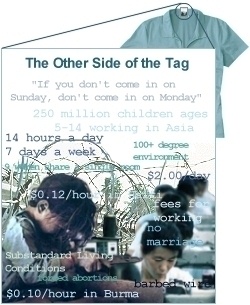
Before we buy, we need to think about what it is that we are actually buying, and what we are supporting by doing so. After putting on our "Amen Goggles" we might find that attached to that "perfect black dress" are some things we didn't see before: A young girl working 16 hour shifts, 6 days a week . . . greedy (or unthinking) owners who spend the money that could have raised her paycheck at least to living-wage standards on expensive cars . . . diseased birds which ingested the pesticides used in growing cotton for the dress. . . streams polluted with chemical fertilizers. Are these the sorts of events we want to occur? By buying that black dress we are saying "yes." Before we shop, we need to ask ourselves what is attached to the garment that we may not have noticed without looking closely. |
|
Each time we purchase an item,
we are showing that we support the store from which we bought it. Whether we want to or
not, we indirectly tell the company that we like the way they are running business. Stores
aimed at making profit will base how they change their business according to how consumers
react to their company. Workers' Rights As consumers it is our responsiblity to make sure that the garments we buy are from sources that are making a conscious effort to be socially and environmentally responsible. Putting on our Amen Goggles helps us take a critical look at the things we're buying and allows us to see what's on the other side of the tag. Equipped with this information, we are able to make more responsible purchases.
Answer # 1: Wear them to your favorite store! Inspect the tags, and notice where and from what materials the garment was made. Are these sweatshop-free, and environmentally sound sources? Look around the store, noticing the type of lighting and materials used in its construction. Are the lights energy efficient? Are the materials recycleable or reusable? Notice the music being played in the store. What sort of message is it giving? Ask the employees questions: Does the store donate slightly damaged clothing to charities, clothing banks or thrift stores? What is the employee dress code? What is the average age of the customers? Do minorities work at the store? What is the criteria for music played in the store? Answer # 2: Wear them in the library and online! Collect all your questions and dive into
some research. See if the retailer has been involved in lawsuits, if they donate
to charities, have been accused of manufacturing in sweatshops, have monitors in their
factories, use animal products, or advertise with anorexic models. Ask the company for information:
Answer # 3: Take them home with you! Decode the information you have gathered and figure out whether or not the retailer you researched is responsible enough to buy from. You may decide that some garments they produce are worth buying, while others are not. Look at the clothes you already have, especially ones that are easily recognizable as belonging to a particular brand due to a logo or label printed on them. Ask yourself if these brands are worthy of being advertised by you wearing the clothes. If the answer is no, figure out a creative way to cover up or alter the logo or label. Answer # 4: Share them with others!
Once you've used the goggles, put them in your replicator and share them with people around you. Show them what you've found out, and what they can do with their goggles! |