|
4 March 2005: Yesterday, an exhibition of visual poetry at Harvard opened. Its electronic catalogue is
here.
Very nice catalogue--although there's one simple way they could improve it: put a click to "next" in each artist's page so one would not always have to go back to start after viewing one page before being able to view another page. One quick thought while on the subject of the catalogue: whether a hard copy will be made or not (I think not), it demonstrates yet again what an incredible boon computers and the Internet are: it contains (so far as I know) all the works in the show, everything is in full-color, everything was readily available to those with computers and on the Internet the day after the show opened (and could have been available sooner), and it was close to free, both for its creators and its audience.
As for the items in the show, I haven't looked at all of them, but up through "f" (they're arranged alphabetically by artist), my favorites are the following:
|
|
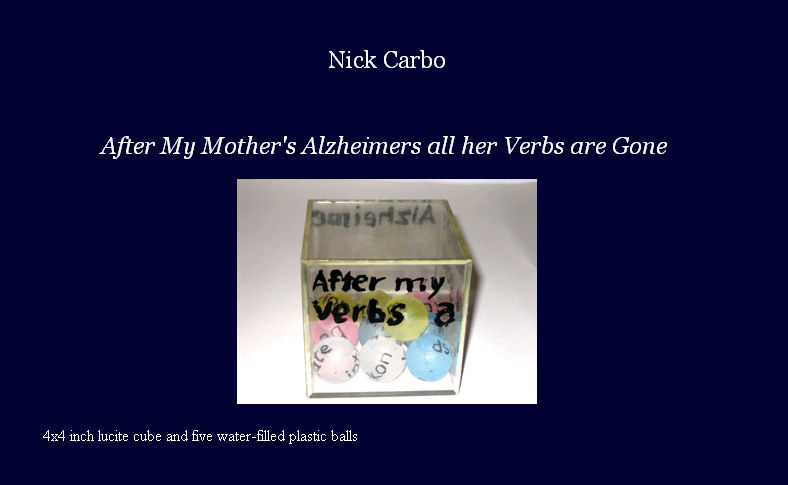
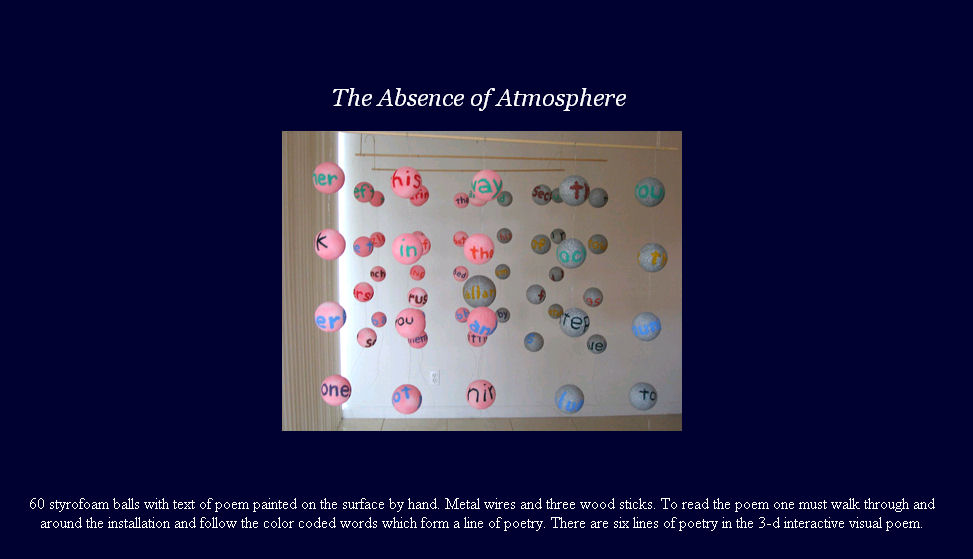
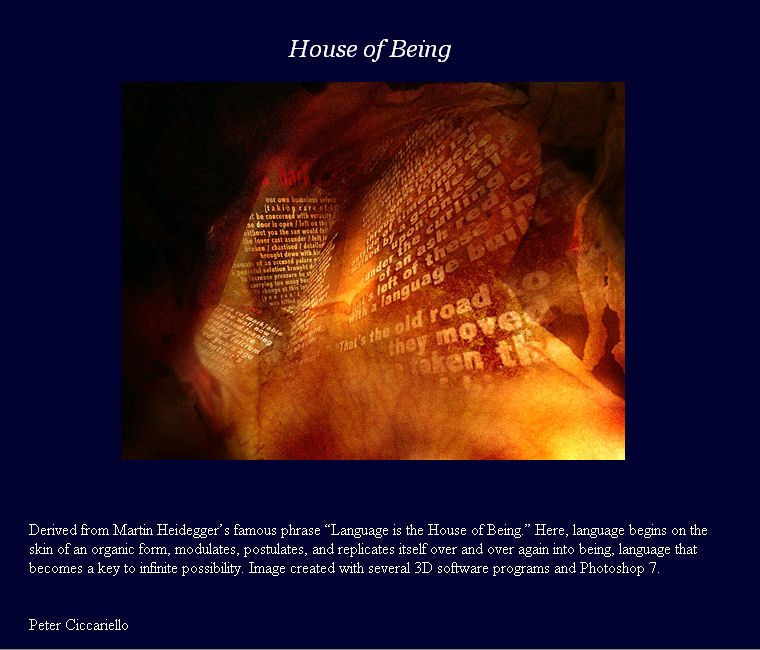
I at first didn't think much of the Carbo pieces: words on balloons? So what? But his explanation (and I applaud the show's curators for asking for artists' statements about their works, and those of the artists who supplied them) woke me up. The Ciccariello piece seemed gorgeous to me at first glance (and still seems so), and I'm big on 3-D. In fact, I want to do much more of it than I've done (which is miniscule), so am hugely excited by Ciccariello's reference to "3-D software." Gonna get me some of that soon! I want to get software for shading things, too, if any exists. Sure, one can do it with Paint Shop, but it's a tedious process, at least doing it the way I know how, which is just to paint a transparent gray where you want a shadow. I want a program that you give a light source's location to and it does the rest!
A big reason the three images above stood out for me is that they're verbal. I'm continuing to be bothered by current visio-textual artists' diminishing interest in including words in their works that are more than captions, if that. They seem mainly doing collages that sometimes use texts one can read, often not, but which seem to me not to force an aestheriencer to read and see at the same time but (linearly) to read, then see, or vice versa. The resulting collages are often as rewarding, for me, as works in which the verbal and the graphic is in my view more fully integrated (John M. Bennett is more and more becoming a leading master of this after years in which he seemed to me to be using graphics "only" to visually-enhance his predominantly verbal pieces). I'll have more to say on all this in due course, no doubt.
I have one piece in the show, by the way: the one in which I divide poetry by Aphrodite that I've shown and discussed here at my blog.
|
|
|

|
|
|