Jimmy Adamson; The Park Drive Book of Football, 1968-69.

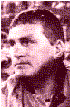
Steve Kindon and Dave Thomas, two members of the 1968 F.A. Youth Cup winning side

My life in football has had plenty of happy moments, but very few have brought as much pleasure and satisfaction as Burnley's Football Association Youth Cup win. The climax, a victory over the gallant lads from Coventry, is something which for me belongs in the same drawer of memories as a 1962 appearance at Wembley in the F.A. Cup Final.
Ten years ago, it was a comparatively easy matter to pick up the top junior talent, but things have since changed drastically. So many clubs have realised the value of having a youth policy that competition for the cream of the country's schoolboy talent is fierce. How fierce is illustrated by the fact that Burnley not long ago appointed their first ever chief scout, and he has a full-time assistant as well as part-time colleagues dotted around Britain.
Nearly all their attention is concentrated on boys aged 13 or 14, because if they are missed at this age other clubs move in before the player leaves school. It is rather curious, but undoubtedly a sign of the times, that whereas seven or eight years ago 70% of Burnley's youthful talent came from England's North Eastern corner, we now find it saturated with scouts from other clubs. Partly because of this, we have had to cast our eyes around elsewhere and one result is that of the team which won the FA Youth Cup only one was recruited from the North East - inside-left David Thomas.
Once we manage to get a promising youngster to Turf Moor, it is the job of the coaching staff to mould, or attempt to mould, him into a first class professional footballer. Burnley have certain advantages - such as the finest training facilities bar none in England and a coaching staff whose experience and technique has helped many a man reach First Division status. Our back room staff consists of George Bray, Joe Brown and Brian Miller and take it from me, you couldn't have three more able people for the job.
The football world seemed staggered when, within a few months of winning the Youth Cup, we introduced SEVEN members of that Under-18 side to Division One football. We had so many colts in our squad at one time that when we went away for an overnight stay prior to a Saturday match, we couldn't have got the party in at an X-certificate film! Many people, in and out of the football world, have asked what the secret is at Burnley. How do we manage to produce so many youngsters who are ready for the First Division?
Let me emphasise that there is no magic formula. Our success in this particular field has been achieved through hard work, long hours with the players at Gawthorpe (our training ground) and repetitive coaching. There were two amateurs in our side that won the Youth Cup and because of school duties they could not train during the day with the other nine who were apprentice professionals.
So what we did was to get all eleven down to Gawthorpe in the evenings (under floodlights) and on Sundays for teamwork sessions. It was strenuous morning, noon and night stuff for the young professionals, but they got down to it with terrific enthusiasm and their dedication paid a deserved dividend in the end. A great asset to our youth team was the captain, Tommy Docherty's son, Michael. Like his father, young Mick is a real driving force and I was delighted to see him called up for duty with the England Youth team alongside Thomas and our Warrington-born winger Steve Kindon.
It was the success of the youth team that led directly to so many of our young players getting into the first eleven the following winter. Winning that trophy gave the lads a tremendous feeling of confidence and it was quite something that four of the boys who were in the team which defeated Coventry to win the Youth Cup played in the semi-final of the Football League Cup against Swindon only seven months later.
To be quite honest, when we started that Youth Cup campaign with a 7-1 win over Yorkshire Amateurs I didn't think we would win the trophy. I knew we had a better side than ever before, but some of the boys were only fifteen and I reckoned that the next season's competition would be the one for us to win. The lads themselves were extremely confident from the start and beat some fine sides in Manchester City, Manchester United, Sheffield United and Everton to reach the final. It wasn't until we beat Everton's exceptionally talented team in the semi's that I began to believe we had a real chance of getting our hands on the trophy.
Our young Clarets had always looked a very professional side. Against Manchester United at Old Trafford they were expected to lose, but surprised a few folk and fully warranted the draw they gained before winning the replay. Of course, any team which wins a Cup needs some luck, and we got that against the other Manchester side, City. We won 4-3, but, in truth, City deserved another crack at us and it was a tie that could have gone either way.
However, our boys were so professional, so dedicated, that they were in with a chance against the very best. They knew as much about tactics as our first team - and an example is that they had six possible variations for attacking free kicks on the edge of the opposition box. Very little was left to chance by Thomas, Docherty, Kindon, Probert and others whose names you will be hearing about a lot more in the future.
Docherty and his colleagues worked up an amazing degree of team spirit and finished up in the later matches of the competition going out feeling, "We are unbeatable." The clinching of the cup was without doubt a team effort, but I must mention the goals scored by Peter Jones, a full-back from Ellesmere Port and one of five members of the team who went on to collect an international youth cap. Also, the defensive work of solid, dependable Wilf Wrigley, a Lancashire lad, and the striking power of Thomas and Kindon were major factors.
When we finally HAD got that Cup back into the dressing room, the motto was, "European Cup in 1972," and who knows. It could happen. Certainly with these boys about, Burnley's future is rosy.


Back to
Index pageForward to
next article