Kenneth Wolstenholme's Book of World Soccer, 1969

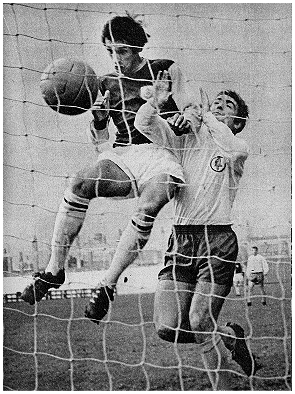
Burnley vs Liverpool, First Division, 1969. Freddie Smith and a flying Harry Thompson defend the Burnley goal.

True, harsh economics comes into the reckoning now and then, and one of the Burnley stars has to be sold to balance the books. But far from slipping back, Burnley keep on plodding away because no one is sold until there is some unknown waiting in the wings ready to take his place.
Last season they seemed to have overdone it. They started to get some terrible spankings. They crashed 3-0 at Everton, 5-0 at West Ham United, and then Tottenham Hotspur really tore them apart 7-0. At home they managed to hold on, but only just. Even Coventry City went to Turf Moor and won a point. Then Liverpool turned up, and Burnley were annihilated 4-0. This, the knowing ones said, was it. At long last the Burnley bubble had burst. They had struggled hard, but now their gates were at a ludicrous figure of around 12,000, and not even Burnley could exist on that. The gap had widened until it could not be bridged, and those who like to back their fancy were going around enquiring what sort of odds bookmakers would lay against Burnley for relegation.
Those people were right in a way. The bubble had burst. Burnley had come to the end of the road. But the gap had not widened quite so much that it could not be bridged. Harry Potts, the manager, and Jimmy Adamson, the assistant manager and coach, produced the bridge: a bunch of unknown youngsters whose identity even had to be explained to the few remaining Burnley fans. And these youngsters took hold of the world, turned it upside down and set Burnley off on a run of success which beat anything the club had ever achieved before.
Eight matches in succession they won, and that was something no Burnley side had ever done before. So well did they play that Harry Potts was able to announce not one but two sales of star players - Willie Morgan to Manchester United and Andy Lochhead to Leicester City. Few clubs could have withstood the loss of two players of such high calibre and still remained on the high road to success. The run began with a 3-1 home victory over West Ham United, a result the experts would say was impossible. For not only were Burnley at that time sliding rapidly towards the bottom of the league, but such experienced players as Andy Lochhead and Brian O'Neil were injured, Doug Collins was suspended, and Jimmy Thompson, whom Mr. Potts had bought from Chelsea for �40,000, was not match fit. To make matters worse, West Ham United were right in form, and anyone who knows anything about football knows what that means - ask teams like Sunderland, who took a 8-0 thrashing from them.
If the West Ham United result was impossible, what about the 3-1 away win at Stoke which followed. And then the sensation of the lot on October 19 - a 5-1 win over Leeds United. For anyone to beat Leeds was sensational enough, but to score five goals against the strongest defence in the country was incredible. From then onwards the young Burnley side never looked back, and side by side with success in the Football League Cup, this was the splendid run which took them right up the First Division table. Six games, six wins and sixteen goals against three. No wonder the world sat up, rubbed its eyes and asked who on earth these Burnley youngsters were.
Two men in the side cost transfer fees. Colin Waldron was a youngster who sprang into prominence overnight with Bury. Tommy Docherty signed him and took him to Chelsea. He never settled there, and Burnley brought him back to Lancashire. They did this when Brian Miller, their fine old stalwart centre-half, was forced to give up the game because of injury. Waldron is still under twenty-one. Frank Casper, the other signing, is around twenty-four. When he was eighteen he played for Rotherham United against Burnley in a cup-tie and scored the equalising goal. Harry Potts never forgot, and four years later he signed him.
Two men look out of place in the side. They are Harry Thompson, the Scottish goalkeeper, and Les Latcham, one of the full-backs. Thompson is twenty-eight, Latcham is three years younger, so they qualify for the title of old men in the Burnley dressing-room. The general of the side is Ralph Coates, who at twenty-three is a distinct possibility for the England team in Mexico. Coates is a player of great ability and even greater confidence. Once, in a derby clash with Blackburn Rovers, he sat on the ball during the middle of the game. He explained that things were getting a bit tough and he thought a little time for thought was needed!
Perhaps more than anyone, Coates typifies the Burnley approach to the game. At heart and by inclination he is a wingman of the old school, the sort of player who likes to move down the touchline at speed. But when the wholesale influx of youth into the side came along Coates was moved inside and told to be a midfield general. Without a murmur of protest he did the job, and did it so well that Sir Alf Ramsey chose him in that role for the England Under-23 match against Holland. During that game England congregated too much in the middle, so Coates was ordered to play as an orthodox wingman in the second half. This he did splendidly.
The moving of Coates to a midfield role gave a permanent chance at Burnley to David Thomas, an eighteen-year-old who made his First Division debut against Everton at the tender age of sixteen. He admits to being scared to death that day, but Thomas now has the Burnley ring of confidence around him, and has taken his chance as well as the others.
The names roll off the tongue at Burnley. Steve Kindon, John Murray, Martin Dobson (a free transfer man from Bolton Wanderers, where he was a centre-forward - he is now a midfield player). What really produces this soccer miracle? First of all, money is always tight at Burnley, where the chairman, Bob Lord, a Lancashire businessman, insists that the club is run on a business-like basis. That means it must pay its way.
But Burnley's gates are poor. They have to be. The population of the town is only 85,000, so even at the top of the First Division Burnley cannot command 60,000 gates, even with the support of people from the surrounding areas. Many people pass adverse comment about Burnley's gates, but they should remember that 20,000 people at Turf Moor represents 23.5% of the population. To equal that percentage, Manchester United would need a gate of 175,000!
Nevertheless, if Burnley draw 20,000 people every week - and they don't - it means that there is little to spare after expenses have been paid. So the club can afford only occasional modest excursions into the transfer market, except as sellers. In this role they do such good business that players like McIlroy, Robson, Harris, Elder, Morgan and Lochhead have been allowed to leave. This gives Burnley a little financial leeway, but it also demands that the coaching staff continues to produce the replacements for the stars. The coaching staff hasn't let the club down.
It was a brilliant stroke to decide that money should be spent on improving the spectator facilities at Turf Moor and on providing a coaching school which would equal anything found anywhere in the world. Burnley have just that at Gawthorpe Hall on the outskirts of the town. When training grounds were only being talked about elsewhere Burnley were using Gawthorpe Hall, so you can forgive anyone there who boasts, "Oh, a training school? Ours is eleven years old."
But training facilities are not enough by themselves. You have got to find the raw material in the shape of young players, and you have to find the coaches. Burnley have failed in neither role. Their scouts have their ears close to the ground, so a steady stream of promising material comes Burnley way.
There it is handled by Harry Potts and Jimmy Adamson. There could not be two better men in charge. Both are former players with the club, so both have the spirit of Burnley running through their veins. Jimmy Adamson is such a loyalist that he even turned down the chance of succeeding Walter Winterbottom as England's manager to stay at Burnley. In recent years he could have had his pick of a number of plum manager's jobs. But he has stayed at Turf Moor.
Everyone at Burnley has this dedication to the club: otherwise he does not stay. The youngsters when they arrive are taught that they must eat and sleep Burnley Football Club, and before long they are willing to work until they drop for it.
There is nothing complicated about the Burnley football, which is based on the team rather than the star principle. Everyone must be enthusiastic and be willing to run and work for everyone else. The result is that Burnley might not be one of the glamour sides, but they are one of the most effective. As one player put it, "When you play against Burnley you can never find a weak spot. Everyone is covering for everyone else, so if a man is a wee bit off form the fact never becomes apparent to the opposition."
And so the miracle goes on, season after season. Every bit of success that comes Burnley's way has been bought - by the loyalty, enthusiasm, skill and hard work of the whole of the club's staff.

Back to
Index pageForward to
next article